
Chef Lupita
Acitrón de Cidra Conventual
Puebla's convent-style acitrón, made from cidra peel instead of endangered biznaga, built through repeated syrup soakings until the cubes turn firm, translucent, and ready for rosca or chiles en nogada.
A cooking platform built around craft, culture, and the stories behind what we eat.
Created by
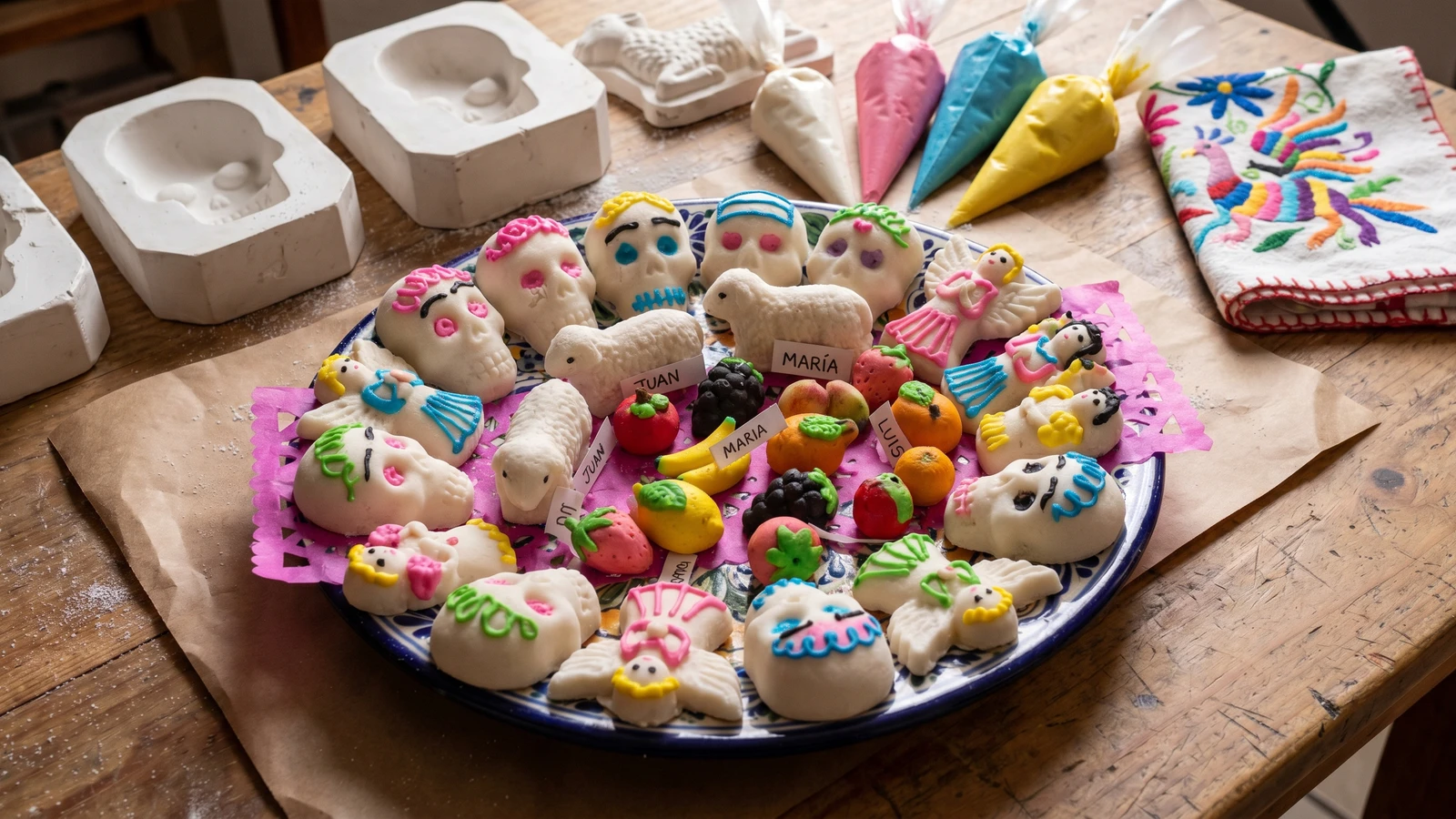
Guanajuato's Day of the Dead alfeñiques are cane-sugar figures pressed in dry molds, finished with bright icing, and set on Talavera guanajuatense platones for the altar.
Guanajuato, in the Bajío, makes alfeñiques for Todos Santos and Día de Muertos, not as Halloween candy, even if the calendar confuses people outside Mexico. In the city, around Mercado Hidalgo and the old plazas, you see skulls, borreguitos, angels, and little fruit laid out on paper, all white sugar and bright icing, waiting for the altar.
This candy is cane sugar, clara de huevo, jugo de limón mexicano, and the hand of the dulcera. The paste has to be firm enough to take the mold and soft enough not to crack at the nose of the skull or the wing of the angel. The women who make them in Guanajuato read the air better than a thermometer. If the morning is damp, more azúcar glass. If the paste breaks, a touch more lemon on the fingers. No me vengas con atajos.
My mother did not make Guanajuato alfeñiques. She was from Jalisco. But in her notebook, beside a recipe for capirotada, she wrote one line from a woman she met near Mercado Hidalgo: el molde seco manda. The dry mold decides. She was right. A wet mold ruins the figure before you can blame the sugar.
Set them on a Talavera guanajuatense platón from Dolores Hidalgo, crowded together with cempasúchil and pan de muerto. This is altar work, not pastry-shop decoration. Cada estado, su propia cocina.
The word alfeñique comes from the Arabic al-fanid, a hard sugar confection that entered Spanish sweets during the medieval Islamic period and traveled to New Spain with cane sugar and mold work. In central Mexico, the technique passed through convent kitchens and urban dulceros, but Guanajuato's altar figures became a mercado register by the 19th century: skulls, borreguitos, angels, and fruit sold for Todos Santos around the city's plazas and markets. Toluca built the most famous alfeñique fair, but Guanajuato's version belongs to the Bajío altar table, where mining wealth, cane sugar, and local ceramic traditions met in domestic offerings.
Quantity
4 cups (480 grams)
sifted, plus more for kneading
Quantity
2 tablespoons or 1 large
for the paste
Quantity
1 tablespoon
strained
Quantity
1/8 teaspoon
Quantity
1/2 teaspoon
for firmer large figures
Quantity
2 tablespoons
for dusting molds
Quantity
1 cup (120 grams)
sifted, for decorating icing
Quantity
1 tablespoon
for decorating icing
Quantity
1 teaspoon
strained, for decorating icing
Quantity
as needed
rosa mexicano, yellow, blue, green, and black
Quantity
as needed
for altar names
| Ingredient | Quantity |
|---|---|
| azúcar glass de caña (powdered cane sugar)sifted, plus more for kneading | 4 cups (480 grams) |
| pasteurized egg white or large egg whitefor the paste | 2 tablespoons or 1 large |
| fresh jugo de limón mexicanostrained | 1 tablespoon |
| fine sea salt | 1/8 teaspoon |
| powdered chautle or gum tragacanth (optional)for firmer large figures | 1/2 teaspoon |
| fécula de maíz or extra azúcar glassfor dusting molds | 2 tablespoons |
| azúcar glass de cañasifted, for decorating icing | 1 cup (120 grams) |
| pasteurized egg whitefor decorating icing | 1 tablespoon |
| fresh jugo de limón mexicanostrained, for decorating icing | 1 teaspoon |
| vegetable food colorsrosa mexicano, yellow, blue, green, and black | as needed |
| papel de china or edible paper strips (optional)for altar names | as needed |
Choose clean, dry alfeñique molds, yeso if you have them, food-safe silicone if that is what your kitchen allows. Brush out old sugar dust, then dust lightly with fécula de maíz or azúcar glass and tap away the excess. A dry mold pulls moisture from the paste and gives the figure a clean edge. A damp mold gives you a sticky lump. La cocina no es decoración, es trabajo.
Put the egg white, jugo de limón mexicano, and salt in a wide bowl. Stir with a fork until loose and lightly foamy, not whipped into meringue. Add the chautle if using it, then add the sifted azúcar glass one cup at a time, mixing with your fingers or a wooden spoon. Stop when the mixture becomes a rough, stiff dough that pulls away from the bowl.
Turn the paste onto a board dusted with azúcar glass. Knead 6 to 8 minutes, folding and pressing with the heel of your hand, until it feels like firm clay: smooth, matte, and not tacky. If it cracks, touch your fingers to a little limón water and knead again. If it droops or sticks, add more azúcar glass. The dulceras around Mercado Hidalgo do not measure humidity with a machine. They read it with their hands.
Wrap the paste tightly in plastic or tuck it into a covered bowl for 20 minutes. Do not refrigerate it. The refrigerator is wet and sugar remembers water. Resting lets the sugar hydrate evenly so the paste presses cleanly into the nose of a skull, the wool of a borreguito, or the wing of an angel.
Work with one walnut-sized piece at a time and keep the rest covered. Press the paste firmly into the dusted mold from the center outward, forcing it into every carved detail. Overfill slightly, then scrape the back flat with a bench scraper or dull knife. Tap the mold gently and unmold onto parchment or butcher paper. For two-part skulls, make matching halves and keep the seam clean.
Leave the molded blanks uncovered in a dry room for 6 to 8 hours, until the surface feels firm and the base no longer sticks to the paper. Turn lambs, angels, and fruit once so the bottoms dry. Keep skull halves seam-side up. If one figure slumps, the paste was too wet. Knead the remaining paste with more azúcar glass before molding the next batch.
For the decorating icing, stir the sifted azúcar glass with the egg white and jugo de limón mexicano until thick and smooth. It should fall from the spoon in a heavy ribbon and hold a raised line for several seconds. Divide into small bowls and tint with rosa mexicano, yellow, blue, green, and black. Fill paper cones or fine piping bags.
Use plain white icing to glue skull halves together, pressing just enough to seal the seam without crushing the sugar. Pipe eyes, teeth, flowers, crosses, wool curls, angel wings, and name panels. The line should sit on the surface, not sink into it. If the icing runs, add more azúcar glass. No me vengas con atajos. Thin icing makes sloppy alfeñiques.
Let the finished alfeñiques dry 12 to 18 hours more, uncovered, in a dry place. Store them in a cardboard box lined with parchment, not in plastic where trapped moisture softens the edges. Set them on a Talavera guanajuatense platón from Dolores Hidalgo with cempasúchil, pan de muerto, and the family photographs. If they sit on the altar for days, they are offerings, not candy for later.
1 serving (about 54g)
Culinary guides, cultural storytelling, and the editorial depth that makes cooking meaningful.
Discover Culinary ExplorerChef Lupita
Puebla's convent-style acitrón, made from cidra peel instead of endangered biznaga, built through repeated syrup soakings until the cubes turn firm, translucent, and ready for rosca or chiles en nogada.

Chef Lupita
Ciudad de México's Tulyehualco alegría is popped huautli folded into piloncillo honey, pressed with peanuts, pepitas, and raisins, then cut into the rectangular bars that built a pueblo's identity.

Chef Lupita
Oaxaca's pre-Columbian amaranth bar, popped on a hot comal and bound with piloncillo, honey, and the sacred Zapotec grain that the Spanish tried, and failed, to outlaw.

Chef Lupita
Querétaro's mercado candy of popped amaranto pressed with dark piloncillo syrup, pepitas, pecans, and cacahuate, a Bajío sweet that respects the seed before it decorates the table.