Culinary Explorer

A cooking platform built around craft, culture, and the stories behind what we eat.
Discover Culinary Explorer
Rahmsauce

Rahmsauce

Created by

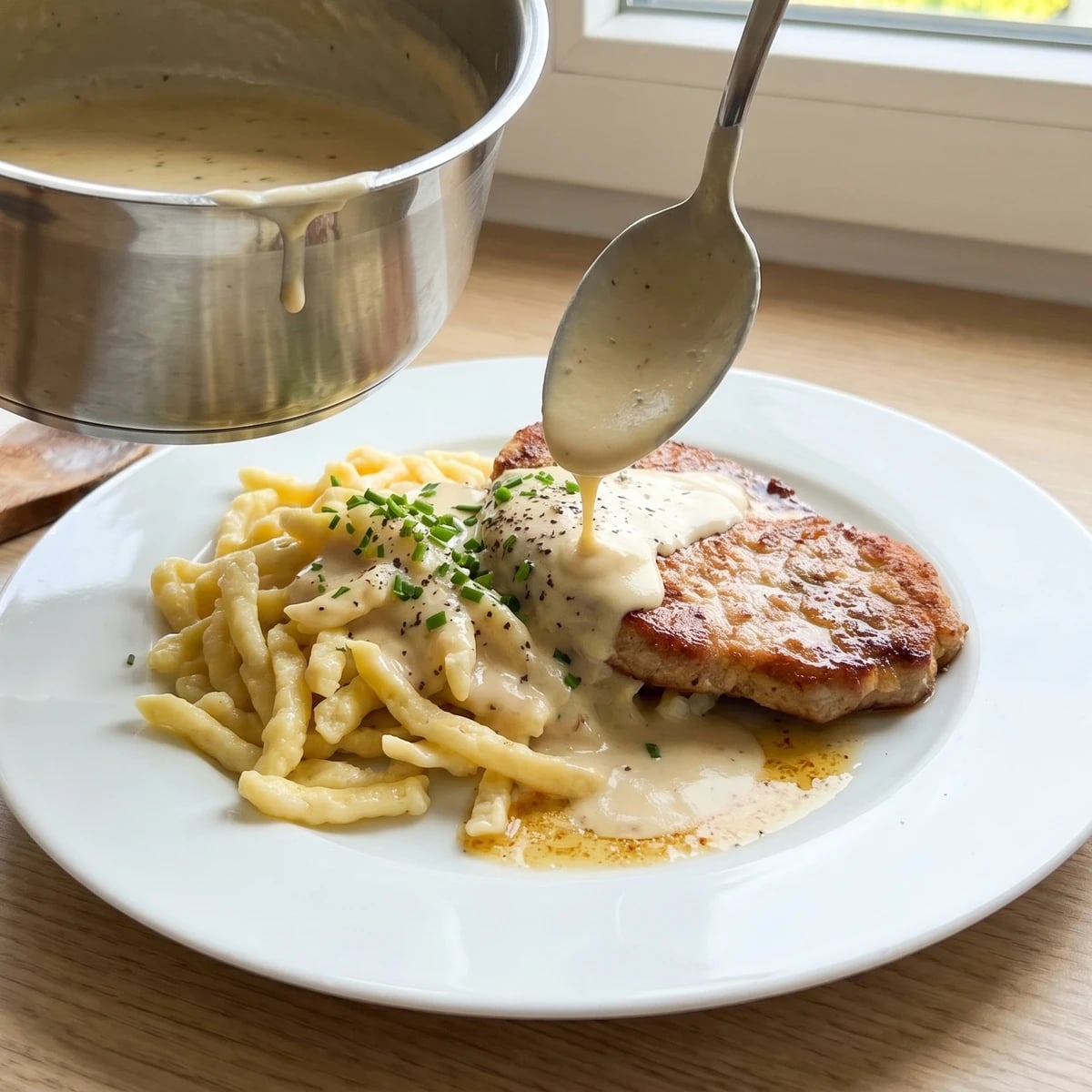
The German cream sauce that lives between weeknight Schnitzel and the Sunday roast, built from browned pan bits, good stock, and cream reduced until it coats the spoon.

Sauces & Condiments
German
Weeknight
Comfort Food
Quick Meal
10 min
Active Time
15 min cook25 min total
Yield4 servings

Rahmsauce is the weeknight pan sauce and the Sunday helper. It belongs wherever a browned cut of meat, a plate of Spätzle, or a bowl of Nudeln needs something proper over it. In Swabia it leans toward the pan drippings and the Spätzle. In Franconia and Bavaria it may run darker from roast juices. In the north you find it lighter, sometimes with mustard or herbs beside fish or pork. Im Norden anders, im Süden anders.

The sauce is simple, which means it has nowhere to hide. I brown the onion slowly, scrape the pan clean with stock, then reduce before the cream goes in. That order matters. Stock first pulls the browned bits off the pan and concentrates their flavour; cream too early dulls the browning and can split if you boil it hard. Erst verstehen, dann kochen.

Use real stock if you've got it, especially one made from bones or roast trimmings. Weggeworfen wird nichts. The jarred brown sauce with cream stirred through it is not Rahmsauce. Nicht aus dem Glas. This is ten minutes of attention, a wooden spoon, and enough patience to let the sauce coat the back of it.

Finish with salt, pepper, and a small spoon of mustard or lemon only if the plate needs brightness. Würzen, Fett, Salz zum Schluss. A cream sauce should taste of the pan, not of a dairy cupboard.

Rahmsauce has no single inventor because it grew out of the German and Austrian pan sauce tradition, where browned meat juices were loosened with broth and enriched with cream or sour cream. Its spread follows the everyday rise of dairy-based cookery in southern German regions, especially Swabia and Bavaria, where cream, Schmand, and Spätzle made a natural table together. The regional argument is practical: the south often builds Rahmsauce from meat fond and cream, while northern versions may run paler and sharper beside pork, fish, or mushrooms.

The technique, the tradition, and the story behind every dish.

Discover Culinary Explorer

Ingredients

butter

Quantity

1 tablespoon

neutral oil or lard

Quantity

1 tablespoon

small onion

Quantity

1

finely diced

plain flour

Quantity

1 teaspoon

dry white wine or extra stock (optional)

Quantity

150ml

good beef, veal, chicken, or vegetable stock

Quantity

250ml

heavy cream

Quantity

200ml

mild German mustard (optional)

Quantity

1 teaspoon

lemon juice (optional)

Quantity

1 teaspoon

salt and black pepper

Quantity

to taste

parsley or chives (optional)

Quantity

1 tablespoon

chopped

Equipment Needed

  • Wide 24 to 28cm skillet or saute pan
  • Wooden spoon
  • Fine whisk

Instructions

  1. 1

    Brown the onion

    Set a skillet over medium heat and melt the butter with the oil or lard. Add the diced onion with a pinch of salt and cook until soft and pale gold, 6 to 8 minutes. Don't rush it. Onion that browns gently gives sweetness; onion scorched in a hot pan gives bitterness, and cream will carry that bitterness straight to the plate.

  2. 2

    Toast the flour

    Stir in the flour and cook for one minute, scraping as you go. The flour has to meet the fat and lose its raw taste before the liquid goes in; add stock too soon and you get a floury sauce with little lumps sitting in it.

    If you cooked Schnitzel, pork chops, mushrooms, or a small roast in the pan first, use that same pan. The browned bits on the bottom are the sauce. Clean pan, thinner sauce.
  3. 3

    Deglaze and reduce

    Pour in the wine or 150ml extra stock and scrape the bottom until every browned bit has dissolved. Let it bubble until reduced by half, then add the stock and simmer 4 to 5 minutes. This is where the sauce gets its backbone; reduce the stock now, before the cream, so the flavour concentrates without the dairy boiling hard.

  4. 4

    Add the cream

    Turn the heat down to a steady simmer and stir in the cream. Cook 4 to 6 minutes, stirring often, until the sauce coats the back of a spoon and a line drawn through it holds for a second. Runter mit der Temperatur. Cream thickens by gentle reduction; a hard boil can split it and leave you with fat at the edge.

  5. 5

    Season and serve

    Taste first, then season with salt and black pepper. Stir in the mustard or lemon only if the plate needs a little lift, because acid sharpens cream but too much turns the sauce sour. Finish with herbs if they belong to the dish, then spoon it over Schnitzel, Spätzle, Nudeln, mushrooms, or sliced roast.

Chef Tips

  • Use stock that tastes good by itself. A weak stock makes a white cream sauce with no spine; a stock from bones, roast trim, or mushroom stems gives the sauce something to stand on.
  • Add cream after the stock has reduced. Cream is there for body and roundness, not for long boiling, and it behaves better when the pan has already done the concentrating.
  • For Jägersauce, brown 250g sliced mushrooms before the onion and keep the same method. The mushrooms need contact with the pan so their water cooks off and their edges brown.
  • For a pale Rahmsauce beside fish or chicken, use chicken or vegetable stock and skip the dark fond. For pork, Schnitzel, or Rouladen, beef or veal stock is better. Same family, different table.

Advance Preparation

  • Rahmsauce is best made just before serving, because cream sauces tighten as they sit.
  • If making ahead, cook it through, cool it quickly, and refrigerate up to 2 days. Reheat gently with a splash of stock or cream, because hard boiling can split the sauce.
  • Freeze it only if you must. Cream sauces can turn grainy after thawing; warm it slowly and whisk in a spoon of fresh cream to bring it back.

Frequently Asked Questions

Nutrition Information

1 serving (about 145g)

Calories
190 calories
Total Fat
17 g
Saturated Fat
9 g
Trans Fat
0 g
Unsaturated Fat
7 g
Cholesterol
45 mg
Sodium
500 mg
Total Carbohydrates
6 g
Dietary Fiber
0 g
Sugars
3 g
Protein
2 g

Note: Chef personas and recipes are created with AI assistance. Cook with care: follow safe food-handling practices, check doneness with a thermometer when needed, and adapt for allergies and your kitchen.

Where cooking meets culture.

Culinary guides, cultural storytelling, and the editorial depth that makes cooking meaningful.

Discover Culinary Explorer

More from Sauces, Gravies & the Made Stock (Nicht aus dem Glas)

Browse the full collection