
Chef Lupita
Aguascalientes Beef Tongue Pozole (Pozole de Lengua)
Aguascalientes' Bajio pozole de lengua, built with cacahuazintle hominy, tender beef tongue, chile ancho and guajillo, with xoconostle brightness and table garnishes.
A cooking platform built around craft, culture, and the stories behind what we eat.
Created by
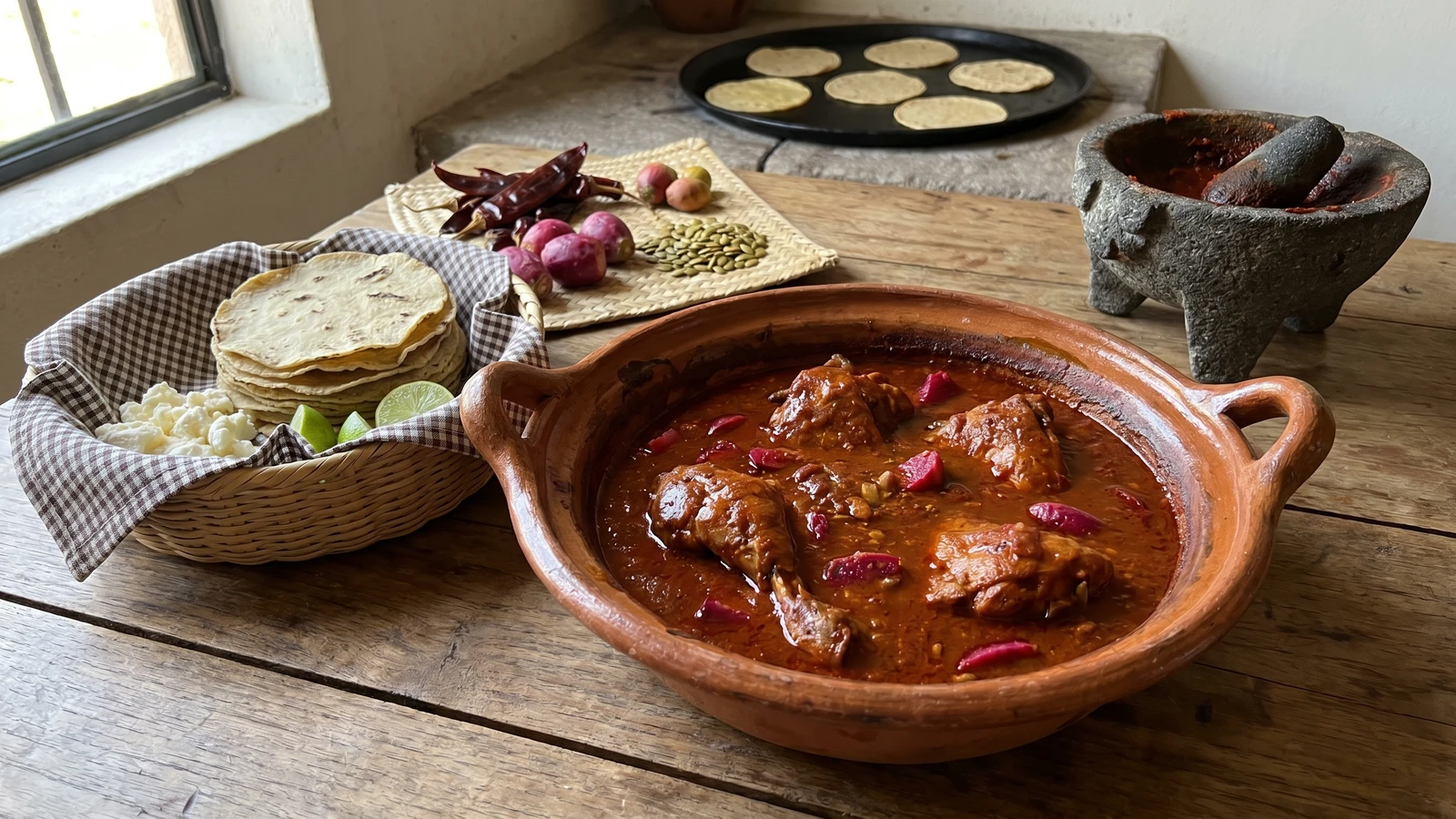
Querétaro's semi-desert mole de conejo, built with guajillo, pepita, almendra, xoconostle, and chilcuague, the kind of slow guiso that belongs to Tolimán's Otomí kitchens.
Querétaro, the semi-desert around Tolimán and the Sierra Gorda foothills, is where this mole de conejo belongs. Not Puebla. Not Oaxaca. Querétaro. This is Hñähñu, Otomí country, where rabbit, xoconostle, nopal, garambullo, corn, and chiles are not decorative regional words. They are what the land gives when you know how to cook from it.
The sauce is built with chile guajillo, pepita, almendra, xoconostle, and a little chilcuague, that root from the Bajío that wakes the tongue with a clean, electric bitterness. It is not a fiery mole. Not all Mexican food is hot, and anyone who says that has not eaten enough of Mexico. Here the work is balance: guajillo for color, pepita for body, almond for roundness, xoconostle for acid, manteca de cerdo to carry the flavor. No me vengas con atajos.
I learned versions of this guiso from women in Querétaro's Mercado de La Cruz and from cocineras who travel in from Tolimán with dried chiles, quelites, and baskets of xoconostle. They cook on blackened comales and serve from clay cazuelas, not because it looks charming, but because that is the working kitchen. My mother wrote in her notebook: 'The sauce must be fried until the fat appears.' She was talking about Jalisco, but the rule holds here too. Saber cocinar es saber vivir.
The Otomí, or Hñähñu, communities of Querétaro have long cooked with the semi-desert foods of the region: rabbit, xoconostle, nopal, quelites, maguey products, and maize. Tolimán's Otomí-Chichimeca ceremonial landscape was recognized by UNESCO in 2009, and its foodways remain tied to the same dryland agriculture and seasonal gathering that shaped the region before the Camino Real de Tierra Adentro brought Spanish livestock, wheat, dairy, and almonds into the Bajío. This mole shows that the Bajío has its own mole vocabulary, with pepita, xoconostle, chilcuague, and lard-fried sauces, separate from the better-known Oaxacan and Poblano traditions.
Quantity
1, about 3 pounds
cut into 8 serving pieces
Quantity
2 teaspoons, plus more to taste
Quantity
1/2 teaspoon
Quantity
3 tablespoons
Quantity
1 medium
halved
Quantity
5
unpeeled
Quantity
10
stemmed and seeded
Quantity
2
stemmed and seeded
Quantity
1/2 cup
Quantity
1/3 cup
Quantity
2
torn into pieces
Quantity
2 medium
peeled, seeded, and chopped
Quantity
1 small
charred
Quantity
1/2 teaspoon
Quantity
1/4 teaspoon
Quantity
1/8 teaspoon
Quantity
1 small piece, about 1 inch
Quantity
1 teaspoon dried grated, or 2 teaspoons fresh finely minced
Quantity
4 cups
hot
Quantity
1 tablespoon
grated
Quantity
1 cup
Quantity
for serving
warm
Quantity
for serving
Quantity
for serving
| Ingredient | Quantity |
|---|---|
| whole rabbitcut into 8 serving pieces | 1, about 3 pounds |
| kosher salt | 2 teaspoons, plus more to taste |
| freshly ground black pepper | 1/2 teaspoon |
| manteca de cerdo | 3 tablespoons |
| white onionhalved | 1 medium |
| garlic clovesunpeeled | 5 |
| dried chile guajillostemmed and seeded | 10 |
| dried chile pasillastemmed and seeded | 2 |
| raw hulled pepitas | 1/2 cup |
| blanched almonds | 1/3 cup |
| corn tortillas made from cacahuazintle masatorn into pieces | 2 |
| xoconostlespeeled, seeded, and chopped | 2 medium |
| tomatocharred | 1 small |
| dried Mexican oregano | 1/2 teaspoon |
| ground cumin | 1/4 teaspoon |
| ground clove | 1/8 teaspoon |
| canela | 1 small piece, about 1 inch |
| chilcuague root | 1 teaspoon dried grated, or 2 teaspoons fresh finely minced |
| chicken broth or light rabbit brothhot | 4 cups |
| piloncillograted | 1 tablespoon |
| cooked cacahuazintle kernels (optional) | 1 cup |
| hand-pressed corn tortillas (optional)warm | for serving |
| crumbled queso ranchero (optional) | for serving |
| lime halves (optional) | for serving |
Pat the rabbit dry and season it all over with the salt and black pepper. Let it sit at room temperature for 30 minutes while you prepare the chiles. Rabbit is lean, so do not treat it like pork shoulder. It needs browning, sauce, and patience, not a violent boil.
Heat a dry comal over medium. Toast the guajillo chiles about 20 to 30 seconds per side, just until the skins shine and puff. Toast the pasilla more carefully because it burns faster. Put the toasted chiles in a bowl and cover with hot water for 20 minutes. Hot water, not boiling. Boiling water pulls bitterness from the skins.
On the same comal, char the onion halves, unpeeled garlic, tomato, and xoconostle pieces until they pick up dark spots and soften at the edges. Peel the garlic. The xoconostle is not decoration. It gives the semi-desert acidity that cuts through the pepita and almond.
Toast the pepitas on the dry comal until they puff and begin to snap. Move them constantly. Toast the almonds until lightly golden. Toast the tortilla pieces until dry and spotted. This is how the mole gets body without flour. The Bajío has its own register with pepita, xoconostle, and chilcuague. Not every mole is Oaxacan or Poblano.
Drain the chiles and transfer them to a blender with the charred onion, peeled garlic, tomato, xoconostle, pepitas, almonds, tortilla pieces, oregano, cumin, clove, canela, chilcuague, piloncillo, and 2 cups of hot broth. Blend until completely smooth. Take your time. A grainy mole is a lazy mole. If the blender struggles, add more broth by the spoonful.
Melt the manteca de cerdo in a wide clay cazuela or heavy Dutch oven over medium-high heat. Brown the rabbit pieces in batches until golden on both sides, 3 to 4 minutes per side. Do not crowd the pot. La manteca es el sabor, and here it protects the lean meat while giving the sauce a proper base.
Lower the heat to medium. Pour the blended mole into the hot fat left in the cazuela. It will sputter, so stand back and stir with authority. Cook 10 to 12 minutes, scraping the bottom, until the sauce darkens from red-orange to deep brick and the fat begins to show at the edges. This frying is not a shortcut step. It is the step.
Return the rabbit to the cazuela and add enough hot broth to loosen the mole into a thick stew. Bring it to the gentlest simmer, cover partially, and cook 55 to 70 minutes, turning the pieces once, until the rabbit is tender but not falling into strings. Add the cooked cacahuazintle during the last 15 minutes if using. Taste for salt. The sauce should be nutty, lightly acidic, red from guajillo, and gently tingling from the chilcuague.
Let the mole rest off the heat for 15 minutes before serving. Spoon the sauce over the rabbit in the cazuela and carry it to the table with warm corn tortillas, lime halves, and a little queso ranchero on the side. Serve it family-style. The comales de Tolimán, the cazuela, the tortillas in the chiquihuite, that is part of the dish. Así se hace y punto.
1 serving (about 430g)
Culinary guides, cultural storytelling, and the editorial depth that makes cooking meaningful.
Discover Culinary ExplorerChef Lupita
Aguascalientes' Bajio pozole de lengua, built with cacahuazintle hominy, tender beef tongue, chile ancho and guajillo, with xoconostle brightness and table garnishes.

Chef Lupita
Veracruz's Gulf coast rice from Alvarado, built with seafood stock, tomato, chile chipotle, epazote, shrimp, fish, jaiba, and pulpo, served loose and brothy in a clay cazuela.

Chef Lupita
Costa Chica's wet salt-beef stew, built from chile costeño, guajillo, tomato, manteca, yuca, plantain, and masa dumplings, the ranching pot of Cuajinicuilapa and Pinotepa.

Chef Lupita
Michoacán's P'urhépecha atápakua is a masa-thickened sauce and stew at once, built with pork, chile guajillo, and hierbabuena added only at the end.