
Chef Lupita
Arroz a la Tumbada Veracruzano
Veracruz's Gulf coast rice from Alvarado, built with seafood stock, tomato, chile chipotle, epazote, shrimp, fish, jaiba, and pulpo, served loose and brothy in a clay cazuela.
A cooking platform built around craft, culture, and the stories behind what we eat.
Created by
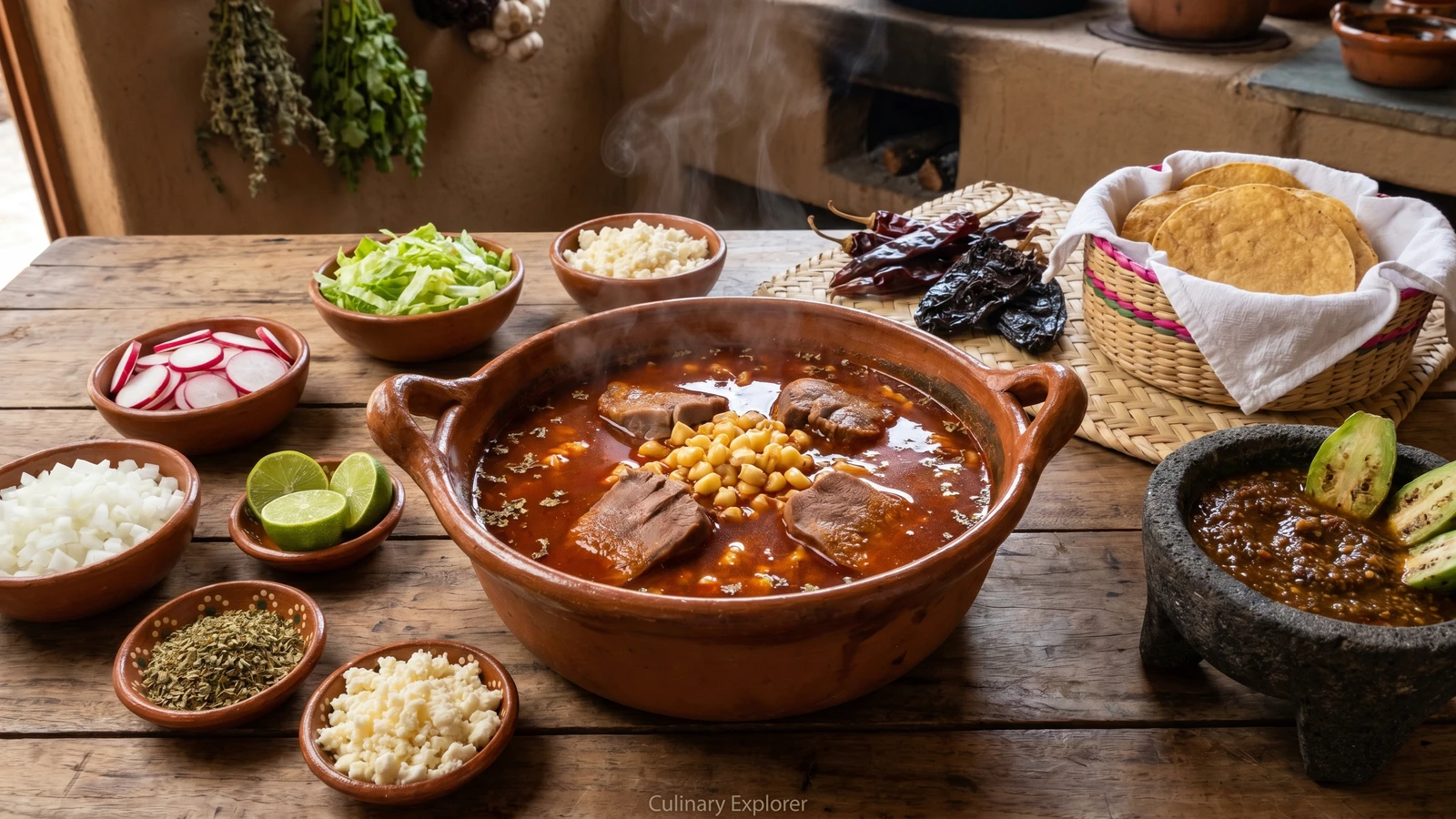
Aguascalientes' Bajio pozole de lengua, built with cacahuazintle hominy, tender beef tongue, chile ancho and guajillo, with xoconostle brightness and table garnishes.
Aguascalientes sits in the Bajio, on the old Camino Real de Tierra Adentro, and this pozole de lengua belongs to that inland table: cattle country, market corn, dried chiles, and cooks who know how to make celebration food from the parts other people pretend not to see.
The tongue is the point. You simmer it with onion, garlic, bay, and xoconostle until the skin slips off, then slice the meat thick enough that it stays tender in the bowl. The broth gets its color from chile ancho and chile guajillo, toasted on a comal and fried in manteca de cerdo. La manteca es el sabor. Don't make a face at the tongue and then ask for tradition. This is the dish.
In the Mercado Teran in Aguascalientes, the women will tell you which butcher has clean lengua and which chile vendor has guajillo that still bends instead of cracking like old paper. The Bajio has its own register, with chilcuague from the Sierra Gorda, xoconostle for acidity, dairy from the haciendas, and cazuelas that go straight to the table. Not all Mexican food is spicy. Not all pozole is from Jalisco. Cada estado, su propia cocina.
My mother didn't write this one in her Jalisco notebook, but she wrote a sentence that applies: 'El caldo manda.' The broth gives the orders. If the corn is hard, cook longer. If the tongue is tight, cook longer. If the chile tastes raw, fry it again. Saber cocinar es saber vivir.
Aguascalientes developed as a provisioning stop along the Camino Real de Tierra Adentro, where cattle, wheat, chile, dairy, and corn moved between Zacatecas, Guanajuato, Queretaro, San Luis Potosi, and Mexico City during the colonial period. Pozole itself comes from the Nahuatl 'pozolli,' referring to the foamy burst of nixtamalized corn, but the use of beef tongue reflects the Bajio's ranching economy and the criollo-mestizo habit of valuing the whole animal. Xoconostle and chilcuague mark the wider Bajio and Sierra Gorda pantry, a reminder that the region has its own chile, acid, and herb logic, not a borrowed one.
Quantity
2 pounds
rinsed and picked over
Quantity
2 tablespoons
only if nixtamalizing dried corn from scratch
Quantity
1, about 3 to 3 1/2 pounds
rinsed
Quantity
1 1/2 pounds
Quantity
1 large
halved
Quantity
1
halved crosswise
Quantity
3
Quantity
2
peeled, seeds removed, quartered
Quantity
1 tablespoon, plus more to taste
Quantity
8
stemmed and seeded
Quantity
3
stemmed and seeded
Quantity
1 small
stemmed and seeded
Quantity
1/2 teaspoon
finely grated, or 1 small pinch ground chilcuague
Quantity
1 teaspoon
Quantity
1 teaspoon, plus more for serving
Quantity
3 tablespoons
Quantity
1 tablespoon
Quantity
for serving
Quantity
for serving
Quantity
for serving
Quantity
for serving
Quantity
for serving
Quantity
for serving
| Ingredient | Quantity |
|---|---|
| dried cacahuazintle corn or prepared pozole cornrinsed and picked over | 2 pounds |
| cal (calcium hydroxide)only if nixtamalizing dried corn from scratch | 2 tablespoons |
| whole beef tonguerinsed | 1, about 3 to 3 1/2 pounds |
| beef shank or beef neck bones | 1 1/2 pounds |
| white onionhalved | 1 large |
| head of garlichalved crosswise | 1 |
| bay leaves | 3 |
| xoconostlespeeled, seeds removed, quartered | 2 |
| kosher salt | 1 tablespoon, plus more to taste |
| dried chile guajillostemmed and seeded | 8 |
| dried chile anchostemmed and seeded | 3 |
| dried chile pasillastemmed and seeded | 1 small |
| dried chilcuague rootfinely grated, or 1 small pinch ground chilcuague | 1/2 teaspoon |
| cumin seeds | 1 teaspoon |
| dried Mexican oregano | 1 teaspoon, plus more for serving |
| manteca de cerdo | 3 tablespoons |
| apple cider vinegar or pulque vinegar | 1 tablespoon |
| thinly sliced radishes (optional) | for serving |
| shredded romaine lettuce (optional) | for serving |
| finely diced white onion (optional) | for serving |
| lime halves (optional) | for serving |
| tostadas (optional) | for serving |
| crumbled queso ranchero (optional) | for serving |
If using dried cacahuazintle, cover it with 4 quarts water in a nonreactive pot and stir in the cal. Bring to a simmer for 25 minutes, then turn off the heat, cover, and let it sit overnight. The next day, rub the corn between your hands under running water until the skins loosen and the kernels feel clean but still whole. Rinse well. This is work. Pozole begins with corn, not with a can.
Put the beef tongue, beef shank or neck bones, onion, garlic, bay leaves, xoconostles, salt, and 5 quarts cold water in a large stockpot. Bring slowly to a simmer and skim the gray foam during the first 20 minutes. Lower the heat until the surface barely trembles. Cook 2 1/2 to 3 hours, until a knife slides into the thickest part of the tongue without resistance.
Lift the tongue onto a board while it is still warm. Peel off the thick outer skin with your fingers and a small knife. Do not wait until it cools or the skin will fight you. Trim any tough bits from the base, then slice the tongue into thick half-moons. Strain the broth and keep it. Discard the spent onion, garlic, bay, bones, and xoconostle pieces.
Put the rinsed cacahuazintle into the strained broth. Add enough water to keep the corn covered by 2 inches. Simmer gently for 1 1/2 to 2 hours, until the kernels bloom open like little flowers and are tender at the center. If the broth drops too low, add hot water. The corn tells you when it is ready, not the clock.
Heat a dry comal over medium. Toast the chile guajillo, chile ancho, and chile pasilla separately, 20 to 30 seconds per side. The skins should puff and darken one shade. They should not blacken. Toast the cumin seeds for 30 seconds, just until fragrant. Burned chile makes bitter broth. Throw it out and start again if you burn it.
Cover the toasted chiles with hot water and let them soften for 20 minutes. Drain them and blend with 2 cups of the pozole broth, the toasted cumin, Mexican oregano, chilcuague, and vinegar until completely smooth. Strain through a fine-mesh sieve. Chilcuague is strong and numbing, so use a disciplined hand. This is a Bajio accent, not a dare.
Melt the manteca de cerdo in a cazuela or heavy skillet over medium heat. Pour in the strained chile puree. It will jump, so stir with authority. Cook 8 to 10 minutes, scraping the bottom, until the color deepens to brick red and the fat begins to separate at the edges. This frying is what removes the raw chile taste. No me vengas con atajos.
Stir the fried chile adobo into the pot of opened cacahuazintle. Add the sliced tongue. Simmer 25 to 30 minutes so the tongue, corn, and chile broth become one pot instead of three separate jobs. Taste for salt. The broth should be full, lightly acidic from the xoconostle, and red from chile, not tomato.
Ladle the pozole into deep clay bowls. Set out radish, romaine lettuce, white onion, lime, oregano, tostadas, and crumbled queso ranchero in small dishes. Let each person finish the bowl at the table. Aguascalientes food is generous, but it is not confused. No cheddar. No sour cream. No flour tortillas here. Así se hace y punto.
1 serving (about 720g)
Culinary guides, cultural storytelling, and the editorial depth that makes cooking meaningful.
Discover Culinary ExplorerChef Lupita
Veracruz's Gulf coast rice from Alvarado, built with seafood stock, tomato, chile chipotle, epazote, shrimp, fish, jaiba, and pulpo, served loose and brothy in a clay cazuela.

Chef Lupita
Costa Chica's wet salt-beef stew, built from chile costeño, guajillo, tomato, manteca, yuca, plantain, and masa dumplings, the ranching pot of Cuajinicuilapa and Pinotepa.

Chef Lupita
Michoacán's P'urhépecha atápakua is a masa-thickened sauce and stew at once, built with pork, chile guajillo, and hierbabuena added only at the end.

Chef Lupita
Michoacán's Purépecha atápakua is a chile-red, masa-thickened stew from the Lake Pátzcuaro region, built with guajillo, pasilla, toasted pepita, and quelites until the broth turns sturdy and alive.