Culinary Explorer

A cooking platform built around craft, culture, and the stories behind what we eat.
Discover Culinary Explorer
Aguascalientes Steamed Lamb Birria (Birria de Borrego al Vapor)

Aguascalientes Steamed Lamb Birria (Birria de Borrego al Vapor)

Created by

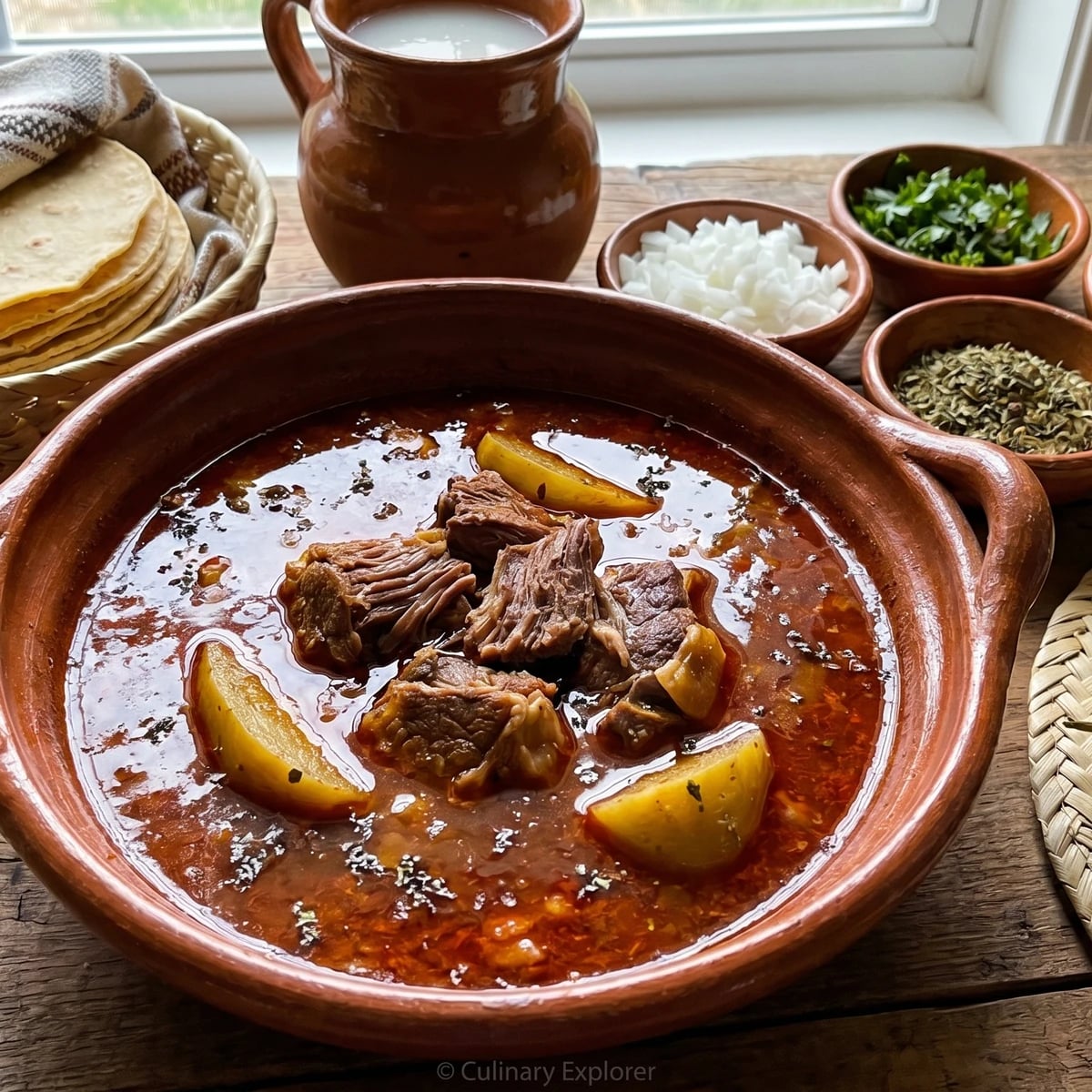
Aguascalientes' Feria de San Marcos birria: borrego sealed over chile-stained consomé and cooked through the night with guajillo, ancho, chilcuague, xoconostle, and a Bajío table of tortillas.

Soups & Stews
Mexican
Celebration
Make Ahead
Slow Cooker
1 hr 15 min
Active Time
8 hr cook17 hr 15 min total
Yield8 to 10 servings

Aguascalientes sits at the northern edge of the Bajío, on the old Camino Real de Tierra Adentro between Zacatecas and León, and this birria belongs to that ranching country. At the Feria de San Marcos, borrego al vapor is not a side note. It is the pot people look for after walking the fair all day: lamb, guajillo, ancho, xoconostle, and the red fat of the consomé staining the clay bowl.

The Feria de San Marcos began in 1828 as a commercial and livestock fair in Aguascalientes, a state shaped by ranching, dairy, and traffic along the Camino Real de Tierra Adentro. Birria is often treated as a Jalisco goat dish, but Aguascalientes cooks built a borrego al vapor register in which lamb is adobado, set above seasoned liquid, and cooked long enough for the fat and chile to build the consomé below. Chilcuague, a tingling root associated with Guanajuato and the Sierra Gorda of Querétaro, marks the wider Bajío pantry more clearly than any lazy label about heat could.

The technique, the tradition, and the story behind every dish.

Discover Culinary Explorer

Ingredients

bone-in lamb shoulder, neck, or shank

Quantity

5 pounds

cut into 3-inch pieces

kosher salt

Quantity

1 tablespoon, plus more to taste

dried chile guajillo

Quantity

12

stemmed and seeded

dried chile ancho

Quantity

4

stemmed and seeded

dried chile cascabel

Quantity

3

stemmed and seeded

dried chile pasilla

Quantity

2

stemmed and seeded

Roma tomatoes

Quantity

3

charred on a comal

white onions

Quantity

3 medium

1 quartered, 1 halved, 1 finely diced for serving

garlic cloves

Quantity

12

8 peeled for the adobo and 4 lightly crushed for the consomé

xoconostles

Quantity

3

peeled and seeded, 1 chopped and 2 quartered

pulque blanco

Quantity

1 cup

vinagre de piña or apple cider vinegar

Quantity

1/2 cup

manteca de cerdo

Quantity

2 tablespoons

cumin seeds

Quantity

1 teaspoon

black peppercorns

Quantity

1 teaspoon

whole cloves

Quantity

5

allspice berries

Quantity

4

Mexican cinnamon

Quantity

1 small stick

dried Mexican oregano

Quantity

2 teaspoons, plus more for serving

dried thyme

Quantity

1 teaspoon

dried marjoram

Quantity

1 teaspoon

dried chilcuague root powder

Quantity

1/4 teaspoon

or 1/2 inch fresh root, finely grated

bay leaves

Quantity

4

water or light lamb stock

Quantity

3 cups

roasted maguey pencas

Quantity

2 to 3

cleaned and softened

cooked cacahuazintle nixtamal (optional)

Quantity

2 cups

warmed

hand-pressed corn tortillas (optional)

Quantity

for serving

warmed

finely diced white onion (optional)

Quantity

for serving

chopped cilantro (optional)

Quantity

for serving

lime halves (optional)

Quantity

for serving

Equipment Needed

  • Cast iron comal for toasting chiles and charring vegetables
  • High-powered blender
  • Fine-mesh strainer
  • 8- to 10-quart vaporera or tamalera with rack, electric roaster, or slow cooker with rack
  • Food-safe roasted maguey pencas
  • Instant-read thermometer
  • Deep barro cazuela or clay bowls for serving

Instructions

  1. 1

    Salt the borrego

    Pat the lamb dry and rub it all over with the tablespoon of salt. Let it sit while you prepare the adobo, or refrigerate it for up to 12 hours if you are planning properly. Bone-in lamb is the point here. The bones give the consomé body and the fat carries the chile.

  2. 2

    Toast the chiles

    Heat a dry comal over medium. Toast the guajillo, ancho, cascabel, and pasilla separately, 15 to 30 seconds per side, just until the skins darken slightly and the kitchen smells like a chile stall at Mercado Terán. Do not blacken them. Burned chile makes bitter birria and there is no fixing it later.

    Watch the cascabel. It is round and small, so roll it on the comal instead of pressing it flat. The guajillo gives color, the ancho gives sweetness, the pasilla gives depth, and the cascabel gives that nutty Bajío edge.
  3. 3

    Soak and char

    Place the toasted chiles in a bowl and cover with hot water, not boiling water. Let them soften for 20 minutes. Meanwhile char the tomatoes, quartered onion, and 8 peeled garlic cloves on the comal until blistered in spots. Toast the cumin, peppercorns, cloves, allspice, and cinnamon in a small dry skillet until fragrant, about one minute.

  4. 4

    Blend the adobo

    Drain the chiles. Taste the soaking water. If it is bitter, throw it out and use fresh water. Blend the chiles with the charred tomatoes, charred onion, charred garlic, chopped xoconostle, pulque, vinegar, toasted spices, Mexican oregano, thyme, marjoram, chilcuague, and 1 cup of the chile soaking water or fresh water. Blend until completely smooth, then strain through a fine-mesh sieve. Press hard on the solids. A lazy adobo gives you a gritty consomé.

    Chilcuague is not a chile. It is a Bajío root with a tingling bite. Use the amount given. More is not more. It will take over the pot if you let it.
  5. 5

    Fry the adobo

    Melt the manteca de cerdo in a heavy cazuela or Dutch oven over medium heat. Add the strained adobo carefully because it will sputter. Cook 10 to 12 minutes, stirring often, until the sauce turns brick red, thickens, and the fat begins to separate at the edges. La manteca es el sabor. Vegetable oil will not give you the same depth. Reserve 1 cup of the fried adobo for finishing the consomé, then cool the rest slightly.

  6. 6

    Marinate overnight

    Coat the salted lamb with the fried adobo, pushing it into every cut and around the bones. Cover and refrigerate at least 8 hours and up to 12. Two days is two days when a dish asks for it. No me vengas con atajos.

  7. 7

    Line the vaporera

    Warm the roasted maguey pencas on the comal until flexible. Trim away any tough spines. Set a rack inside an 8- to 10-quart vaporera, tamalera, electric roaster, or large slow cooker. Pour the water or light lamb stock into the bottom with the halved onion, crushed garlic cloves, bay leaves, quartered xoconostles, and a pinch of salt. The liquid must sit below the rack. Line the rack with the maguey, add the marinated lamb, spoon any bowl adobo over it, and fold the leaves over the meat.

  8. 8

    Cook through the night

    Cover tightly. For a stovetop vaporera, cook over low heat 6 to 8 hours, checking the water level every hour and adding hot water if needed. For true overnight cooking, use an electric roaster, a covered roasting pan in a 275F oven, or a slow cooker on low for 8 to 10 hours. Do not leave an open flame unattended while you sleep. The lamb is ready when the bone pulls free and the thickest pieces reach 195F to 203F.

    If your slow cooker has no rack, set three heatproof ramekins in the bottom and place a small heatproof plate over them. The lamb should sit above the liquid so the drippings season the consomé below.
  9. 9

    Finish the consomé

    Lift out the lamb and keep it covered. Strain the liquid from the bottom of the pot into a saucepan, pressing on the xoconostle, onion, and garlic before discarding them. Skim excess fat, but leave a red glossy layer on top. Stir in the reserved cup of fried adobo and simmer 10 minutes. Taste for salt. The consomé should be savory, tart from the xoconostle, and deep red from the guajillo.

  10. 10

    Shred the lamb

    Pull the lamb from the bones in thick pieces, not tiny strings. Discard any hard cartilage and keep the soft fat that melted into the meat. Moisten the lamb with a ladle of consomé. This is borrego al vapor, not dry roasted meat.

  11. 11

    Serve Aguascalientes style

    If using cacahuazintle, put a small spoonful of the warm kernels in the bowl first. Do not turn the bowl into pozole. Add lamb, ladle over the consomé, and finish with finely diced white onion, cilantro, crumbled Mexican oregano, and lime. Serve with warm corn tortillas in a cloth-lined chiquihuite. No yellow cheese, no sour cream, no lettuce. Así se hace y punto.

Chef Tips

  • At Mercado Terán in Aguascalientes, a good chile guajillo still bends a little before it tears. If it snaps like old paper, it has been sitting too long. You can have perfect technique and dead chiles and you will still get dead birria.
  • Buy borrego with bone. Shoulder, neck, shank, ribs, all of that works. A boneless leg looks tidy and tastes thin. The bone is not decoration. It builds the consomé.
  • This is not Jalisco's chivo tatemado. Jalisco has its birria and Aguascalientes has borrego al vapor through the night. Cada estado, su propia cocina.
  • Chilcuague is hard to find outside central Mexico. Ask Mexican herb vendors, especially those who carry Sierra Gorda or Guanajuato products. If you cannot find it, omit it. Do not replace it with cayenne. That is a different sensation and a lazy one.
  • Xoconostle is acidic, not sweet. If the market has no xoconostle, add one extra tablespoon of vinegar to the consomé as a compromise. You will miss the cactus-fruit tartness. A substitution is a compromise, not an upgrade.
  • Pulque blanco means plain pulque, not flavored curado and not beer. If you cannot get pulque, use water with a spoonful of vinegar. But know what you are losing: that lactic, mineral edge from the maguey.
  • Cacahuazintle is optional here and it must be cooked nixtamal, not canned sweet corn. Sweet corn has no business in this bowl.

Advance Preparation

  • The adobo can be made up to 3 days ahead and refrigerated. The flavor deepens, and the fat will rise to the top. Warm it before coating the lamb.
  • The lamb should marinate overnight. Less than 8 hours works only if you like regret.
  • The cooked birria keeps 4 days in the refrigerator. Store lamb and consomé together so the meat stays moist. Reheat gently; a hard boil toughens the lamb.
  • For a slow cooker, cook on low 8 to 10 hours with the lamb elevated above the liquid. If the meat sits in the liquid, you are braising. It will still taste good, but it is not the same technique.

Frequently Asked Questions

Nutrition Information

1 serving (about 340g)

Calories
505 calories
Total Fat
31 g
Saturated Fat
13 g
Trans Fat
0 g
Unsaturated Fat
15 g
Cholesterol
145 mg
Sodium
980 mg
Total Carbohydrates
16 g
Dietary Fiber
5 g
Sugars
6 g
Protein
42 g

Note: Chef personas and recipes are created with AI assistance. Cook with care: follow safe food-handling practices, check doneness with a thermometer when needed, and adapt for allergies and your kitchen.

Where cooking meets culture.

Culinary guides, cultural storytelling, and the editorial depth that makes cooking meaningful.

Discover Culinary Explorer

More from Bajío Soups & Stews

Browse the full collection