
Chef Lupita
Aguascalientes Beef Tongue Pozole (Pozole de Lengua)
Aguascalientes' Bajio pozole de lengua, built with cacahuazintle hominy, tender beef tongue, chile ancho and guajillo, with xoconostle brightness and table garnishes.
A cooking platform built around craft, culture, and the stories behind what we eat.
Created by
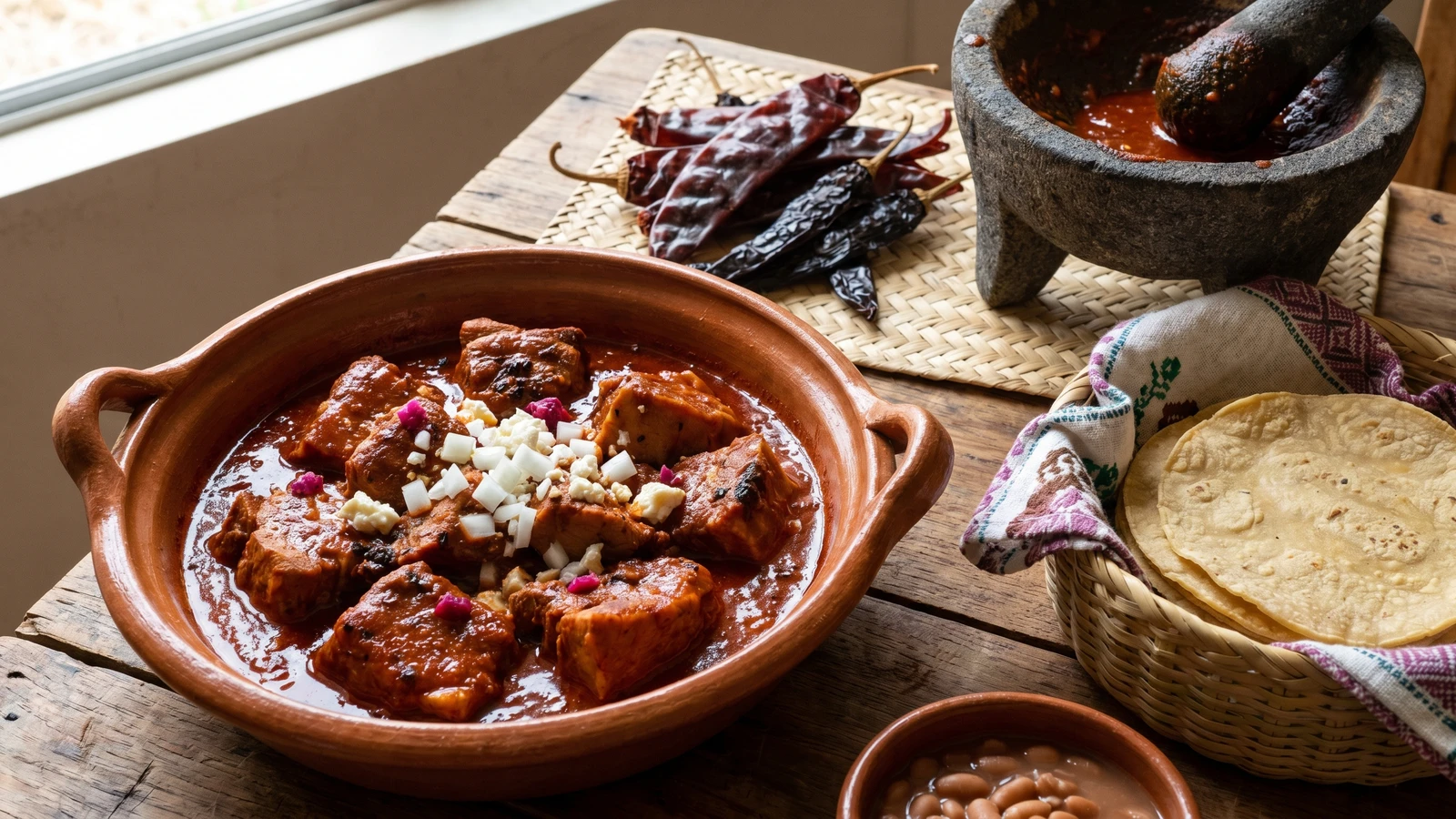
Guanajuato's Bajio carne con chile colorado, pork browned in lard and simmered in a red adobo of guajillo, pasilla, jitomate, garlic, comino, and oregano.
Guanajuato, in the Bajio, is where this carne con chile colorado belongs on my table: between Leon's working kitchens, the old mining roads, and the ranch houses that fed people after long days of dust, cattle, wheat, corn, and trade. This is not northern chile colorado with flour tortillas, and it is not a restaurant plate drowned in melted cheese. It is pork, red chile adobo, lard, and a clay cazuela set in the middle of the table.
The Bajio developed as a criollo-mestizo food corridor along the Camino Real de Tierra Adentro, the colonial trade route that connected Mexico City to the northern mining districts from the 16th century onward. Pork, wheat, dairy, and lard from Spanish ranching met Indigenous chile, corn, xoconostle, and grinding techniques, creating the stews, adobos, and market foods associated with Guanajuato, Queretaro, San Luis Potosi, and Aguascalientes. Carne con chile colorado belongs to that practical hacienda-mining register: portable chile pastes, tough cuts made tender, and sauces built to feed working households.
Quantity
2 1/2 pounds
cut into 1 1/2-inch pieces
Quantity
1 1/2 teaspoons, plus more to taste
Quantity
3 tablespoons
Quantity
8
stemmed and seeded
Quantity
3
stemmed and seeded
Quantity
2
quartered
Quantity
1/2 medium
thickly sliced
Quantity
4
unpeeled
Quantity
1/2 teaspoon
Quantity
1 teaspoon
Quantity
1 small pinch
Quantity
1
peeled, seeded, and diced
Quantity
2 cups, plus more as needed
Quantity
1
Quantity
1 tablespoon
Quantity
for serving
Quantity
for serving
Quantity
for serving
Quantity
for serving
| Ingredient | Quantity |
|---|---|
| pork shouldercut into 1 1/2-inch pieces | 2 1/2 pounds |
| kosher salt | 1 1/2 teaspoons, plus more to taste |
| manteca de cerdo | 3 tablespoons |
| dried chile guajillostemmed and seeded | 8 |
| dried chile pasillastemmed and seeded | 3 |
| ripe jitomatesquartered | 2 |
| white onionthickly sliced | 1/2 medium |
| garlic clovesunpeeled | 4 |
| cumin seeds | 1/2 teaspoon |
| dried Mexican oregano | 1 teaspoon |
| ground chilcuague (optional) | 1 small pinch |
| xoconostle (optional)peeled, seeded, and diced | 1 |
| pork stock or water | 2 cups, plus more as needed |
| bay leaf | 1 |
| apple cider vinegar or pulque vinegar | 1 tablespoon |
| warm corn tortillas (optional) | for serving |
| beans from the pot (optional) | for serving |
| crumbled queso ranchero (optional) | for serving |
| diced raw white onion (optional) | for serving |
Season the pork shoulder with the salt and let it sit while you prepare the adobo. The salt starts working before the meat ever sees the cazuela. Pork shoulder is the cut for this dish because it has fat and connective tissue. Lean loin will dry out and embarrass you.
Heat a dry comal over medium. Toast the chile guajillo and chile pasilla separately, about 20 to 30 seconds per side, pressing them flat with tongs until the skins darken slightly and smell deep, not burned. The guajillo gives the Bajio red color and a clean fruitiness. The pasilla gives raisin-dark depth. Burn either one and the adobo turns bitter.
Put the toasted chiles in a bowl and cover with hot water. Hot, not boiling. Let them soften for 20 minutes, then drain. Boiling water toughens the skins and pulls bitterness forward. Hot water softens the flesh so the blender can make a smooth adobo.
On the same comal, roast the jitomates, onion, and unpeeled garlic until the jitomate skins blister, the onion browns at the edges, and the garlic softens inside its paper. Toast the cumin seeds for the last 30 seconds, just until fragrant. Peel the garlic. This is where the sauce stops tasting raw.
Blend the soaked chiles, roasted jitomates, onion, peeled garlic, cumin, oregano, chilcuague if using, vinegar, and 1 cup pork stock until completely smooth. Strain through a fine-mesh sieve, pressing hard on the solids. A strained adobo coats the pork cleanly. A lazy adobo leaves skins stuck between your teeth.
Heat the manteca de cerdo in a wide clay cazuela or heavy Dutch oven over medium-high. Brown the pork in batches, leaving space between pieces, until the edges take on a deep golden crust. Do not crowd the pot. La manteca es el sabor, and browning in lard gives the stew the Bajio register: practical, rich, and direct.
Lower the heat to medium. Return all the pork to the pot and pour in the strained adobo. It will sputter. Stir and cook for 8 to 10 minutes, scraping the bottom, until the sauce darkens from bright red to brick red and the fat begins to show at the edges. This is not decoration. Frying the adobo is what gives it authority.
Add the remaining 1 cup stock, the bay leaf, and the diced xoconostle if using. Bring to a low simmer, cover partially, and cook for 1 hour to 1 hour 15 minutes, stirring now and then, until the pork gives under a fork and the sauce clings to each piece. Add a splash of stock if it thickens too fast.
Turn off the heat and let the stew rest for 10 minutes. Taste for salt. Serve in a warm clay cazuela with corn tortillas, beans from the pot, diced white onion, and a little queso ranchero if your table wants it. The sauce should be thick enough to drag a tortilla through. Así se hace y punto.
1 serving (about 435g)
Culinary guides, cultural storytelling, and the editorial depth that makes cooking meaningful.
Discover Culinary ExplorerChef Lupita
Aguascalientes' Bajio pozole de lengua, built with cacahuazintle hominy, tender beef tongue, chile ancho and guajillo, with xoconostle brightness and table garnishes.

Chef Lupita
Veracruz's Gulf coast rice from Alvarado, built with seafood stock, tomato, chile chipotle, epazote, shrimp, fish, jaiba, and pulpo, served loose and brothy in a clay cazuela.

Chef Lupita
Costa Chica's wet salt-beef stew, built from chile costeño, guajillo, tomato, manteca, yuca, plantain, and masa dumplings, the ranching pot of Cuajinicuilapa and Pinotepa.

Chef Lupita
Michoacán's P'urhépecha atápakua is a masa-thickened sauce and stew at once, built with pork, chile guajillo, and hierbabuena added only at the end.