
Chef Makoa
Kānga Waru (Māori Corn and Kūmara Steamed Pudding)
Aotearoa's kānga waru, grated corn and kūmara folded back into corn husks, steamed until dense and sweet, then served warm with cream for Matariki or the whānau table.
A cooking platform built around craft, culture, and the stories behind what we eat.
Created by
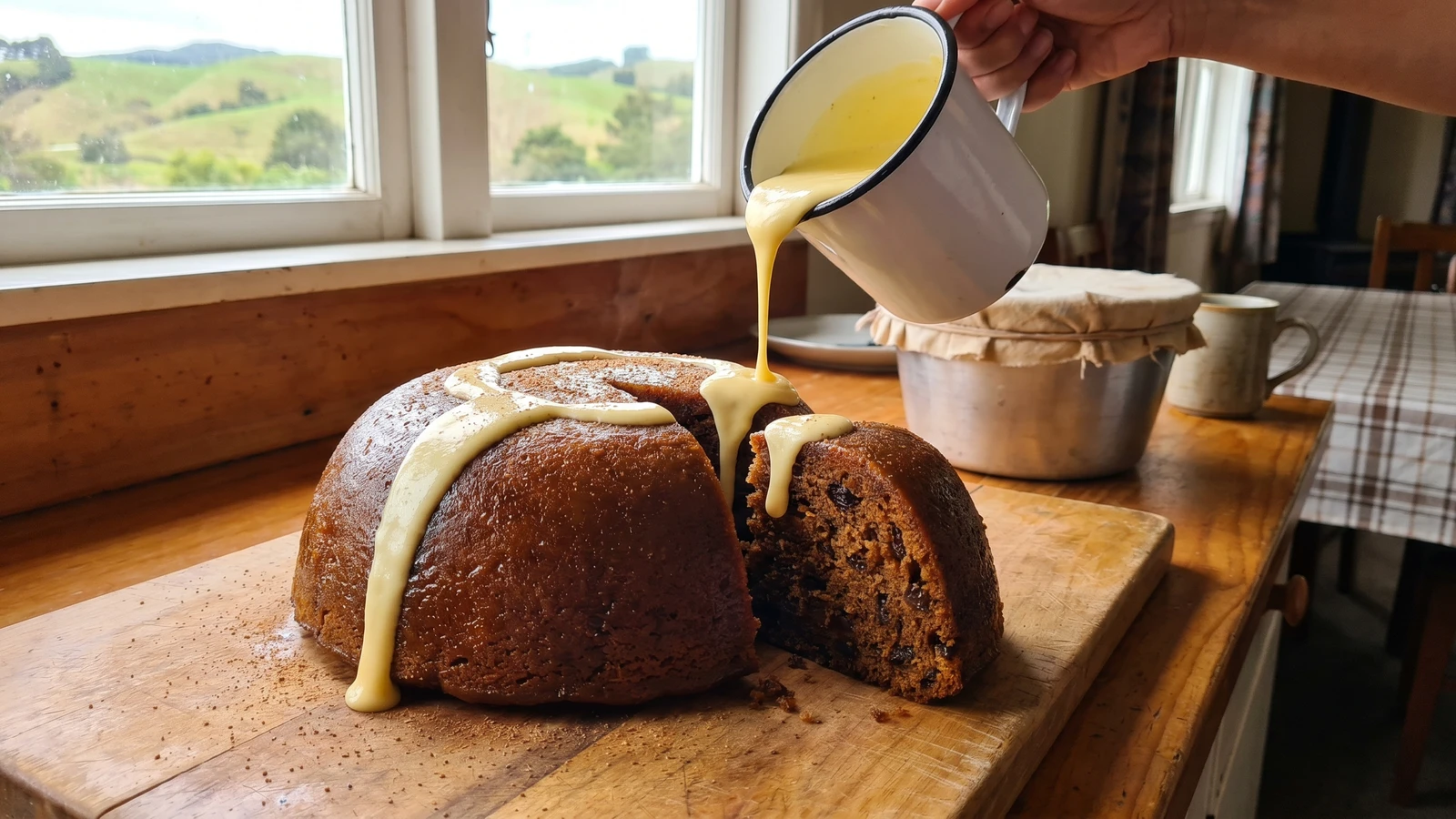
Aotearoa Māori purini mamaoa, dark from burnt sugar and slow in the pudding basin, turned out for Christmas or the hāngī table and finished with warm custard.
Not every relative at the table came in the first canoe. Some foods came later, with flour sacks and sugar tins and the hard push of mission and settler kitchens, and still the people took them in, fed the whānau, the family, and made them answer to the house. Purini mamaoa, steamed pudding in te reo Māori, the Māori language, belongs to Aotearoa Māori tables: Christmas, the hāngī, the Māori earth oven, the marae kāuta, the cooking shed, the whānau kitchen where somebody older knows exactly how dark the sugar should go.
I first met this one from the outside, yeah, standing in a kitchen where the pudding basin was tied tighter than a canoe lashing and the custard was waiting like it already knew its job. I'm Kanaka Maoli, so I don't take the deep tikanga, the customs and correct ways, of the marae or the tangi, the mourning ceremony, into my mouth like it's mine to teach. For that, go sit with Māori kaumātua, elders, and tradition-bearers. What I can do is cook the kai, the food, open-handed, name whose hand it comes from, and keep the family table wide.
The why here is the slow darkening. Burn the sugar just shy of bitter, then soften it with boiling water until it becomes a brown river through the batter. If you stop too pale, the pudding tastes only sweet. If you push to black, no blame the sugar, you walked away. Steam it slow, no peeking every five minutes, and the crumb comes out dark, tender, and a little sticky under the custard.
Across the Triangle the sweet cousins tell different stories: Sāmoan puligi with its dark pudding body, Tahitian poʻe and Cook Islands poke, fruit puddings thickened with starch, Tongan faikakai under coconut syrup. But this bowl is Aotearoa's. Kūmara, sweet potato, is the old canoe starch of this south corner; this purini is the newer pantry made whānau, comfort food that still knows how to feed a crowd.
Purini mamaoa means steamed pudding in te reo Māori, and this burnt-sugar version belongs to Aotearoa Māori whānau tables, especially Christmas, hāngī, and marae meals. It is not a pre-contact canoe-crop food like kūmara; it grew after nineteenth-century British puddings, flour, sugar, dried fruit, and custard powder entered the pantry, then Māori cooks made it kai Māori through their own tables and ways of feeding. Sāmoan puligi is the closest cousin from that same flour-and-sugar era, while Cook Islands poke, Tahitian poʻe, and Tongan faikakai show the wider Triangle's love of sweet starch and sauce, each one named by its own island and carried by its own people.
Quantity
as needed
for greasing a 6-cup pudding basin
Quantity
1 cup
for the burnt sugar
Quantity
1 cup
plus more for topping up the pot
Quantity
1/2 cup
cubed
Quantity
2 cups
Quantity
1/2 cup
packed
Quantity
1 teaspoon
Quantity
1 teaspoon
Quantity
1 1/2 teaspoons
Quantity
1/2 teaspoon
Quantity
1/2 teaspoon
Quantity
1 cup
Quantity
2
lightly beaten
Quantity
1/2 cup
Quantity
1 teaspoon
Quantity
2 tablespoons
Quantity
2 tablespoons
Quantity
2 cups
Quantity
1 teaspoon vanilla or 1 small knob butter
| Ingredient | Quantity |
|---|---|
| softened butterfor greasing a 6-cup pudding basin | as needed |
| granulated sugarfor the burnt sugar | 1 cup |
| boiling waterplus more for topping up the pot | 1 cup |
| unsalted buttercubed | 1/2 cup |
| all-purpose flour | 2 cups |
| dark brown sugarpacked | 1/2 cup |
| baking soda | 1 teaspoon |
| baking powder | 1 teaspoon |
| mixed spice | 1 1/2 teaspoons |
| ground cinnamon | 1/2 teaspoon |
| fine sea salt | 1/2 teaspoon |
| sultanas, raisins, or chopped mixed dried fruit (optional) | 1 cup |
| large eggslightly beaten | 2 |
| whole milk | 1/2 cup |
| vanilla extract | 1 teaspoon |
| custard powder | 2 tablespoons |
| sugar | 2 tablespoons |
| whole milk | 2 cups |
| vanilla extract or butter (optional) | 1 teaspoon vanilla or 1 small knob butter |
Butter a 6-cup pudding basin or deep heatproof bowl, then line the bottom with a small round of parchment. Set a trivet or folded towel in a heavy pot wide enough to hold the basin, and add water to come halfway up the side once the basin is in. Bring that water to a gentle simmer. This is humble gear, but it has to be steady.
Put the granulated sugar in a heavy saucepan over medium heat and let it melt without rushing. Swirl the pan as the edges liquefy, then stir only when most of it is amber. Take it to a deep brown, darker than honey and just shy of bitter, with a smell like toasted caramel, not scorched.
Take the pan off the heat and carefully pour in the boiling water, a little at a time, using a long-handled spoon and keeping your face back because the caramel will spit hard. Return the pan to low heat and stir until the seized sugar melts smooth again. Add the cubed butter and stir until glossy, then let the syrup cool until warm, not hot.
Whisk the flour, brown sugar, baking soda, baking powder, mixed spice, cinnamon, and salt in a large bowl, breaking up any hard lumps of brown sugar with your fingers. If you're using sultanas or dried fruit, toss them through the flour now so they hold in the batter instead of sinking straight to the bottom.
Whisk the eggs, milk, and vanilla into the warm burnt-sugar syrup. Pour that dark mixture over the dry ingredients and fold until no dry flour shows. The batter should be thick but pourable, shiny brown, and smelling of caramel and spice. Don't beat it mean. Once the flour is wet, you're done.
Spoon the batter into the buttered basin, leaving at least an inch of room at the top for the pudding to rise. Cover with a pleated sheet of buttered parchment and a pleated sheet of foil, then tie it snug under the rim with kitchen string. The pleat gives the pudding space to lift. The tight tie keeps water from sneaking in.
Lower the basin onto the trivet, cover the pot, and keep the water at a steady low simmer for 2 hours 30 minutes. Check the water level every 35 to 40 minutes and top up with boiling water as needed, always pouring beside the basin, not over it. The pudding is ready when a skewer comes out with sticky crumbs, not wet batter, and the top springs back under your finger.
While the pudding rests, whisk the custard powder and sugar with a splash of the cold milk until smooth. Whisk in the rest of the milk, set over medium-low heat, and stir until it thickens enough to coat the spoon in a pale yellow sheet. Stir in vanilla or a small knob of butter if you like. Custard powder is no shame, that's the pantry many aunties keep.
Let the pudding stand in the basin for 10 minutes, then loosen the edge with a thin knife and turn it onto a warm plate or wooden board. The dome should be dark, glossy, and soft under the knife, with a tender brown crumb inside. Pour the custard over the top at the table and cut big slices. Celebration food should feed like it means it.
1 serving (about 200g)
Culinary guides, cultural storytelling, and the editorial depth that makes cooking meaningful.
Discover Culinary ExplorerChef Makoa
Aotearoa's kānga waru, grated corn and kūmara folded back into corn husks, steamed until dense and sweet, then served warm with cream for Matariki or the whānau table.

Chef Juliette
Five almond preparations, one discipline: remove the skins cleanly, dry every kernel through, then cut, toast, or cloak it in pale caramel without letting its fragrant oils escape.

Chef Juliette
A pastry pantry lesson in one tray: filberts warmed only until their red skins release, rubbed clean, cooled, and chopped into a fragrant mise-en-place for cakes, creams, pralines, and petits fours.

Chef Juliette
The smallest pâtisserie discipline decides whether a cake leaves its mould intact: clarified butter in every corner, followed by the lightest veil of dry flour or fécule.