Culinary Explorer

A cooking platform built around craft, culture, and the stories behind what we eat.
Discover Culinary Explorer
Purépecha Squash and Corn Stew (Calabaza Guisada)

Purépecha Squash and Corn Stew (Calabaza Guisada)

Created by

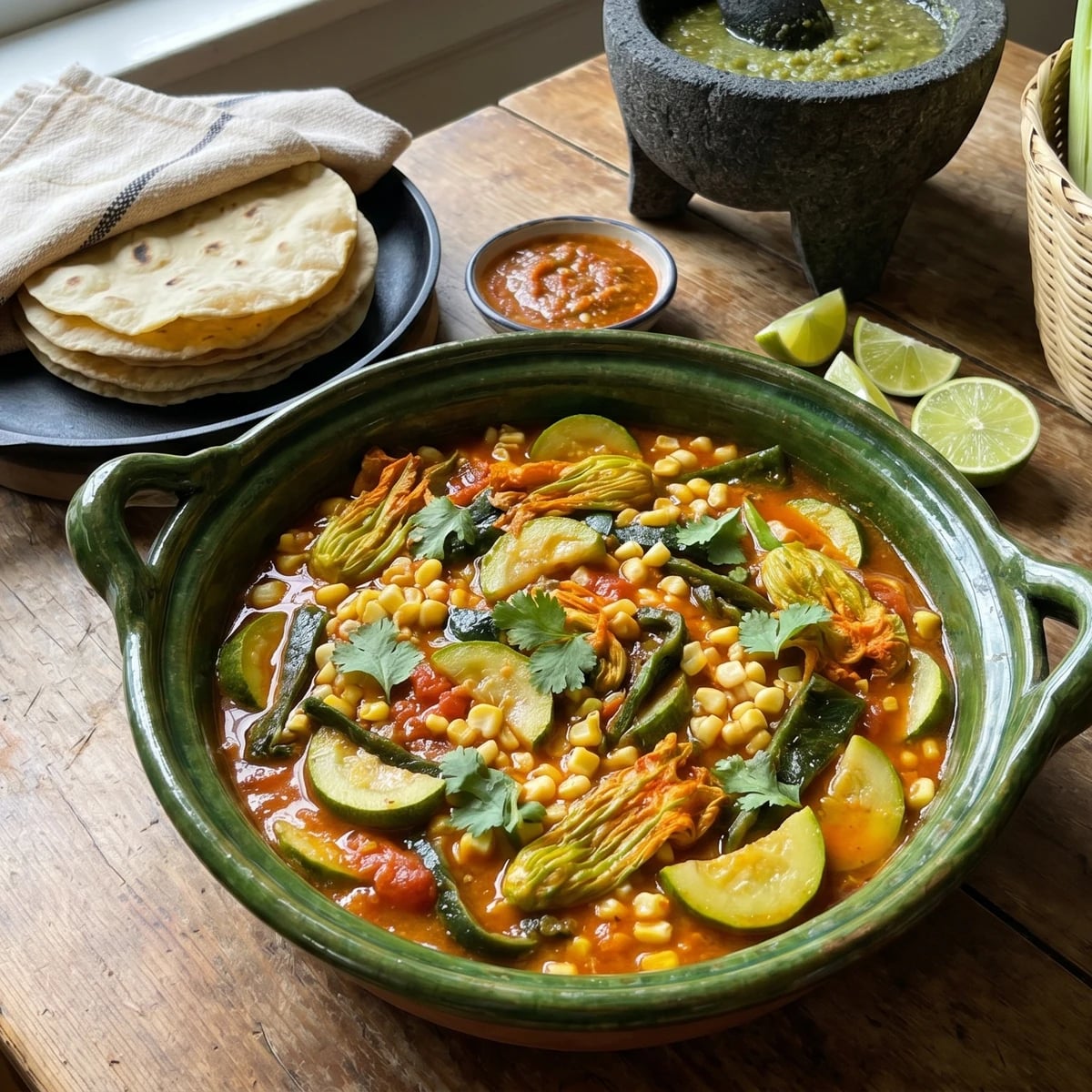
Michoacán's Purépecha milpa stew, built from tender calabacita, fresh corn, squash blossoms, chile poblano, chile serrano, and epazote, served with warm corn tortillas because the milpa feeds you completely.

Main Dishes
Mexican
Budget Friendly
Weeknight
25 min
Active Time
30 min cook55 min total
Yield4 to 6 servings

This comes from Michoacán, from the Purépecha kitchens around the Meseta Purépecha and the Lake Pátzcuaro region, where the milpa is not a decoration on a menu. It is the pantry. Corn, squash, chile, beans, quelites, blossoms. The field tells the cook what dinner is.

Calabaza guisada is a weeknight dish, but don't confuse humble with careless. The squash must stay tender, not collapse into baby food. The corn should still pop under your teeth. The chile poblano gives green depth, the chile serrano gives a clean bite, and epazote ties the pot back to the milpa. If you leave out the epazote, the stew still feeds you. It does not speak the same language.

I learned a version like this from a woman near Tzintzuntzan who cooked it in a green-glazed cazuela while tortillas puffed on the comal beside her. No cheese, no cream, no yellow cheddar nonsense. Just vegetables, chile, oil, salt, and tortillas. Mexican cuisine has fed people without meat for centuries. No me vengas con atajos. Saber cocinar es saber vivir.

The Purépecha people of Michoacán maintained one of Mesoamerica's major pre-Columbian states, centered around the Lake Pátzcuaro basin, and their foodways remained deeply tied to maize, squash, beans, chiles, and wild greens from the milpa. In 2010, UNESCO recognized Traditional Mexican Cuisine as Intangible Cultural Heritage using the Michoacán paradigm, with community cooks, milpa agriculture, nixtamalization, and market knowledge as central evidence. Calabaza guisada belongs to that daily cooking tradition: not ceremonial like corundas or uchepos, but just as important because it shows how a household eats well from the field.

The technique, the tradition, and the story behind every dish.

Discover Culinary Explorer

Ingredients

neutral vegetable oil or avocado oil

Quantity

2 tablespoons

white onion

Quantity

1 medium

finely chopped

garlic cloves

Quantity

3

finely chopped

fresh chile poblano

Quantity

2

roasted, peeled, seeded, and cut into strips

fresh chile serrano

Quantity

1

stemmed and finely chopped

ripe Roma tomatoes

Quantity

3 medium

finely chopped

Mexican calabacita or small zucchini

Quantity

1 1/2 pounds

cut into 3/4-inch half-moons

fresh corn kernels

Quantity

2 cups

cut from 3 to 4 ears

cooked flor de mayo beans or bayos

Quantity

1 cup

with 1/2 cup of their broth

kosher salt

Quantity

1 teaspoon, plus more to taste

fresh epazote

Quantity

1 large sprig

squash blossoms

Quantity

2 cups

stems and stamens removed, torn into wide strips

fresh cilantro

Quantity

1/2 cup

chopped

lime wedges (optional)

Quantity

for serving

hand-pressed corn tortillas (optional)

Quantity

for serving

warmed

salsa de chile peron or salsa verde (optional)

Quantity

for serving

Equipment Needed

  • 10- to 12-inch clay cazuela or heavy wide skillet
  • Cast iron comal for roasting chiles and warming tortillas
  • Sharp knife for cutting fresh corn from the cob
  • Wooden spoon

Instructions

  1. 1

    Roast the poblanos

    Place the chile poblanos directly on a hot comal or over a gas flame, turning until the skins blister and blacken in patches. Put them in a covered bowl for 10 minutes, then rub off the skins, remove the stems and seeds, and cut the flesh into strips. Do not rinse them under water. You worked for that roasted flavor, don't wash it down the drain.

    The poblano should smell green and roasted, not burned. If the flesh turns mushy, the heat was too low and you steamed it instead of blistering the skin.
  2. 2

    Start the sofrito

    Heat the oil in a wide clay cazuela or heavy skillet over medium heat. Add the white onion and cook for 5 minutes, stirring often, until it softens but does not brown. Add the garlic and chile serrano and cook for 1 minute more. The smell should be sharp and green, the smell of a Mexican kitchen waking up.

  3. 3

    Cook the tomato

    Add the chopped Roma tomatoes and cook for 6 to 8 minutes, stirring occasionally, until they collapse and the oil begins to show at the edges. This is the guiso base. If the tomato stays watery, the stew will taste thin. Let it cook down until it looks like it belongs to the pan.

  4. 4

    Add squash and corn

    Stir in the calabacita, fresh corn kernels, roasted poblano strips, salt, and epazote. Cover the cazuela and cook for 10 to 12 minutes, stirring once or twice, until the squash is just tender. Do not drown it in water. The squash and tomato release their own liquid. That small broth is the point.

  5. 5

    Fold in beans

    Add the cooked flor de mayo beans or bayos with 1/2 cup of their broth. Simmer uncovered for 5 minutes so the bean broth thickens the guiso and carries the epazote through the pot. Taste for salt now. Beans are quiet until you season them correctly.

  6. 6

    Finish with blossoms

    Lay the torn squash blossoms over the top and fold them in gently. Cook for 2 minutes, just until they wilt. Squash blossoms are delicate. If you cook them hard, they disappear and you have wasted good market money. Turn off the heat and stir in the cilantro.

  7. 7

    Serve with tortillas

    Spoon the stew into a warm green-glazed Michoacán cazuela or shallow clay bowls. Serve with lime wedges, salsa de chile peron or salsa verde, and hot corn tortillas from the comal. This is not a side dish pretending to be useful. With beans and tortillas, it is a complete meal. Así se hace y punto.

Chef Tips

  • Use Mexican calabacita if you can find it. Small zucchini is the compromise. Big watery zucchini from the supermarket will work, but salt it lightly and let it sit for 10 minutes, then pat it dry before cooking.
  • Squash blossoms are seasonal. If the market doesn't have them, don't buy sad plastic-box flowers. Make the stew with extra corn and a handful of quelites or tender spinach. Cook what the market is selling today.
  • Chile peron is used in Michoacán and gives a fruity heat that belongs to the region. If you cannot find it for the salsa, use chile serrano. A substitution is a compromise, not an upgrade.
  • This dish is vegan because the milpa already knows how to feed you. Do not add cream to make it richer. Do not bury it under cheese. Warm tortillas and good beans do the work.

Advance Preparation

  • The poblano chiles can be roasted, peeled, and cut into strips one day ahead. Keep them covered in the refrigerator.
  • Cook the flor de mayo beans or bayos up to three days ahead and save their broth. Canned beans are usable, but their broth is thin, so rinse them and add 1/2 cup water instead.
  • Do not add squash blossoms ahead of time. They go in at the end, right before serving, or they lose their texture.

Frequently Asked Questions

Nutrition Information

1 serving (about 355g)

Calories
285 calories
Total Fat
7 g
Saturated Fat
1 g
Trans Fat
0 g
Unsaturated Fat
6 g
Cholesterol
0 mg
Sodium
600 mg
Total Carbohydrates
50 g
Dietary Fiber
10 g
Sugars
10 g
Protein
10 g

Note: Chef personas and recipes are created with AI assistance. Cook with care: follow safe food-handling practices, check doneness with a thermometer when needed, and adapt for allergies and your kitchen.

Where cooking meets culture.

Culinary guides, cultural storytelling, and the editorial depth that makes cooking meaningful.

Discover Culinary Explorer

More from Occidente Main Dishes

Browse the full collection