Chef Lupita
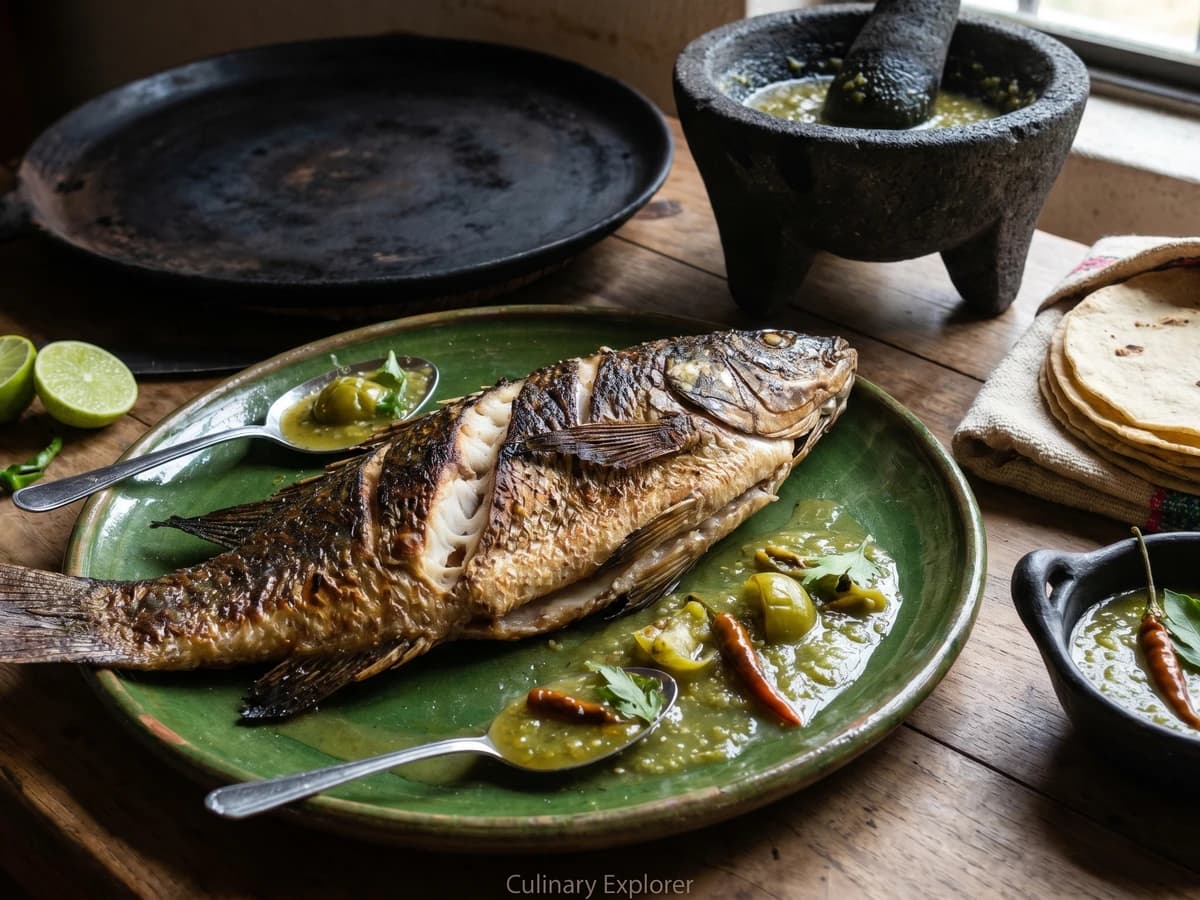
Acúmara Tatemada al Comal
Michoacán's Lake Pátzcuaro acúmara, a whole kurucha from the lago tatemada on a comal de leña and served with chile perón atápakua, corn tortillas, and P'urhépecha discipline.
A cooking platform built around craft, culture, and the stories behind what we eat.

Created by
Colima's coastal pescado en vara, small whole fish skewered upright beside a wood fire, brushed with chile guajillo, chile de arbol, garlic, lime, and eaten on the sand.
Colima, on the coast at Cuyutlan, is where this fish belongs. Not in a restaurant with white plates. On the beach, near the lagoon and the salt flats, where the fish is small, fresh, and cooked standing beside the fire on a stick.
The technique is the identity. The women in the ramadas along Cuyutlan learned to roast fish upright, close enough to the wood fire for the skin to blister and far enough away that the flesh stays moist. You don't throw this on a grill grate and call it the same dish. The vara matters. The angle matters. The patience matters.
The chile here is not trying to punish anybody. Guajillo gives color and fruit, chile de arbol gives a clean bite, garlic and lime wake the fish up, and Cuyutlan sea salt does what salt from that coast has done for generations. If you cannot get fresh lisa, use small pargo, mojarra, or sierra. But buy fish that smells like the tide, not like a refrigerator. Si no conoces el mercado, no conoces la cocina.
My mother didn't cook this in Colonia Roma. I learned it from a woman in Cuyutlan who kept turning the sticks with one hand while pressing tortillas with the other. She didn't measure the salt. She looked at the fish and knew. Saber cocinar es saber vivir.
Cuyutlan, in the municipality of Armeria, has been tied to salt production and lagoon fishing for centuries, and its coastal cooking reflects that practical economy: fresh fish, local salt, fire, and very little ceremony. The use of upright sticks beside a wood fire belongs to Pacific coastal cookery, where cooks could roast multiple small fish without needing metal grates or enclosed ovens. Modern mangroves in Mexico are protected ecosystems, so the old mangle vara should be understood as regional history, not permission to cut living mangrove today.
Quantity
6 fish, 10 to 12 ounces each
scaled, gutted, rinsed, and patted dry
Quantity
2 teaspoons
Quantity
3 tablespoons
Quantity
6
stemmed and seeded
Quantity
3
stemmed
Quantity
4
unpeeled
Quantity
1/2 teaspoon
Quantity
1/4 teaspoon
Quantity
1/3 cup
Quantity
2 tablespoons
Quantity
3 tablespoons
melted
Quantity
1 teaspoon, plus more to taste
Quantity
12
Quantity
6
Quantity
for serving
| Ingredient | Quantity |
|---|---|
| small whole fish such as lisa, pargo chico, mojarra, or sierrascaled, gutted, rinsed, and patted dry | 6 fish, 10 to 12 ounces each |
| coarse sea salt, preferably sal de Cuyutlan | 2 teaspoons |
| fresh lime juice | 3 tablespoons |
| dried chile guajillostemmed and seeded | 6 |
| dried chile de arbolstemmed | 3 |
| garlic clovesunpeeled | 4 |
| dried Mexican oregano | 1/2 teaspoon |
| ground cumin | 1/4 teaspoon |
| fresh orange juice | 1/3 cup |
| fresh lime juice for the adobo | 2 tablespoons |
| neutral oil or rendered pork lardmelted | 3 tablespoons |
| coarse sea salt | 1 teaspoon, plus more to taste |
| warm corn tortillas (optional) | 12 |
| lime halves (optional) | 6 |
| salsa de molcajete with roasted tomato and chile de arbol (optional) | for serving |
Pat the fish completely dry. Make three diagonal cuts on each side, down to the bone but not through it. Rub the fish inside and out with the 2 teaspoons sea salt and 3 tablespoons lime juice. Let them sit 20 minutes while you build the adobo. The cuts let the salt and chile reach the flesh, not just decorate the skin.
Heat a dry comal over medium. Toast the guajillo chiles about 20 to 30 seconds per side, just until they darken slightly and smell fruity. Toast the chile de arbol for only a few seconds. It is thin and burns fast. Burned chile makes bitter fish, and there is no fixing that later.
Put the toasted chiles in a bowl and cover with hot water for 15 minutes. On the same comal, roast the unpeeled garlic until the skins blacken in spots and the cloves soften, about 8 minutes. Peel the garlic. Drain the chiles. Hot water softens the chile flesh without cooking the skins hard. Boiling water is too rough.
Blend the softened guajillo, chile de arbol, roasted garlic, Mexican oregano, cumin, orange juice, 2 tablespoons lime juice, melted lard or oil, and 1 teaspoon sea salt until smooth. The paste should be loose enough to brush, but not watery. Taste it. It should be salty and bright because the fish will soften the seasoning as it roasts.
Thread each fish lengthwise onto a clean soaked hardwood stake or thick bamboo skewer, entering near the mouth and running along the backbone so the fish stands firm. Brush the adobo into the cuts, inside the belly, and across the skin. Do not drown the fish. You want a chile coating that clings, not a sauce that drips into the fire.
Prepare a wood fire and let it burn down until you have steady flames on one side and a bed of hot coals on the other. Push the fish stakes into firm sand, a fire-safe planter filled with sand, or a grill basket set upright, leaning the fish toward the heat but not directly over it. The fish should roast beside the fire, not lie on top of it.
Roast the fish 18 to 25 minutes, turning the stakes every few minutes and brushing lightly with more adobo during the first half of cooking. The skin should char in patches, the chile paste should darken to brick red, and the flesh near the backbone should turn opaque and pull away cleanly. If the skin blackens before the inside cooks, move the fish farther from the fire. Fire has to be managed. No me vengas con atajos.
Slide the fish from the stakes onto a large barro plate or serve them still on the vara if your table allows it. Put warm corn tortillas, lime halves, and salsa de molcajete beside the fish. Each person pulls meat from the bone and makes tacos at the table. This is beach food, but it is not careless food. Cada estado, su propia cocina.
1 serving (about 260g)
Culinary guides, cultural storytelling, and the editorial depth that makes cooking meaningful.
Discover Culinary ExplorerChef Lupita
Michoacán's Lake Pátzcuaro acúmara, a whole kurucha from the lago tatemada on a comal de leña and served with chile perón atápakua, corn tortillas, and P'urhépecha discipline.

Chef Lupita
Puebla's weekday adobo of pork shoulder braised in a thick guajillo and ancho sauce sharpened with vinegar, cumin, and clove. The deep red of a market spice stall, the dish a poblana cooks without thinking.

Chef Lupita
Loreto's pit-roasted clams, planted hinge-up in beach sand and tatemadas under a fast fire of dried romerillo brush, the resinous Baja desert shrub that gives this dish its smoke.

Chef Lupita
Oaxaca's eighth mole, the silky, almond-and-cinnamon almendrado, served over poached chicken. Mild, sweet, restrained, and a quiet rebuttal to anyone who thinks Mexican food has to be hot to be Mexican.