Culinary Explorer

A cooking platform built around craft, culture, and the stories behind what we eat.
Discover Culinary Explorer
Ponteduro Sonorense

Ponteduro Sonorense

Created by

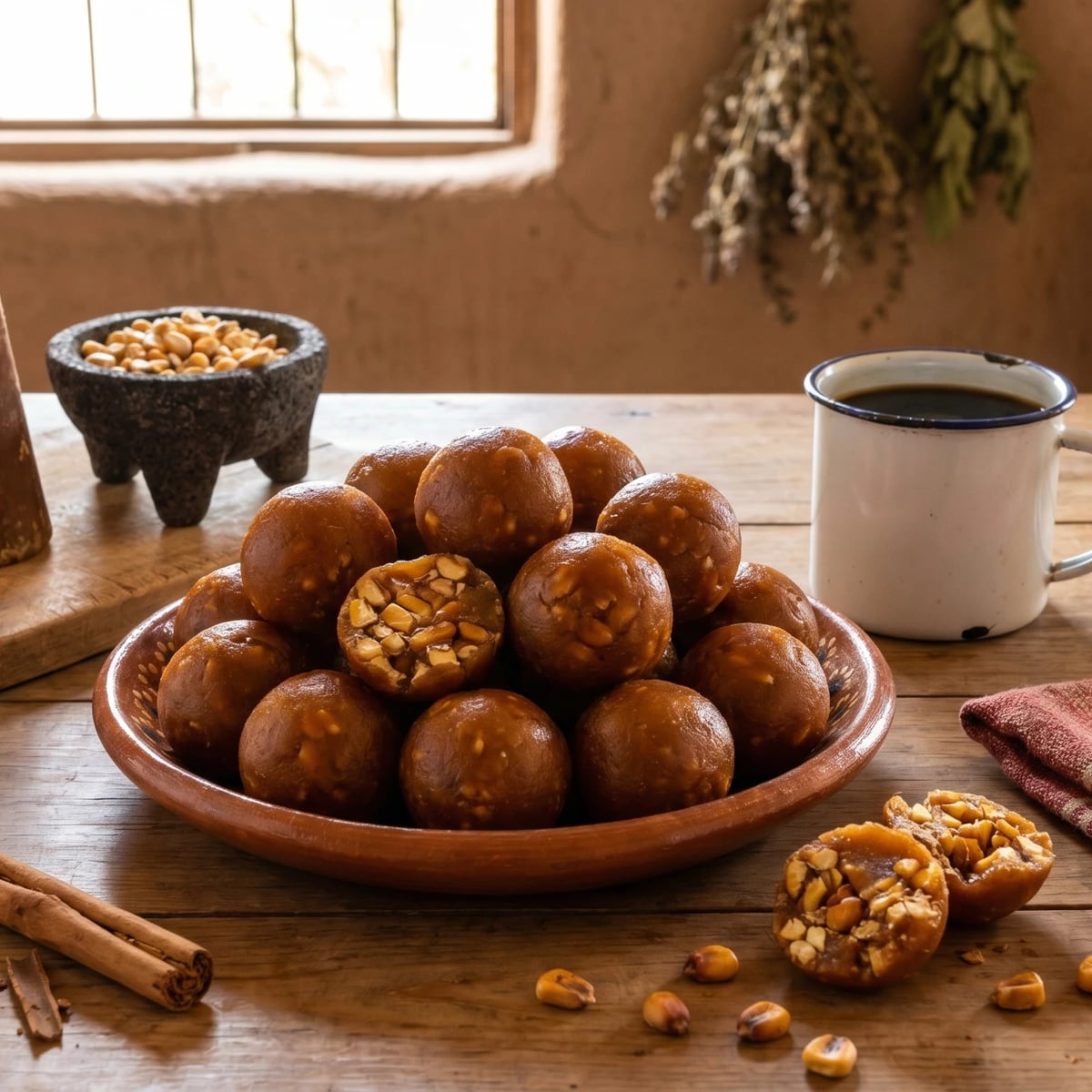
Sonora's old-country corn candy, cracked maize toasted on a comal and bound with hot piloncillo syrup into hard balls you bite alongside black coffee.

Desserts
Mexican
Make Ahead
Comfort Food
Budget Friendly
20 min
Active Time
45 min cook1 hr 5 min total
YieldAbout 18 to 20 balls

This is from Sonora. From the cattle ranches and small-town kitchens of the northern desert, where wheat replaced corn at the table but corn never left the candy jar. Ponteduro is the Sonoran answer to what you make when you have a handful of dried maiz, a cone of piloncillo, and a comal that has been on the fire since before sunrise.

The corn has to be cracked, not ground. Sonoran cooks pounded it in a molcajete or wrapped the kernels in a cloth and worked them with a stone. You want pieces with edges and uneven shapes so the syrup grabs hold and the finished ball has texture under the tooth. Toast the cracked corn on a dry comal until it smells like pinole, that nutty sweetness that comes from the corn sugars caramelizing in the dry heat. This is the same toasting the ranch cooks did over mesquite. The smell tells you when it is right.

The syrup is piloncillo, water, and canela. Nothing else needs to be there. Piloncillo carries a mineral depth that white sugar cannot fake, and the canela, the soft true cinnamon from Mexican groceries, not the harsh cassia bark from the supermarket spice aisle, ties the whole candy to the Sonoran sweet tradition. The mixture has to cook to the hard ball stage or the candy will stay sticky and sad. No me vengas con atajos.

My mother did not make ponteduro. She was from Jalisco and her sweets were ate, jericalla, dulce de leche cooked in a clay pot. The first time I tasted ponteduro was at a small market in Magdalena de Kino, sold three for a peso by a woman who had been making them every Saturday for forty-two years. She told me her recipe in five sentences and watched me write it down. That is how this knowledge travels. Saber cocinar es saber vivir.

Ponteduro is one of several traditional cracked-corn candies that survive in northern Mexico, with close cousins in Sinaloa and Chihuahua, all descended from the broader pre-Columbian tradition of pinole, the toasted ground maize that Mesoamerican peoples carried as portable nourishment for long journeys. The name 'ponteduro' translates roughly as 'turn hard' or 'make it hard,' a direct reference to the hard-ball candy stage that defines the texture. Sonora's version is distinct for its use of cracked rather than ground corn, a choice tied to the state's ranching economy and the practical reality of preparing food without fine mills, and it remains a fixture at rural fiestas, posadas, and dia de muertos altars in towns across the Sierra Madre Occidental.

The technique, the tradition, and the story behind every dish.

Discover Culinary Explorer

Ingredients

dried white corn kernels (maiz blanco)

Quantity

2 cups

cracked coarsely in a molcajete or pulsed in a blender

piloncillo

Quantity

1 pound (about 2 cones)

chopped

water

Quantity

1 cup

Mexican canela (true cinnamon)

Quantity

1 stick, about 3 inches

kosher salt

Quantity

1/4 teaspoon

manteca de cerdo (pork lard)

Quantity

1 tablespoon

ground anise seed (optional)

Quantity

1/2 teaspoon

Sonoran ranch style

Equipment Needed

  • Cast iron comal or heavy skillet for toasting the corn
  • Heavy 2-quart saucepan for the piloncillo syrup
  • Candy thermometer (or a glass of cold water for the hard ball test)
  • Wooden spoon
  • Molcajete or dry blender for cracking the corn
  • Parchment paper or a lightly greased baking sheet

Instructions

  1. 1

    Crack the corn

    If you cannot find pre-cracked maiz, work the dried kernels in a heavy molcajete or pulse them in a dry blender until they break into coarse pieces, somewhere between a grain of rice and a peppercorn. You want texture, not flour. Ponteduro is a candy you bite, not one that dissolves on the tongue. The unevenness of hand-cracked corn is the signature.

    Do not use cornmeal or polenta. They are ground too fine and the candy will not bind into hard balls the way cracked kernels do.
  2. 2

    Toast the corn on a comal

    Heat a dry cast iron comal or heavy skillet over medium heat. Add the cracked corn in a single layer. Toast for 12 to 15 minutes, stirring constantly with a wooden spoon. The corn will pop softly, turn the color of toffee, and smell sweet and nutty, like a country kitchen where someone has been making pinole all morning. This is the same toasting the Sonoran ranch cooks did over mesquite fires for generations. Skip it and you have raw corn glued to sugar.

  3. 3

    Pull the corn off the heat

    When the kernels are evenly amber-brown and the aroma fills the kitchen, scrape the toasted corn into a wide bowl and let it cool. Wipe the comal clean. Do not leave the corn on the heat past the point of color. Burned corn will turn the whole batch bitter and there is no recovering from it later.

  4. 4

    Build the piloncillo syrup

    Combine the chopped piloncillo, water, canela stick, and salt in a heavy saucepan. Bring to a simmer over medium heat, stirring until the piloncillo dissolves completely. This takes about 8 minutes. The piloncillo is unrefined cane sugar with a deep mineral flavor that white sugar cannot replicate. No me vengas con atajos. Brown sugar is not piloncillo.

  5. 5

    Cook the syrup to the hard ball stage

    Once the piloncillo has dissolved, stop stirring. Let the syrup boil steadily for 15 to 20 minutes, until it reaches 250F (121C) on a candy thermometer. If you do not have a thermometer, drop a small spoonful into a glass of cold water. It should form a firm ball you can pinch between your fingers without it falling apart. This is the temperature the candy needs to set hard once it cools. Pull it short and the balls stay sticky. Push it past and they crack like glass.

    Watch the pot. From 230F to 250F happens fast, sometimes inside two minutes. Do not walk away.
  6. 6

    Combine corn and syrup

    Remove the canela stick. Stir the tablespoon of lard into the hot syrup until it melts in. La manteca es el sabor and here it also keeps the candy from sticking to your hands when you shape it. Pour the syrup over the toasted corn in the bowl and stir hard with a wooden spoon. Add the anise if you are using it. Every kernel needs to be coated. Work fast. The syrup begins to set the moment it hits the cooler corn.

  7. 7

    Shape the balls by hand

    Rub a little lard or a few drops of neutral oil on your palms. While the mixture is still warm enough to handle but cool enough not to burn you, scoop a generous tablespoon and press it firmly between both hands into a ball about the size of a walnut. Squeeze hard. Loose balls fall apart. Set each one on a sheet of parchment as you go. You will have about 18 to 20 balls.

    If the mixture cools too much to shape, set the bowl over a low flame for 30 seconds to loosen it. Do not add more water. Water at this stage turns the candy soft.
  8. 8

    Cure and store

    Leave the ponteduro on the parchment, uncovered, for at least two hours. They will harden into the dense, biteable candy Sonora knows. Once fully set, store in a tin or glass jar with a tight lid. They keep for two to three weeks at room temperature, longer in dry climates. Serve with a cup of strong black coffee, the way they do it on the ranches outside Hermosillo. Asi se hace y punto.

Chef Tips

  • The piloncillo is the flavor. Find the real cones at a Mexican grocery, the dark brown ones that smell like molasses and earth. Brown sugar with corn syrup mixed in is not piloncillo and the candy will taste flat. A substitution is a compromise, not an upgrade.
  • Mexican canela, also called Ceylon cinnamon or true cinnamon, is soft and crumbles between your fingers. Cassia, the hard reddish bark sold as 'cinnamon' in most American supermarkets, is too aggressive for this candy. The Mexican groceries carry the right kind in plastic bags for almost nothing.
  • If your first batch comes out sticky, the syrup did not reach hard ball. Cook the next batch to a true 250F. If your first batch cracks like peanut brittle, you went past hard ball. Pull it at 250F exactly. Candy is chemistry, not opinion.
  • Serve with cafe de olla, black coffee brewed in a clay pot with piloncillo and canela, the way they take it on Sonoran ranches at six in the morning. The bitter coffee and the sweet candy are made for each other.

Advance Preparation

  • The corn can be cracked and toasted up to a week in advance. Store in a sealed jar at room temperature.
  • Finished ponteduro keeps for two to three weeks in a tight tin or glass jar at room temperature, longer in dry climates. They do not need refrigeration and the texture stays better if you keep them out of humidity.
  • These travel well, which is part of why Sonoran ranch families have made them for generations. Wrap individually in wax paper for lunches, road trips, or to send with someone who is going far from home.

Frequently Asked Questions

Nutrition Information

1 serving (about 40g)

Calories
160 calories
Total Fat
1 g
Saturated Fat
0 g
Trans Fat
0 g
Unsaturated Fat
1 g
Cholesterol
0 mg
Sodium
20 mg
Total Carbohydrates
36 g
Dietary Fiber
1 g
Sugars
23 g
Protein
2 g

Note: Chef personas and recipes are created with AI assistance. Cook with care: follow safe food-handling practices, check doneness with a thermometer when needed, and adapt for allergies and your kitchen.

Where cooking meets culture.

Culinary guides, cultural storytelling, and the editorial depth that makes cooking meaningful.

Discover Culinary Explorer

More from Noroeste Desserts

Browse the full collection