
Chef Lupita
Acitrón de Cidra Conventual
Puebla's convent-style acitrón, made from cidra peel instead of endangered biznaga, built through repeated syrup soakings until the cubes turn firm, translucent, and ready for rosca or chiles en nogada.
A cooking platform built around craft, culture, and the stories behind what we eat.
Created by
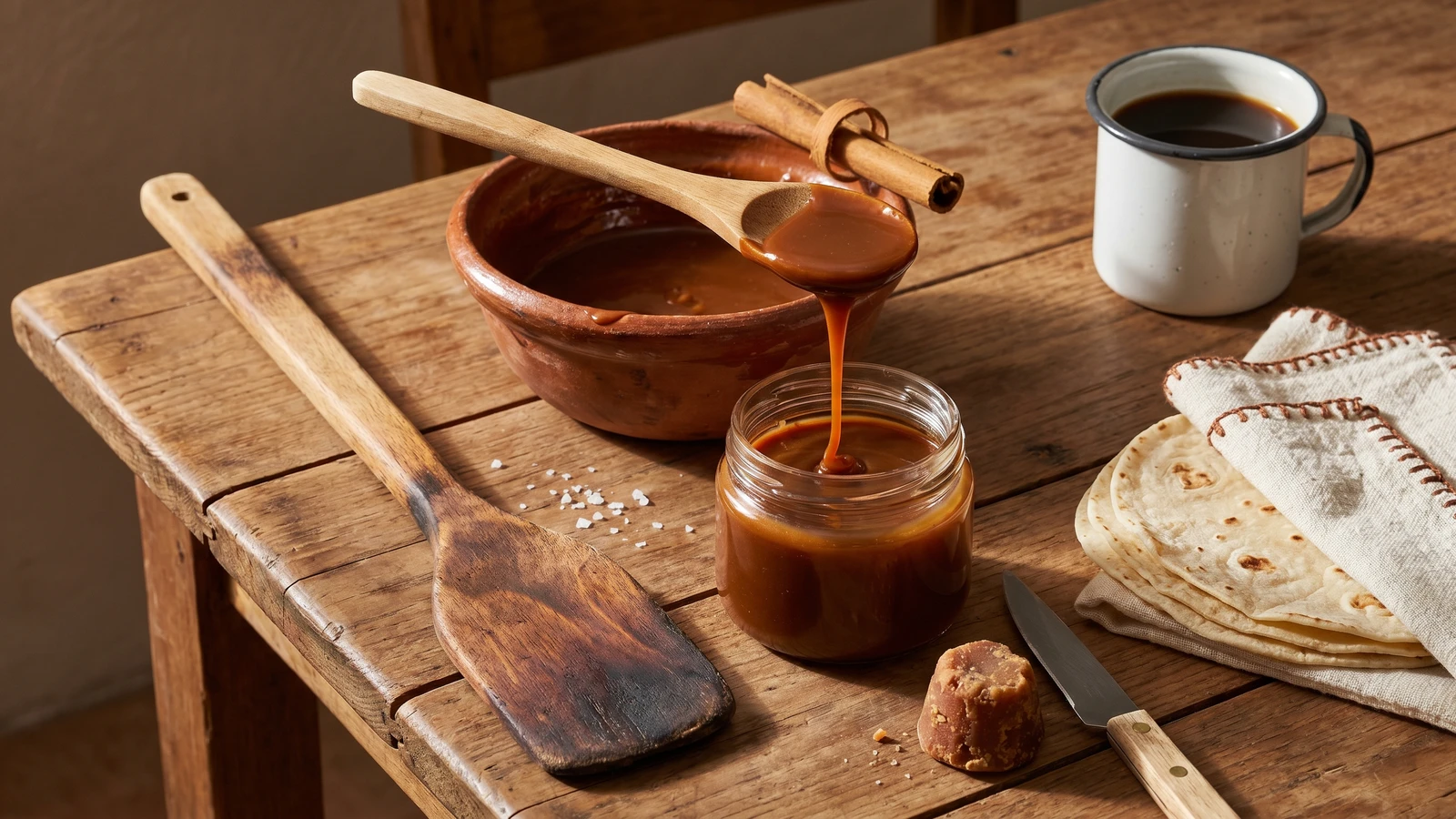
Sonora's slow-cooked goat-milk caramel, simmered for three hours with piloncillo and canela until it turns the color of dark tobacco and pulls a clean trail behind the wooden spoon.
Cajeta is from the north. Most cookbooks tell you it is from Celaya in Guanajuato, and Celaya does make a famous version, but the ranches of Sonora and the high pastures of Coahuila and Chihuahua have been cooking goat's milk down into caramel for as long as there have been goats in the north, which is to say since the Jesuits brought them in the seventeenth century. This is a northern dish. The goats came to the desert because cattle could not survive there, and the women on the ranches learned to use what the goats gave them.
Leche quemada means burnt milk, but it is not burnt. It is caramelized to the edge of burning, held there for hours by a cook who knows the difference. The piloncillo gives the molasses depth. The canela Mexicana, the soft, true cinnamon, not the hard cassia bark, gives the perfume. The pinch of baking soda is the technical trick: it neutralizes the goat milk's acidity so the proteins brown into mahogany instead of curdling into sour ruin. Skip the baking soda and you waste three hours and two quarts of good milk.
My mother did not make cajeta. She was from Jalisco and Jalisco has its own dulces. I learned this recipe from a woman named Dona Cuca in a small ranch outside Ures, Sonora, who set me on a stool next to her wood stove and made me stir for two hours while she told me about her husband, her grandchildren, and the price of alfalfa. Recetas probadas y garantizadas, she said when I tasted the first spoonful off the wooden paddle. She was right. Some recipes are not written down. They are stood next to.
Cajeta takes its name from the small wooden boxes (cajetas) in which the caramel was traditionally sold in 19th-century Mexico, and the goat's milk version dates to the colonial period when Jesuit missionaries introduced Iberian dairy goats to the arid north and the Bajio in the 17th and 18th centuries. While Celaya, Guanajuato, holds the protected denomination of origin granted in 2010 for its cajeta production, traditional goat-milk caramels are made across the northern states of Sonora, Coahuila, Chihuahua, and Nuevo Leon, where goat herding remained more economically viable than cattle ranching in the semi-arid terrain. The leche quemada style, distinguished by its deeper, near-burnt caramelization, is associated with the northern ranches and is darker and less sweet than the lighter envinada and vainilla versions sold in central Mexico's mercados.
Quantity
2 quarts (8 cups)
whole and unhomogenized if you can find it
Quantity
1 cup
chopped, or packed dark brown sugar if you cannot find piloncillo
Quantity
1/2 cup
Quantity
1 stick
Quantity
1/2 teaspoon
Quantity
2 tablespoons
Quantity
1 tablespoon
traditional in northern Sonora
Quantity
a pinch
| Ingredient | Quantity |
|---|---|
| fresh goat's milkwhole and unhomogenized if you can find it | 2 quarts (8 cups) |
| piloncillochopped, or packed dark brown sugar if you cannot find piloncillo | 1 cup |
| granulated sugar | 1/2 cup |
| canela Mexicana (true cinnamon, soft bark) | 1 stick |
| baking soda | 1/2 teaspoon |
| cold water | 2 tablespoons |
| mezcal or Bacanora (optional)traditional in northern Sonora | 1 tablespoon |
| fine sea salt | a pinch |
Pour the goat's milk into a wide, heavy-bottomed pot. Wide, not tall. You want surface area for the milk to reduce. A 6-quart Dutch oven or a copper cazo is right. A tall narrow pot will keep you stirring for five hours instead of three and the caramel will still come out pale. The Sonoran ranch women who taught me this used wide tin-lined copper because the heat travels evenly and the milk does not scorch on the bottom. La cocina no es decoracion, es trabajo.
Set the pot over medium heat. Add the piloncillo, granulated sugar, and the canela stick. Stir with a long-handled wooden spoon until the piloncillo dissolves completely. Piloncillo is unrefined cane sugar pressed into a cone, and it carries a molasses depth that white sugar alone cannot give you. This is what makes cajeta taste like cajeta and not like dulce de leche. If you cannot find piloncillo, dark brown sugar is a compromise. Not an upgrade.
In a small cup, stir the baking soda into the 2 tablespoons of cold water until it dissolves. When the milk is just starting to steam at the edges, pour the baking soda solution in slowly while stirring. The milk will foam up dramatically. Keep stirring until the foam settles. The baking soda neutralizes some of the acidity in the goat's milk, which keeps it from curdling over the long cook and helps it brown into that deep mahogany color. Skip this step and your cajeta will break, separate, and taste sour. No me vengas con atajos.
Adjust the heat so the milk simmers steadily but does not boil hard. Lazy bubbles across the surface, not a rolling boil. A hard boil will scald the milk solids on the bottom and turn the whole pot bitter. The cajeta needs heat that is patient. Stir every five minutes for the first hour, scraping the bottom and the corners of the pot each time. The milk will be thin and pale and you will wonder if anything is happening. Trust the time.
After the first hour, the milk will begin to take on a faint cream color and the volume will have dropped noticeably. Now you stir more often, every two or three minutes. The Sonoran women I learned from set a low stool next to the stove and stayed there with their wooden paddles, talking, drinking cafe de olla, telling stories. This is a dish that asks you to sit with it. Around the second hour the color will deepen from cream to pale gold and the pot will start to smell like browned milk and brown sugar. That is the lactose caramelizing. Saber cocinar es saber vivir.
In the third hour, the cajeta will darken quickly. Pale gold becomes amber. Amber becomes the deep tobacco-brown that gives leche quemada its name, burnt milk, though it is not burnt, it is caramelized to the edge. From this point you do not leave the stove. Stir constantly. The bubbles will get thick and slow and shiny, like lava. Drag the spoon across the bottom of the pot and you will see the bottom for a full second before the cajeta closes back over the trail. That is your sign.
Pull the pot off the heat. Fish out the canela stick. Stir in the pinch of sea salt and, if you are using it, the spoonful of mezcal or Bacanora. The alcohol cooks off almost immediately against the residual heat and leaves behind a faint smokiness that anchors the cajeta to the Sonoran high desert where the agaves grow. Let the cajeta cool in the pot for fifteen minutes, then ladle it into clean glass jars. It will thicken further as it cools. Cada estado, su propia cocina, and this one is Sonora's. Asi se hace y punto.
1 serving (about 40g)
Culinary guides, cultural storytelling, and the editorial depth that makes cooking meaningful.
Discover Culinary ExplorerChef Lupita
Puebla's convent-style acitrón, made from cidra peel instead of endangered biznaga, built through repeated syrup soakings until the cubes turn firm, translucent, and ready for rosca or chiles en nogada.

Chef Lupita
Ciudad de México's Tulyehualco alegría is popped huautli folded into piloncillo honey, pressed with peanuts, pepitas, and raisins, then cut into the rectangular bars that built a pueblo's identity.

Chef Lupita
Oaxaca's pre-Columbian amaranth bar, popped on a hot comal and bound with piloncillo, honey, and the sacred Zapotec grain that the Spanish tried, and failed, to outlaw.

Chef Lupita
Querétaro's mercado candy of popped amaranto pressed with dark piloncillo syrup, pepitas, pecans, and cacahuate, a Bajío sweet that respects the seed before it decorates the table.