
Chef Lupita
Arroz con Leche Norteño
Northern Mexico's rice pudding, slow-simmered with piloncillo and canela then crowned with butter-toasted Sonoran pecans. Richer than the central version and built for ranch tables and long cold mornings.
A cooking platform built around craft, culture, and the stories behind what we eat.
Created by
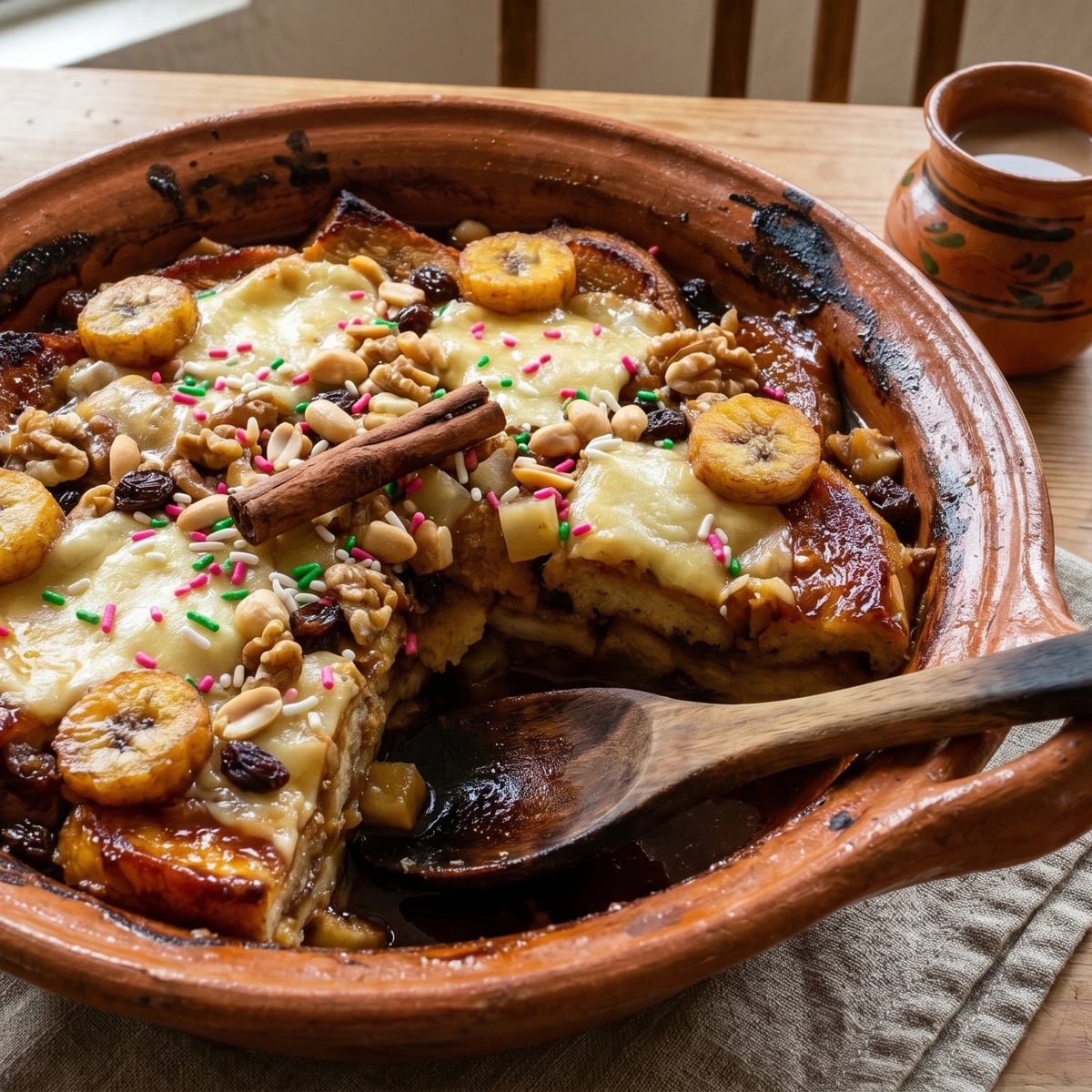
Sonora's Lenten capirotada, layers of lard-toasted bolillo soaked in dark piloncillo syrup with biznaga, fried platano macho, peanuts, walnuts, raisins, and grated queso cocido, baked in a clay cazuela until the bread drinks every drop.
Capirotada belongs to Lent and Lent belongs to capirotada. In Sonora, in the northwest, every Catholic household makes some version of this during Cuaresma, and every family argues that their version is the right one. I am giving you the Sonorense version, the one with bolillo toasted in lard, biznaga from the dryland cactus harvest, fried platano macho, peanuts and walnuts, raisins, prunes, and grated queso melted between the layers. Each ingredient carries meaning. The bread is the body of Christ. The syrup is his blood. The cinnamon sticks are the cross. The cheese is the shroud. The cloves are the nails. People who think Mexican food is taquitos and guacamole do not know that we have been writing theology into our cooking for four hundred years.
The technique is straightforward and the result is unforgiving if you cut corners. The bread has to be stale. Not yesterday-fresh, actually stale, dry enough to knock against the counter. Fresh bread collapses in the syrup and you get a pot of wet bread instead of a pudding with structure. The lard is not optional. La manteca es el sabor and in this dish it is also the difference between a Sonorense capirotada and a sad anglicized bread pudding. The piloncillo is not brown sugar. Brown sugar has no mineral depth, no cane smoke, no body. If your tienda does not carry piloncillo, find one that does before you start.
My mother made capirotada every Viernes Santo. She was from Jalisco and her version had a little less cheese and a little more fruit, but she always wrote in the margin of her notebook: 'In the north they use more queso. They are right.' She had been to Hermosillo once in the 1970s and she came back with that opinion and never changed it. The Sonorense capirotada is the one I make now. The cheese on top, melted into the syrup, is the line between a sweet that satisfies and a sweet that lingers. Cada estado, su propia cocina, and this one is the north's.
Capirotada arrived in New Spain with the Spanish in the 16th century, descended from medieval Iberian dishes of bread soaked in honey, cheese, and nuts that were themselves adaptations of older Roman recipes. The dish became closely tied to Lent because its ingredients, bread, sugar, cheese, dried fruit, and nuts, were permitted during the Catholic season of meat abstinence, and convents across colonial Mexico standardized the symbolic reading of the recipe: bread as the body of Christ, piloncillo syrup as his blood, canela as the wood of the cross, cloves as the nails. The Sonorense version distinguished itself by relying on biznaga (acitron, a candied cactus from the Sonoran desert) and by leaning heavily on lard-toasted bolillo and aged regional cheese, reflecting the cattle-ranching and wheat-farming economy of northwestern Mexico rather than the corn-centered traditions of the south.
Quantity
8
sliced 3/4-inch thick
Quantity
1/2 cup, plus more for the cazuela
Quantity
1 1/2 pounds (about 3 large cones)
chopped
Quantity
8 cups
Quantity
2
Quantity
4
Quantity
1
Quantity
from 1 orange
in wide strips
Quantity
1 cup
diced
Quantity
2
peeled and sliced into 1/2-inch rounds
Quantity
1 cup
Quantity
1 cup
Quantity
1 cup
Quantity
1/2 cup
halved
Quantity
8 ounces
coarsely grated
Quantity
1/4 cup
| Ingredient | Quantity |
|---|---|
| day-old bolillossliced 3/4-inch thick | 8 |
| melted manteca de cerdo | 1/2 cup, plus more for the cazuela |
| piloncillochopped | 1 1/2 pounds (about 3 large cones) |
| water | 8 cups |
| Mexican canela (true cinnamon) sticks | 2 |
| whole cloves | 4 |
| star anise | 1 |
| orange peelin wide strips | from 1 orange |
| biznaga (acitron) candied cactusdiced | 1 cup |
| ripe platanos machospeeled and sliced into 1/2-inch rounds | 2 |
| raw Spanish peanuts, skin on | 1 cup |
| walnut halves (nuez de Castilla) | 1 cup |
| raisins | 1 cup |
| pitted pruneshalved | 1/2 cup |
| queso cocido or queso Chihuahuacoarsely grated | 8 ounces |
| colored sugar sprinkles (grageas) (optional) | 1/4 cup |
If the bolillos are not yet stale, lay the slices on a sheet pan and leave them uncovered overnight. Capirotada is not made with fresh bread. The whole technique depends on the bread being dry enough to drink the syrup without falling apart. Soft bread turns to mush. Dry bread holds its shape and pulls the piloncillo into every pore. No me vengas con atajos.
Heat a wide heavy skillet over medium. Brush both sides of each bolillo slice with melted manteca de cerdo and toast on the skillet until deep golden, about two minutes per side. Lard is what makes Sonorense capirotada taste like Sonora and not like a generic bread pudding. La manteca es el sabor. Butter is wrong here. Vegetable oil is wrong here. If you have no manteca, render some from pork fat before you start the recipe.
In a heavy saucepan, combine the chopped piloncillo, water, canela sticks, cloves, star anise, and orange peel. Bring to a boil over high heat, then lower to a steady simmer. Cook uncovered for 25 to 30 minutes, until the syrup reduces by about a third and coats the back of a spoon. It should be the color of dark amber and taste of cane and spice, not water. Piloncillo is non-negotiable. Brown sugar will give you a pudding that tastes flat and one-note. The mineral edge of piloncillo is the whole point.
While the syrup reduces, heat a tablespoon of manteca in a small skillet over medium. Lay the platano macho rounds in a single layer and fry until the cut surfaces turn deep gold and caramelize at the edges, about three minutes per side. The platano needs to be ripe, the skin almost black. A green platano is starchy and will taste like a vegetable in the finished dish. Set the slices aside on a plate. Toast the peanuts in the same skillet for a minute until fragrant.
Pour the finished syrup through a fine-mesh strainer into a heatproof bowl. Discard the spent canela, cloves, anise, and orange peel. They have given everything they had. You should have a clean, glossy syrup the color of dark amber.
Heat the oven to 350F. Grease a 12-inch clay cazuela or a deep ceramic baking dish with manteca. Lay a layer of toasted bolillo across the bottom, edges overlapping. Scatter a third of the biznaga, raisins, prunes, peanuts, walnuts, and fried platano macho across the bread. Sprinkle a generous handful of grated queso over the top. Ladle a third of the warm syrup evenly across the layer, soaking every piece of bread. Repeat for two more layers. The last layer should end with cheese, nuts, and the final pour of syrup. Press down gently with the back of a spoon so the bread drinks the syrup.
Cover the cazuela with foil and bake for 25 minutes. The syrup will work its way through every layer and the cheese will melt into the bread. Remove the foil and bake for 10 to 15 minutes more, until the top is glossy and the edges of the bread turn dark caramel. The cheese on top should be soft and barely golden. Pull the cazuela from the oven and let it rest for 15 minutes before serving. Capirotada straight from the oven is too hot to taste properly. The pause lets the flavors settle.
Scatter the colored grageas across the top if you are serving for Lent or for a family table. In Sonora, the sprinkles are not decoration, they are how grandmothers signal that this is a special-occasion dish. Spoon the capirotada into deep bowls, making sure each portion carries bread, cheese, nuts, and platano. Eat warm. Recetas probadas y garantizadas.
1 serving (about 290g)
Culinary guides, cultural storytelling, and the editorial depth that makes cooking meaningful.
Discover Culinary Explorer
Chef Lupita
Northern Mexico's rice pudding, slow-simmered with piloncillo and canela then crowned with butter-toasted Sonoran pecans. Richer than the central version and built for ranch tables and long cold mornings.

Chef Lupita
Sonora's slow-cooked goat-milk caramel, simmered for three hours with piloncillo and canela until it turns the color of dark tobacco and pulls a clean trail behind the wooden spoon.

Chef Lupita
Sonora's piloncillo cocadas, shredded coconut cooked down with cane sugar syrup, canela, and a splash of condensed milk until the spoon stands, then set in craggy mounds with toasted edges and a chewy center.

Chef Lupita
Sonora's storied candied barrel-cactus, slowly cured in cal and cooked in a syrup of cane sugar and piloncillo until the flesh turns translucent. The acitrón that flecks rosca de reyes and chiles en nogada, now disappearing from the desert.