Culinary Explorer

A cooking platform built around craft, culture, and the stories behind what we eat.
Discover Culinary Explorer
Patsas Thessalonikis (Πατσάς Θεσσαλονίκης)

Patsas Thessalonikis (Πατσάς Θεσσαλονίκης)

Created by

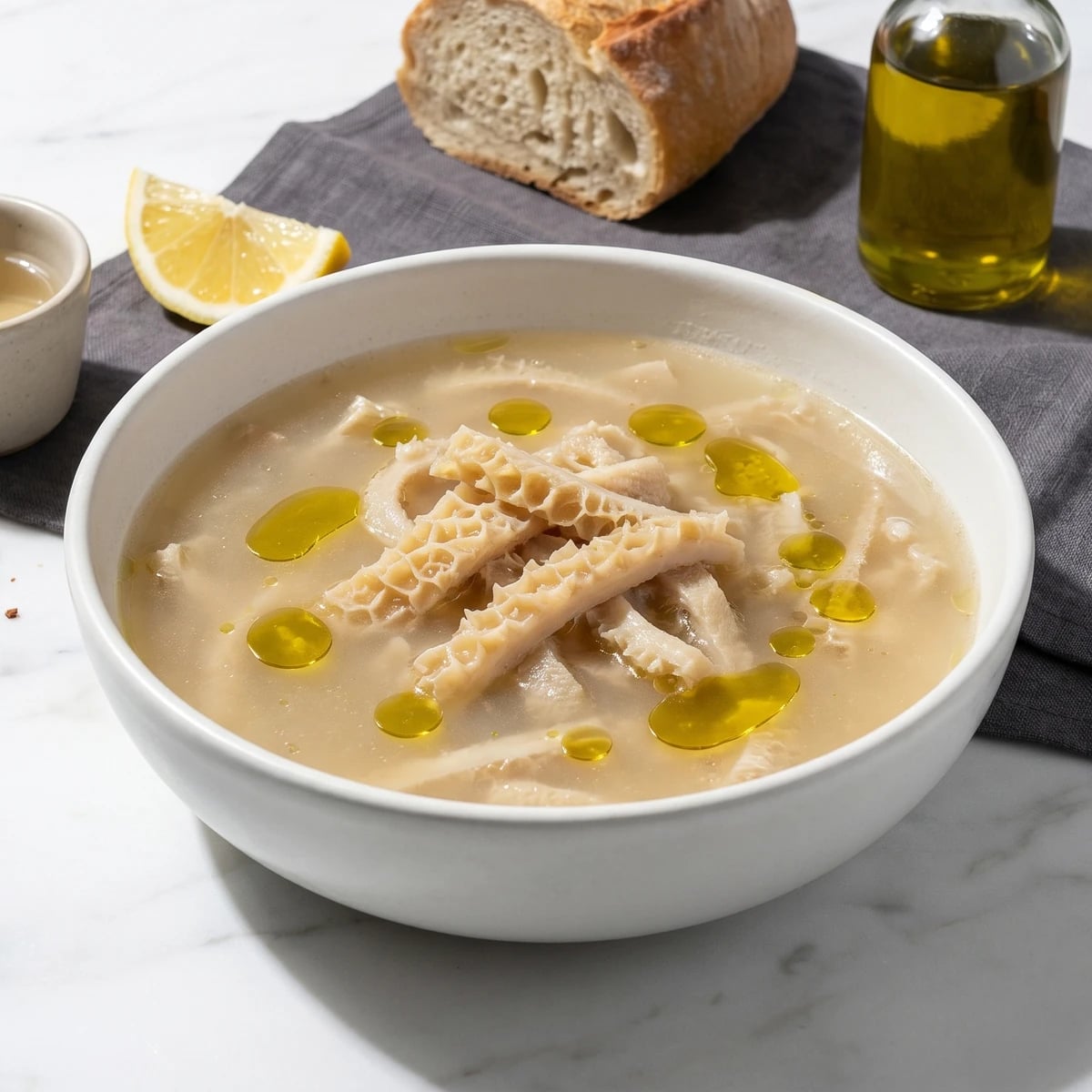
Thessaloniki patsas is tripe, foot, and a clear winter broth, sharpened at the table with garlic vinegar, lemon, and bukovo.

Soups & Stews
Greek
Comfort Food
One Pot
Budget Friendly
25 min
Active Time
4 hr 30 min cook4 hr 55 min total
Yield6 servings

Patsas Thessalonikis is the tripe soup of northern Greece: pale broth, soft strips of honeycomb tripe, the body of beef foot, and garlic crushed into vinegar at the table. It belongs to the late-night patsatzidika of Thessaloniki as much as to the cold kitchen in the morning, when the pot goes on before the day takes hold.

The whole dish is decided by the simmer. Blanch the tripe first, throw that water away, then cook the clean pieces slowly with the foot until the broth turns clear and gently gelatinous. Hard boiling muddies it. Patience gives you the bowl people call restorative, especially with skordostoubi, the sharp garlic vinegar that cuts through the richness.

Use good cleaned tripe from a butcher you trust. Λίγα και καλά, a few things, and good ones. I don't invent patsas. I find it, I test it, I write it down, because even the humble bowls deserve a record.

Patsas comes through the old Ottoman and Balkan soup-shop tradition, and in Greece its strongest urban home is Thessaloniki, where patsa shops fed market workers, night workers, and people coming out after music and drink. The Greek bowl is usually finished with skordostoubi, garlic crushed into vinegar, and often bukovo in Macedonia, a local taste that separates it from smoother tripe soups elsewhere. Its reputation as a morning-after cure is not a new joke, it belongs to the working city that kept soup ready before dawn.

The technique, the tradition, and the story behind every dish.

Discover Culinary Explorer

Ingredients

cleaned beef tripe, preferably honeycomb

Quantity

1.2kg

rinsed well

beef foot or veal feet

Quantity

1 beef foot or 2 veal feet

split by the butcher

white vinegar

Quantity

2 tablespoons

for blanching water

large onion

Quantity

1

peeled and halved

bay leaves

Quantity

2

black peppercorns

Quantity

8

fine sea salt

Quantity

2 teaspoons

plus more to finish

cold water

Quantity

2.5 litres

plus more for blanching

garlic cloves

Quantity

5

red wine vinegar

Quantity

90ml

lemon

Quantity

1

cut into wedges

bukovo (Greek crushed red pepper) (optional)

Quantity

1 teaspoon

Equipment Needed

  • heavy stockpot, 6 to 7 litres
  • fine skimmer
  • mortar and pestle for the garlic vinegar

Instructions

  1. 1

    Blanch the tripe

    Put the tripe and split foot in a large pot, cover with cold water, and add the white vinegar. Bring to a boil and boil for 10 minutes, then drain and rinse everything under warm water. This first water is not the broth. It takes away the harsh smell so the final soup tastes clean, not tired.

  2. 2

    Start the broth

    Return the tripe and foot to the clean pot. Add 2.5 litres cold water, the onion, bay leaves, peppercorns, and salt. Bring just to a boil, skim the foam, then lower the heat until the surface barely trembles.

  3. 3

    Simmer gently

    Cook uncovered for 3 1/2 to 4 hours, skimming now and then, until the tripe is tender enough to cut with a spoon and the broth feels slightly sticky on your lips. Do not let it roll hard. Patsas depends on a patient simmer: boil it furiously and the broth turns cloudy and greasy instead of clear and restorative.

  4. 4

    Cut the meat

    Lift out the tripe and foot. Discard the onion, bay leaves, and peppercorns. Cut the tripe into thin strips and pull any soft meat and gelatin from the foot, discarding bone. Return the chopped pieces to the broth and simmer for 10 minutes more. Taste for salt.

  5. 5

    Make skordostoubi

    Crush the garlic with a pinch of salt until it becomes a rough paste, then stir in the red wine vinegar. This is skordostoubi, garlic vinegar, and it is the finish that makes the bowl wake up.

  6. 6

    Serve hot

    Ladle the patsas into deep bowls while very hot. Let each person add skordostoubi, lemon, and bukovo at the table. Start with a spoonful of the garlic vinegar, taste, then add more. Thessaloniki does not make a shy bowl of patsas.

Chef Tips

  • Buy tripe already cleaned, but not smelling of bleach. It should smell clean and faintly milky after rinsing. If it smells strong before the pot, the recipe cannot rescue it.
  • The foot matters. Without it the broth is thin, and patsas becomes tripe in hot water. Ask the butcher to split it so the gelatin can enter the soup.
  • Serve the garlic vinegar separately. Some people want a gentle spoonful, others want enough to make their eyes open. At the table, nobody has to argue.

Advance Preparation

  • The patsas can be cooked 1 day ahead, cooled, and chilled. The broth will set softly from the foot, which is a good sign.
  • Make the skordostoubi up to 2 days ahead and keep it covered in the refrigerator. Stir before serving.

Frequently Asked Questions

Nutrition Information

1 serving (about 485g)

Calories
295 calories
Total Fat
12 g
Saturated Fat
4 g
Trans Fat
0 g
Unsaturated Fat
7 g
Cholesterol
290 mg
Sodium
1050 mg
Total Carbohydrates
3 g
Dietary Fiber
0 g
Sugars
1 g
Protein
43 g

Note: Chef personas and recipes are created with AI assistance. Cook with care: follow safe food-handling practices, check doneness with a thermometer when needed, and adapt for allergies and your kitchen.

Where cooking meets culture.

Culinary guides, cultural storytelling, and the editorial depth that makes cooking meaningful.

Discover Culinary Explorer

More from Greek Soups & Avgolemono

Browse the full collection