
Chef Lupita
Acambaritas de Acámbaro
Guanajuato's daily bread from Acámbaro, a small glazed roll built on pata, enriched with manteca de cerdo, and baked until the top shines lightly for merienda.
A cooking platform built around craft, culture, and the stories behind what we eat.
Created by
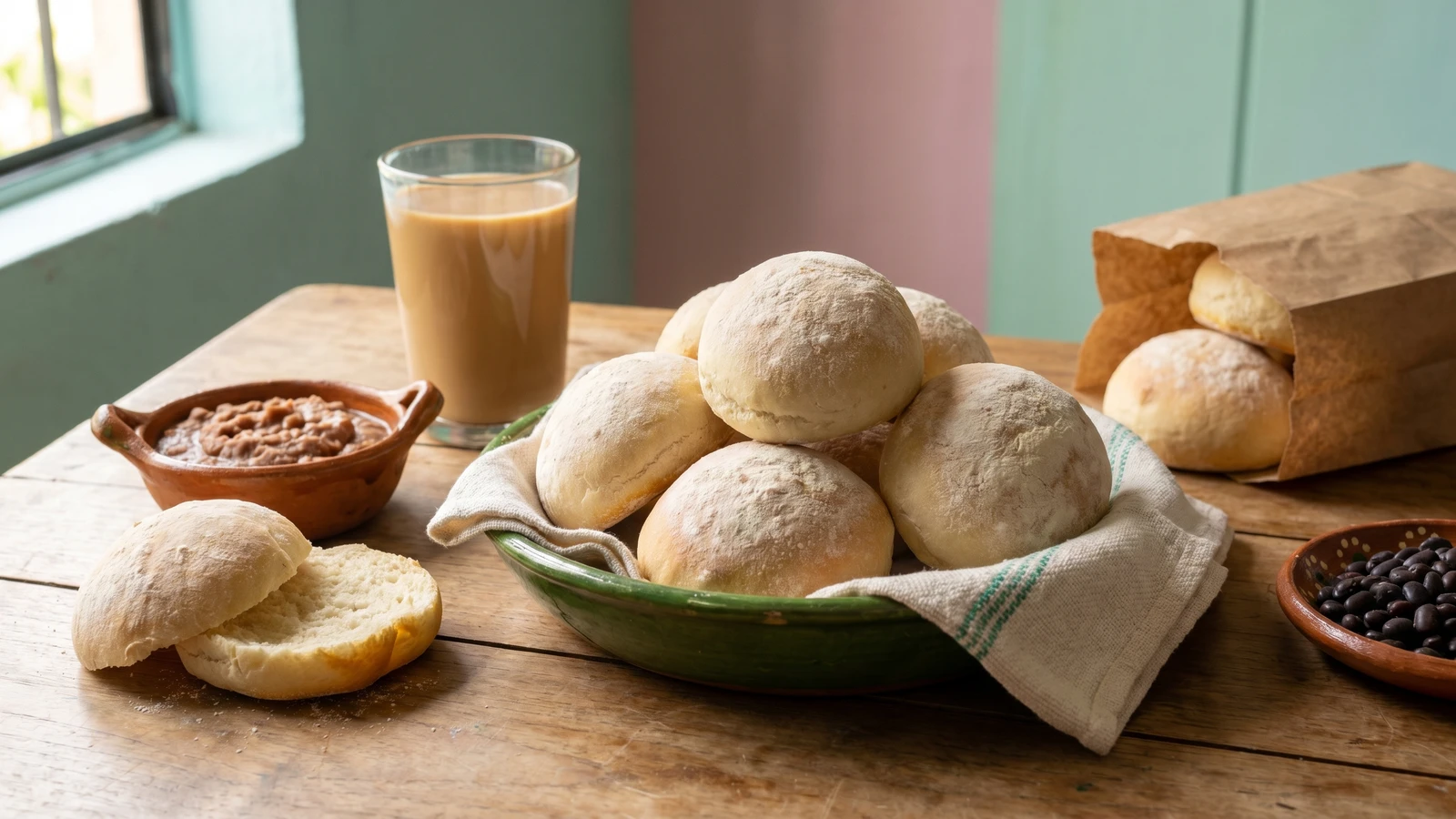
Veracruz's white wheat pambazo is a dry, flour-dusted roll from the port and mountain corridor, built for beans, café lechero, and hard working hands.
Veracruz owns this pambazo before the capital ever dipped one in chile sauce. This is the white wheat roll from the port, Xalapa, Orizaba, and the road that looks up toward Pico de Orizaba, the volcano with flour-white shoulders. The bread is dry on purpose. Rustic on purpose. It should not be soft like a supermarket bolillo trying to win a beauty contest.
Wheat came through Veracruz because Veracruz was Mexico's first Atlantic door from 1519. That matters. Canilla, hojaldra veracruzana, cemita veracruzana, pan de Xico, and this pambazo all live in that port history. Cada estado, su propia cocina. Do not confuse this roll with the Ciudad de México pambazo sandwich stained red with guajillo. That sandwich is a descendant. This is the bread that came first.
The defining thing here is the finish: a pale, firm wheat roll dusted generously with flour until it resembles the snowy peak above Orizaba. You bake it enough to set the crust, not enough to brown it dark. A señora in Veracruz would split it for frijoles refritos, chorizo, queso fresco, or simply dunk it beside café lechero. The bread must hold. If it collapses under a spoonful of beans, you made a soft bun, not pambazo.
My mother did not bake Veracruz bread, she was Jalisciense. But in the mercados of Veracruz I learned quickly that bread can carry a state's history as clearly as a mole or a tamal. Si no conoces el mercado, no conoces la cocina. Start with good flour, real manteca de cerdo, patient rising, and a hot oven. Así se hace y punto.
Veracruz became New Spain's main Atlantic port after the founding of Villa Rica de la Vera Cruz in 1519, and wheat breads entered the region through that colonial trade route even as corn remained the deeper indigenous staple. The pambazo veracruzano is associated especially with the Veracruz-Orizaba-Xalapa corridor and is traditionally recognized as a pale, flour-dusted roll whose white surface recalls Pico de Orizaba, Mexico's highest mountain. The better-known Mexico City pambazo, dipped in guajillo sauce and filled with potato and chorizo, developed later as a street sandwich using the sturdier Veracruz-style bread as its base.
Quantity
500 grams
plus more for dusting
Quantity
150 grams
Quantity
10 grams
Quantity
8 grams
Quantity
18 grams
finely grated
Quantity
390 milliliters
Quantity
60 grams
softened
Quantity
1 tablespoon
for the bowl
| Ingredient | Quantity |
|---|---|
| bread flourplus more for dusting | 500 grams |
| all-purpose flour | 150 grams |
| fine sea salt | 10 grams |
| instant yeast | 8 grams |
| piloncillo or dark brown sugarfinely grated | 18 grams |
| lukewarm water | 390 milliliters |
| manteca de cerdosoftened | 60 grams |
| neutral oilfor the bowl | 1 tablespoon |
In a large bowl, whisk together the bread flour, all-purpose flour, salt, instant yeast, and grated piloncillo. Add the lukewarm water and mix with your hand until no dry flour remains. The dough will feel firm and a little rough. Good. Pambazo is not a tender milk bun.
Add the softened manteca de cerdo and knead it into the dough. At first it will smear and resist you. Keep working. After 8 to 10 minutes by hand, or 5 to 6 minutes in a stand mixer on low, the dough should become smooth, elastic, and only slightly tacky. La manteca es el sabor, but here it also gives the crumb enough strength to hold fillings without turning greasy.
Lightly oil a clean bowl. Set the dough inside, turn it once, cover, and let it rise at warm room temperature for 1 1/2 to 2 hours, until doubled. Press a floured finger into the dough. If the dent slowly fills halfway, it is ready. If it springs back hard, give it more time. Bread follows the kitchen, not your impatience.
Turn the dough onto a lightly floured table. Divide it into 10 pieces of about 110 grams each. Cup your hand over each piece and tighten it into a round, pulling the surface smooth against the table. Cover the rounds with a clean towel and rest them for 15 minutes so the gluten relaxes.
Flatten each round gently into a thick disk, then pull the edges toward the center and pinch them closed underneath. Roll again until the top is smooth and slightly domed. Set the rolls seam side down on parchment-lined sheet pans, leaving space between them. They should look squat and sturdy, not tall and delicate.
Sift a heavy layer of flour over the tops. Be generous. This is the snowy face of Pico de Orizaba, not a polite sprinkle. Cover loosely and let the rolls proof for 45 to 60 minutes, until puffy but still firm when touched. If the flour disappears into the dough, dust them again before baking.
Heat the oven to 400F. Bake the pambazos for 18 to 22 minutes, rotating the pans halfway through, until the bottoms are set and lightly golden but the tops remain pale under their flour. The crust should feel dry and firm when tapped. Do not chase deep browning. This bread is supposed to be white.
Move the rolls to a rack and let them cool completely before splitting. Warm bread tears and lies to you about its texture. A proper pambazo veracruzano cools into a dry, close crumb that can take beans, chorizo, queso fresco, or café lechero without falling apart. Recetas probadas y garantizadas.
1 serving (about 98g)
Culinary guides, cultural storytelling, and the editorial depth that makes cooking meaningful.
Discover Culinary ExplorerChef Lupita
Guanajuato's daily bread from Acámbaro, a small glazed roll built on pata, enriched with manteca de cerdo, and baked until the top shines lightly for merienda.

Chef Lupita
Michoacan's Tinguindin aguacatas are flat, leaf-scored sweet breads made with harina de trigo, piloncillo, anise, and manteca de cerdo, shaped by hand for the wood oven.

Chef Lupita
From Ajijic on Lake Chapala, Pan Tachihual is a lightly sweet wedding loaf built with harina de trigo, harina de maiz, piloncillo, manteca, anise, and the old Guadalajara pata.

Chef Lupita
Comitán's pan de yema shaped into little pigs, birds, and rabbits, a Chiapas bakery bread rich with egg yolks, manteca de cerdo, and anís, baked golden on hoja de plátano.