
Chef Jeong-sun
Baechu-geotjeori (Fresh Napa Cabbage Salad)
Fresh napa cabbage tossed with chili and fermented anchovy sauce, made for the hour when winter kimchi has gone too sour and the table needs something bright.
A cooking platform built around craft, culture, and the stories behind what we eat.
Created by
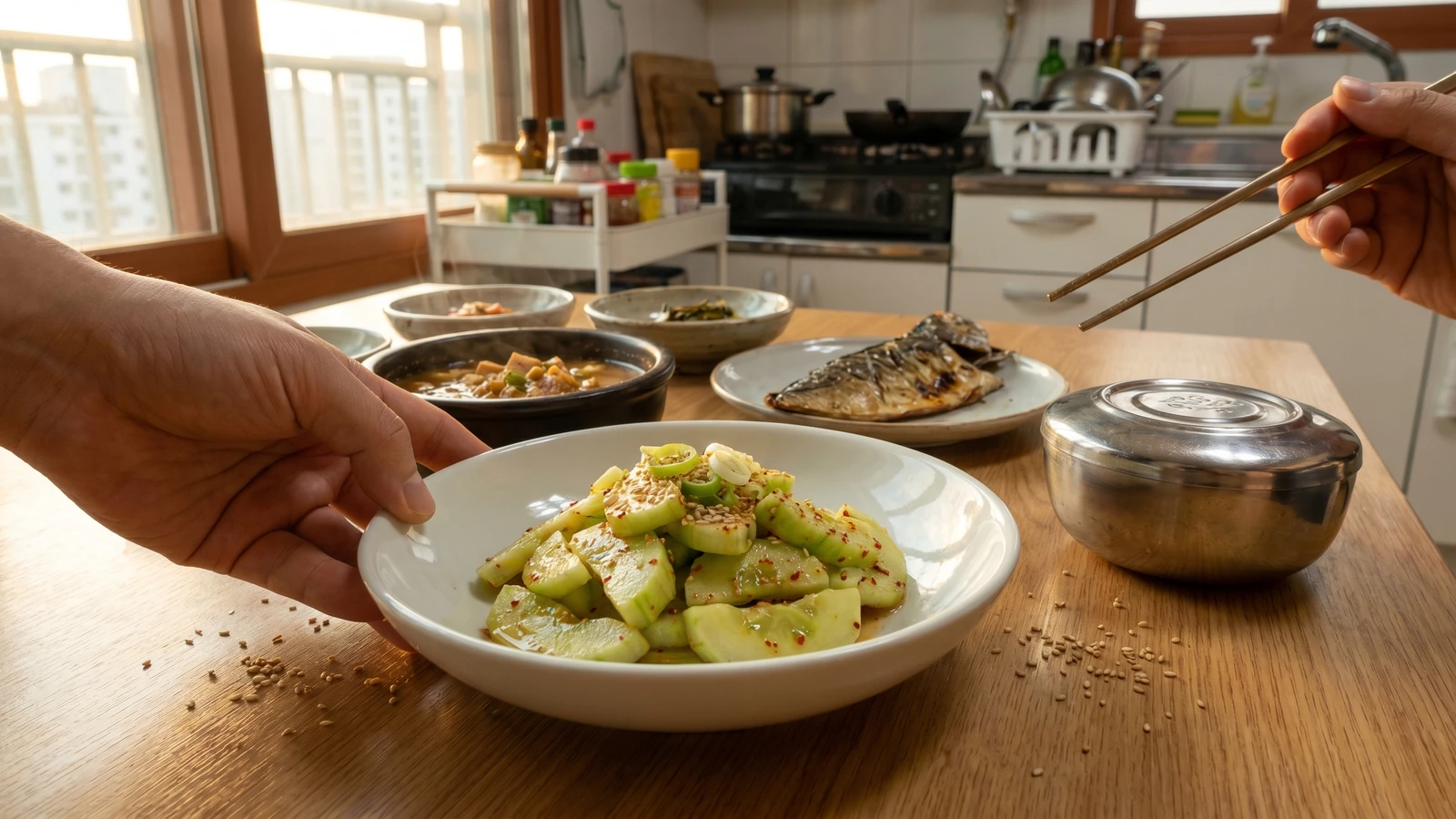
A quick summer banchan of salted cucumber squeezed dry, then dressed with gochugaru, vinegar, garlic, and sesame so it stays crisp beside rice instead of collapsing into a red puddle.
Oi-muchim lives or dies in the first ten minutes, before the seasoning touches the cucumber. Salt it. Wait just long enough. Squeeze it hard. If you skip that, by dinner the bowl will be half salad and half red water, and everyone will pretend not to notice. My teacher noticed everything.
This is summer banchan, the kind of side dish that appears when cucumbers are cheap at the market and the rice is already cooking. It is not kimchi, and it does not need fermentation to earn its place. It gives the table a sharp, cool bite beside grilled fish, egg, stew, or a plain bowl of barley rice. Cook the month you're standing in: make it when the cucumber is firm, thin-skinned, and heavy for its size.
Notebook 28 says 600 grams cucumber, 1 teaspoon fine sea salt, 10 minutes. That is not fussing. That is the difference between crisp and limp. 손맛 is real, the hand-taste every good home cook trusts, and I still measure it so the dish can be handed on.
Oi-muchim belongs to the broad Korean family of muchim, quickly seasoned vegetables tossed just before serving rather than fermented or cooked. Cucumbers have been grown and pickled in Korean household foodways since the Joseon period, while the red gochugaru version reflects the later spread of chili in Korean kitchens after peppers arrived from the Americas. It is an everyday home banchan, not a court dish, and its history is the practical history of summer markets and fast family meals.
Quantity
600g
trimmed
Quantity
1 teaspoon
for salting
Quantity
1 1/2 tablespoons
Quantity
1 tablespoon
Quantity
2 teaspoons
Quantity
1 teaspoon
Quantity
1 teaspoon
Quantity
1 small clove
finely minced
Quantity
1
thinly sliced on the diagonal
Quantity
2 tablespoons
thinly sliced
Quantity
1 teaspoon
| Ingredient | Quantity |
|---|---|
| Korean cucumbers, Persian cucumbers, or English cucumbertrimmed | 600g |
| fine sea saltfor salting | 1 teaspoon |
| gochugaru (Korean chili flakes) | 1 1/2 tablespoons |
| rice vinegar | 1 tablespoon |
| soy sauce | 2 teaspoons |
| sugar | 1 teaspoon |
| toasted sesame oil | 1 teaspoon |
| garlicfinely minced | 1 small clove |
| scallionthinly sliced on the diagonal | 1 |
| onion (optional)thinly sliced | 2 tablespoons |
| toasted sesame seeds | 1 teaspoon |
Trim the cucumbers and slice them into 1/4-inch half-moons. If you are using a large English cucumber with watery seeds, halve it lengthwise and scrape out the soft center first. The cut matters because thin slices season quickly, but paper-thin slices collapse before dinner reaches the table.
Put the sliced cucumber in a bowl and toss with 1 teaspoon fine sea salt. Let it stand 10 minutes, turning once. The cucumber will soften slightly and give off a few tablespoons of water. That water has to leave now, or it will leave later in the serving bowl.
Gather the cucumber in clean hands and squeeze firmly over the sink, handful by handful. Do not rinse. The measured salt has already seasoned the cucumber, and rinsing it away means you will chase the flavor later with soy sauce. The slices should feel flexible but still crisp.
In a clean bowl, stir together the gochugaru, rice vinegar, soy sauce, sugar, sesame oil, and minced garlic until the sugar dissolves and the chili darkens. Taste the seasoning before the cucumber goes in. It should be bright, salty, and a little sharp, because the cucumber will soften it.
Add the squeezed cucumber, scallion, onion if using, and toasted sesame seeds. Toss with your hand or chopsticks until every slice is lightly coated. Stop there. More sauce only makes a puddle. Serve at once, or chill up to 30 minutes for a colder banchan.
1 serving (about 145g)
Culinary guides, cultural storytelling, and the editorial depth that makes cooking meaningful.
Discover Culinary ExplorerChef Jeong-sun
Fresh napa cabbage tossed with chili and fermented anchovy sauce, made for the hour when winter kimchi has gone too sour and the table needs something bright.

Chef Jeong-sun
The first flat cabbage of spring, torn by hand and tossed at the last minute with chili, fish sauce, garlic, and sesame so each leaf stays sweet and alive.

Chef Jeong-sun
A fresh garlic chive muchim tossed at the last minute, sharp with soy and vinegar, lightly red with gochugaru, and made to stand beside bossam or grilled pork.

Chef Jeong-sun
A mountain-root salad with snap and bite: deodeok gently pounded, never shredded, then dressed in chili vinegar so its resinous sweetness still speaks clearly.