
Chef Jeong-sun
Baechu-geotjeori (Fresh Napa Cabbage Salad)
Fresh napa cabbage tossed with chili and fermented anchovy sauce, made for the hour when winter kimchi has gone too sour and the table needs something bright.
A cooking platform built around craft, culture, and the stories behind what we eat.
Created by
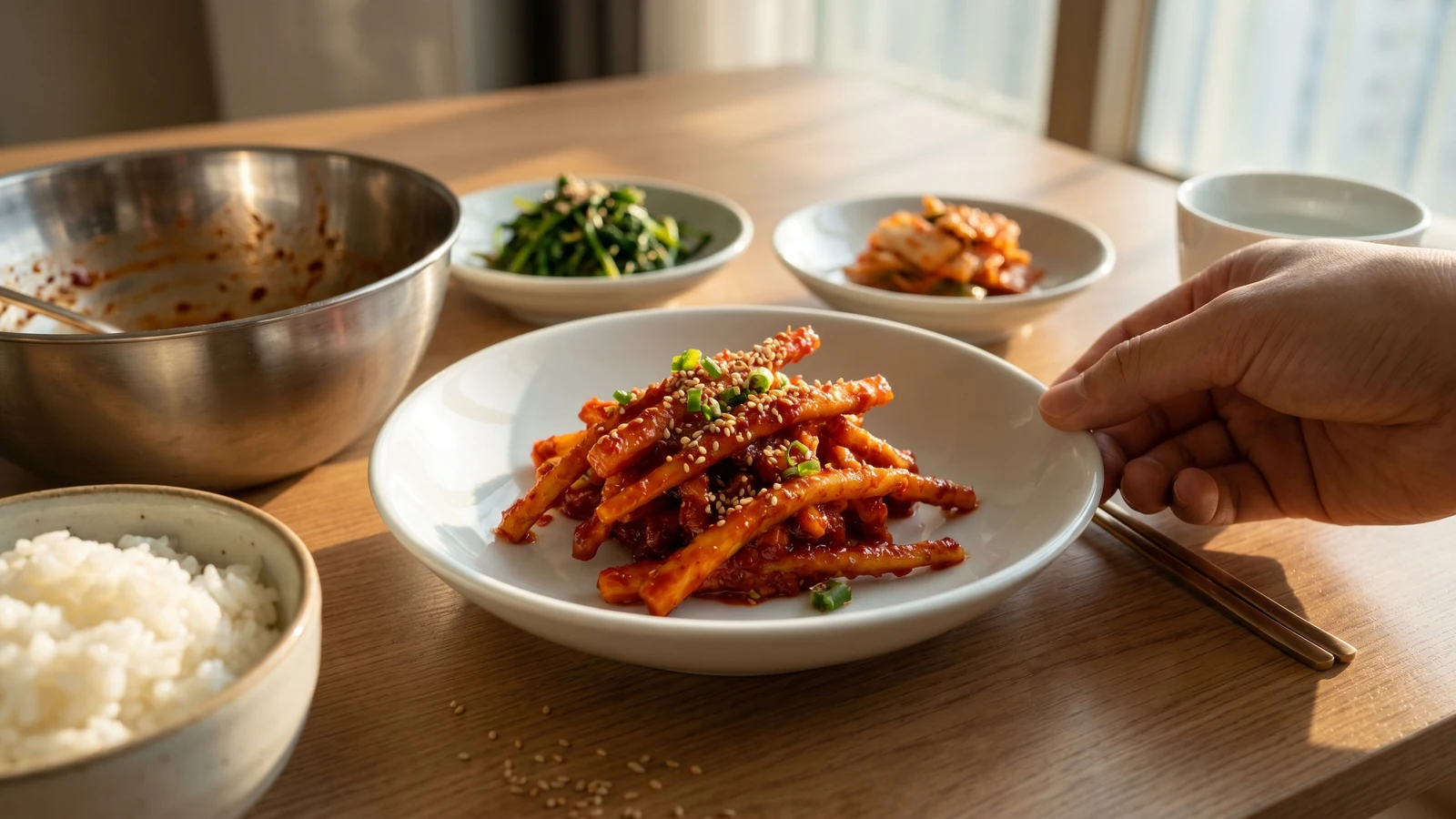
A mountain-root salad with snap and bite: deodeok gently pounded, never shredded, then dressed in chili vinegar so its resinous sweetness still speaks clearly.
Deodeok asks for your hands before it asks for your seasoning. The root is tough in its raw state, with long fibers that fight the teeth if you slice it carelessly. Pound it flat, gently, and it changes. The fibers loosen, the root softens, and the dressing can hold to the surface instead of sliding away.
My teacher Master Seong-nyeo would tap the root with the side of her knife handle, not beat it like laundry on a stone. 눈동냥, 귀동냥. Borrowing with the eyes, borrowing with the ears. I learned the sound first: a dull, careful thud, just enough to bruise the root without breaking it into strings. Shredded deodeok is easier to chew, yes, but then you have lost the dish. This saengchae (raw seasoned salad) should have pieces you can pick up, chew, and recognize.
The dressing is small and sharp: gochugaru (Korean chili flakes), a little gochujang (fermented chili paste), vinegar, maesil-cheong (green plum syrup) or sugar, garlic, and sesame. Do not drown the root. Deodeok has its own bitter-sweet mountain smell, and the cook's work is to clear a path for it, not bury it. Serve it as banchan with rice, or beside grilled meat when the table needs something crisp and stern.
Deodeok, Codonopsis lanceolata, is a mountain root gathered and cultivated across Korea, especially in cooler upland areas of Gangwon Province, where its firm texture and fragrant resin made it valuable as both food and medicinal plant. Deodeok-saengchae belongs to the broader family of raw seasoned namul and muchim dishes, where roots and vegetables are cut or pounded to suit their fibers, then seasoned with vinegar and chili at the home table rather than cooked. The same root is also used for deodeok-gui, a grilled preparation, but the raw salad keeps the root's snap and bitterness most clearly.
Quantity
300g
peeled
Quantity
1 teaspoon
for rubbing
Quantity
4 cups
for rinsing
Quantity
1 tablespoon
Quantity
1 tablespoon
Quantity
1 tablespoon
Quantity
2 teaspoons maesil-cheong or 1 1/2 teaspoons sugar
Quantity
1 teaspoon
Quantity
1 teaspoon
minced
Quantity
1 teaspoon
Quantity
1 tablespoon
finely sliced
Quantity
2 teaspoons
divided
| Ingredient | Quantity |
|---|---|
| fresh deodeok (lance asiabell root)peeled | 300g |
| coarse saltfor rubbing | 1 teaspoon |
| cold waterfor rinsing | 4 cups |
| gochugaru (Korean chili flakes) | 1 tablespoon |
| gochujang (Korean fermented chili paste) | 1 tablespoon |
| rice vinegar | 1 tablespoon |
| maesil-cheong (green plum syrup) or sugar | 2 teaspoons maesil-cheong or 1 1/2 teaspoons sugar |
| soy sauce | 1 teaspoon |
| garlicminced | 1 teaspoon |
| toasted sesame oil | 1 teaspoon |
| scallionfinely sliced | 1 tablespoon |
| toasted sesame seedsdivided | 2 teaspoons |
Rinse the deodeok under cold water, scrubbing away soil from the grooves. Peel thinly with a small knife or vegetable peeler. The sticky sap is part of the root's character, so do not soak it for a long time trying to make it disappear. A quick rinse is enough.
Sprinkle the peeled roots with 1 teaspoon coarse salt and rub them gently for 30 seconds, then rinse in 4 cups cold water and drain well. This takes away harsh surface bitterness without washing out the deodeok's own fragrance. Pat the roots dry with a clean towel so the dressing will cling.
Split thick roots lengthwise into halves or quarters, then lay them between two sheets of plastic wrap or in a clean food bag. Pound with a rolling pin or the side of a knife handle until each piece is about 1/4 inch thick and the surface looks slightly frayed. Bruise it, do not shred it. The pounding softens the fibers so the salad stays crisp instead of woody.
Tear the pounded deodeok into rough strips about 3 inches long and 1/3 inch wide. Do this by hand along the grain. A knife makes clean edges, but clean edges do not hold the seasoning as well. The uneven surface is useful here.
In a bowl large enough for tossing, mix the gochugaru, gochujang, rice vinegar, maesil-cheong or sugar, soy sauce, minced garlic, sesame oil, scallion, and 1 teaspoon of the sesame seeds. Taste the dressing before the root goes in. It should be bright, lightly sweet, and only moderately salty, because the deodeok will bring bitterness and perfume of its own.
Add the deodeok strips to the dressing and toss by hand for 1 to 2 minutes, lifting and turning until every strip is thinly coated. Do not squeeze it into a paste. The salad should look red and glossy in streaks, not buried under sauce. Let it taste like itself.
Let the salad rest 10 minutes at room temperature so the dressing settles into the bruised fibers. Taste one strip. If it needs brightness, add 1 teaspoon more vinegar. If the root is very bitter, add 1/2 teaspoon more maesil-cheong or a small pinch of sugar. Finish with the remaining 1 teaspoon sesame seeds and serve in a small mound as banchan.
1 serving (about 90g)
Culinary guides, cultural storytelling, and the editorial depth that makes cooking meaningful.
Discover Culinary ExplorerChef Jeong-sun
Fresh napa cabbage tossed with chili and fermented anchovy sauce, made for the hour when winter kimchi has gone too sour and the table needs something bright.

Chef Jeong-sun
The first flat cabbage of spring, torn by hand and tossed at the last minute with chili, fish sauce, garlic, and sesame so each leaf stays sweet and alive.

Chef Jeong-sun
A fresh garlic chive muchim tossed at the last minute, sharp with soy and vinegar, lightly red with gochugaru, and made to stand beside bossam or grilled pork.

Chef Jeong-sun
Bellflower root torn by hand, salt-rubbed until its harsh edge softens, then dressed red and sharp so the bitterness remains clean beside rice, not hidden.