
Chef Jeong-sun
Bomdong-geotjeori (Spring Cabbage Salad)
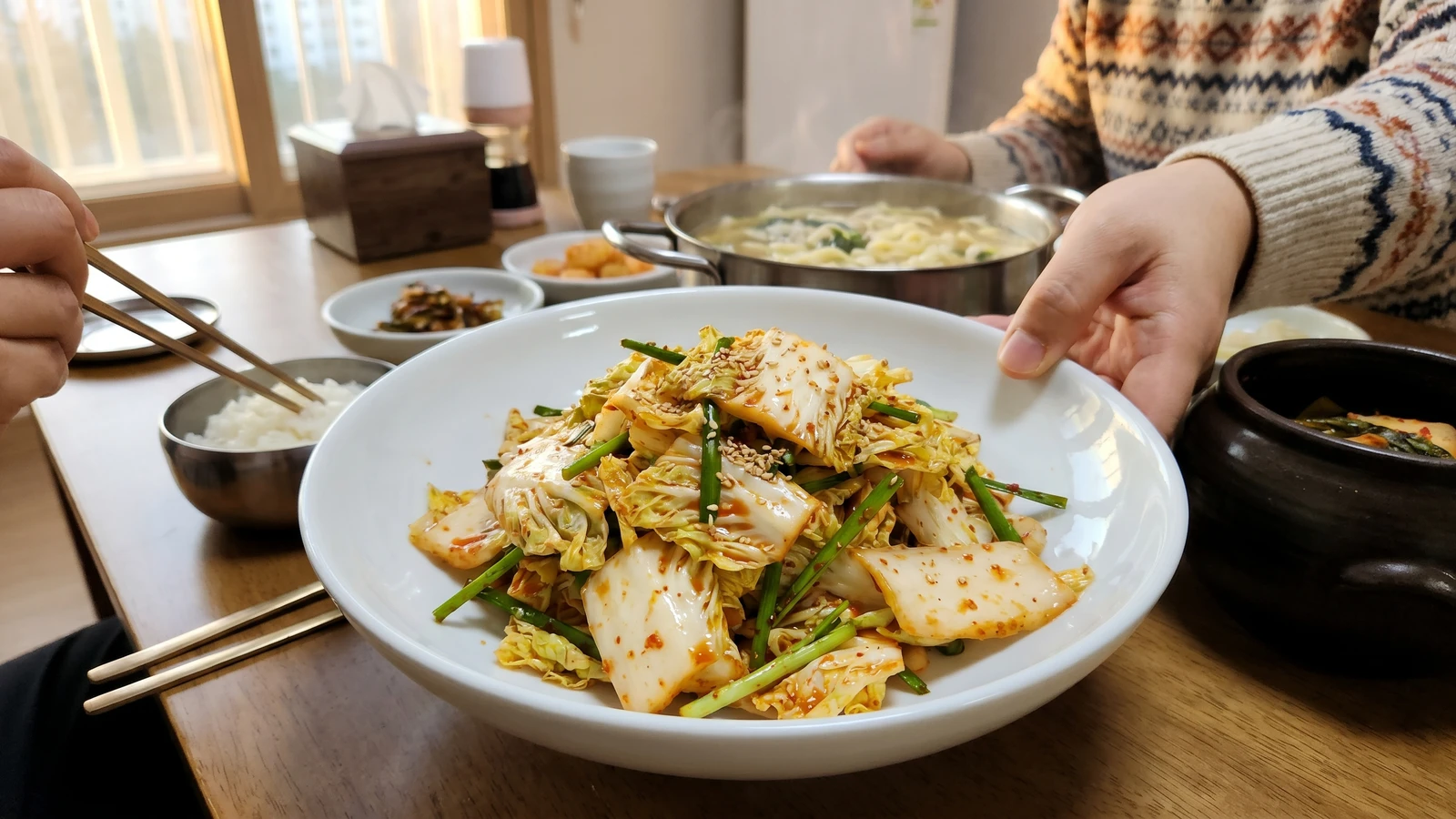
The first flat cabbage of spring, torn by hand and tossed at the last minute with chili, fish sauce, garlic, and sesame so each leaf stays sweet and alive.
A cooking platform built around craft, culture, and the stories behind what we eat.
Created by
Fresh napa cabbage tossed with chili and fermented anchovy sauce, made for the hour when winter kimchi has gone too sour and the table needs something bright.
Geotjeori is not failed kimchi, and it is not kimchi in a hurry. It is its own dish: fresh cabbage salted just enough to bend, then dressed and eaten before fermentation takes the first step. When the winter kimchi in the jar turns sharp enough for stew, this is what the table wants beside rice.
My teacher Master Seong-nyeo made us watch the cabbage first. 눈동냥, 귀동냥, borrowing with the eyes and ears. If the rib cracked when folded, it was not ready. If it hung limp like wet cloth, we had gone too far. That middle place is the whole dish, because geotjeori should keep the crunch of fresh napa while carrying the seasoning into every fold.
The seasoning is not a wall of red. Use good gochugaru (Korean chili flakes), fermented anchovy sauce, garlic, a little ginger, and just enough sweetness to round the salt. Toss by hand from the ribs outward so the thick parts get seasoned before the leafy edges. Eat it with hot rice, bossam, kalguksu, or a weeknight bowl of soup. Write it down. Memory is a borrowed bowl.
Geotjeori means a freshly dressed kimchi or vegetable side dish, made to be eaten soon after seasoning rather than stored for long fermentation. In Korean homes it often appears when mature kimchi has become too sour for the table but still useful for jjigae or bokkeumbap, and regional versions differ by seasoning, with Jeolla-style preparations often using stronger fermented seafood sauces such as myeolchi-aekjeot (fermented anchovy sauce). Unlike kimjang kimchi, geotjeori belongs to immediate eating, not winter preservation.
Quantity
900g, about 1 small head
trimmed
Quantity
2 tablespoons
Quantity
1 tablespoon
Quantity
4
cut into 2-inch lengths
Quantity
50g
cut into 2-inch lengths
Quantity
1/2 small
thinly sliced
Quantity
3 tablespoons
medium-coarse
Quantity
2 tablespoons
Quantity
1 tablespoon
Quantity
1 tablespoon
or 2 teaspoons sugar
Quantity
2 teaspoons
minced
Quantity
1/2 teaspoon
minced
Quantity
1 tablespoon
Quantity
1 teaspoon
| Ingredient | Quantity |
|---|---|
| napa cabbagetrimmed | 900g, about 1 small head |
| coarse sea salt | 2 tablespoons |
| water (optional) | 1 tablespoon |
| scallionscut into 2-inch lengths | 4 |
| buchu (Korean garlic chives) (optional)cut into 2-inch lengths | 50g |
| onionthinly sliced | 1/2 small |
| gochugaru (Korean chili flakes)medium-coarse | 3 tablespoons |
| myeolchi-aekjeot (fermented anchovy sauce) | 2 tablespoons |
| soup soy sauce or Korean soy sauce | 1 tablespoon |
| maesil-cheong (green plum syrup)or 2 teaspoons sugar | 1 tablespoon |
| garlicminced | 2 teaspoons |
| gingerminced | 1/2 teaspoon |
| toasted sesame seeds | 1 tablespoon |
| toasted sesame oil | 1 teaspoon |
Separate the napa leaves and rinse away any grit. Cut the thick white ribs into 2-inch pieces on a diagonal, and leave the tender yellow-green leaf portions a little larger. The ribs need more exposed surface so salt and seasoning can enter; the leaves are delicate and will collapse if you cut them too small.
Put the cabbage in a large bowl and sprinkle the coarse sea salt mostly over the rib pieces. Toss well with your hands. If the cabbage is very dry, add 1 tablespoon water to help the salt cling. Rest 25 to 30 minutes, turning once halfway through. A rib should bend without snapping but still feel crisp in the center.
Rinse the cabbage once in cold water, just enough to remove surface salt. Drain it in a colander for 10 minutes, then shake off trapped water. Taste one rib. It should be lightly seasoned already, not bland and not salty. If water stays in the folds, it will thin the sauce and the cabbage will taste unfinished.
In the large bowl, stir together the gochugaru, fermented anchovy sauce, soy sauce, maesil-cheong, garlic, and ginger. Let it sit 3 minutes so the chili flakes bloom and darken. This short rest matters; dry gochugaru tossed straight onto cabbage tastes dusty before it tastes red.
Add the drained cabbage, scallions, buchu if using, and onion. Toss by hand from the thick ribs outward, lifting and turning instead of squeezing hard. Coat the white ribs first, then let the softer leaves catch what remains. The cabbage should look red and glossy in patches, not painted into one heavy color.
Taste a rib and a leafy piece together. Add 1 teaspoon more anchovy sauce only if the cabbage tastes flat, or 1 teaspoon more maesil-cheong if the chili tastes harsh. Fold in the sesame seeds and sesame oil at the end. Serve right away, while the leaves still stand up a little and the ribs answer back under your teeth.
1 serving (about 165g)
Culinary guides, cultural storytelling, and the editorial depth that makes cooking meaningful.
Discover Culinary ExplorerChef Jeong-sun
The first flat cabbage of spring, torn by hand and tossed at the last minute with chili, fish sauce, garlic, and sesame so each leaf stays sweet and alive.

Chef Jeong-sun
A fresh garlic chive muchim tossed at the last minute, sharp with soy and vinegar, lightly red with gochugaru, and made to stand beside bossam or grilled pork.

Chef Jeong-sun
A mountain-root salad with snap and bite: deodeok gently pounded, never shredded, then dressed in chili vinegar so its resinous sweetness still speaks clearly.

Chef Jeong-sun
Bellflower root torn by hand, salt-rubbed until its harsh edge softens, then dressed red and sharp so the bitterness remains clean beside rice, not hidden.