
Chef Jeong-sun
Baechu-geotjeori (Fresh Napa Cabbage Salad)
Fresh napa cabbage tossed with chili and fermented anchovy sauce, made for the hour when winter kimchi has gone too sour and the table needs something bright.
A cooking platform built around craft, culture, and the stories behind what we eat.
Created by
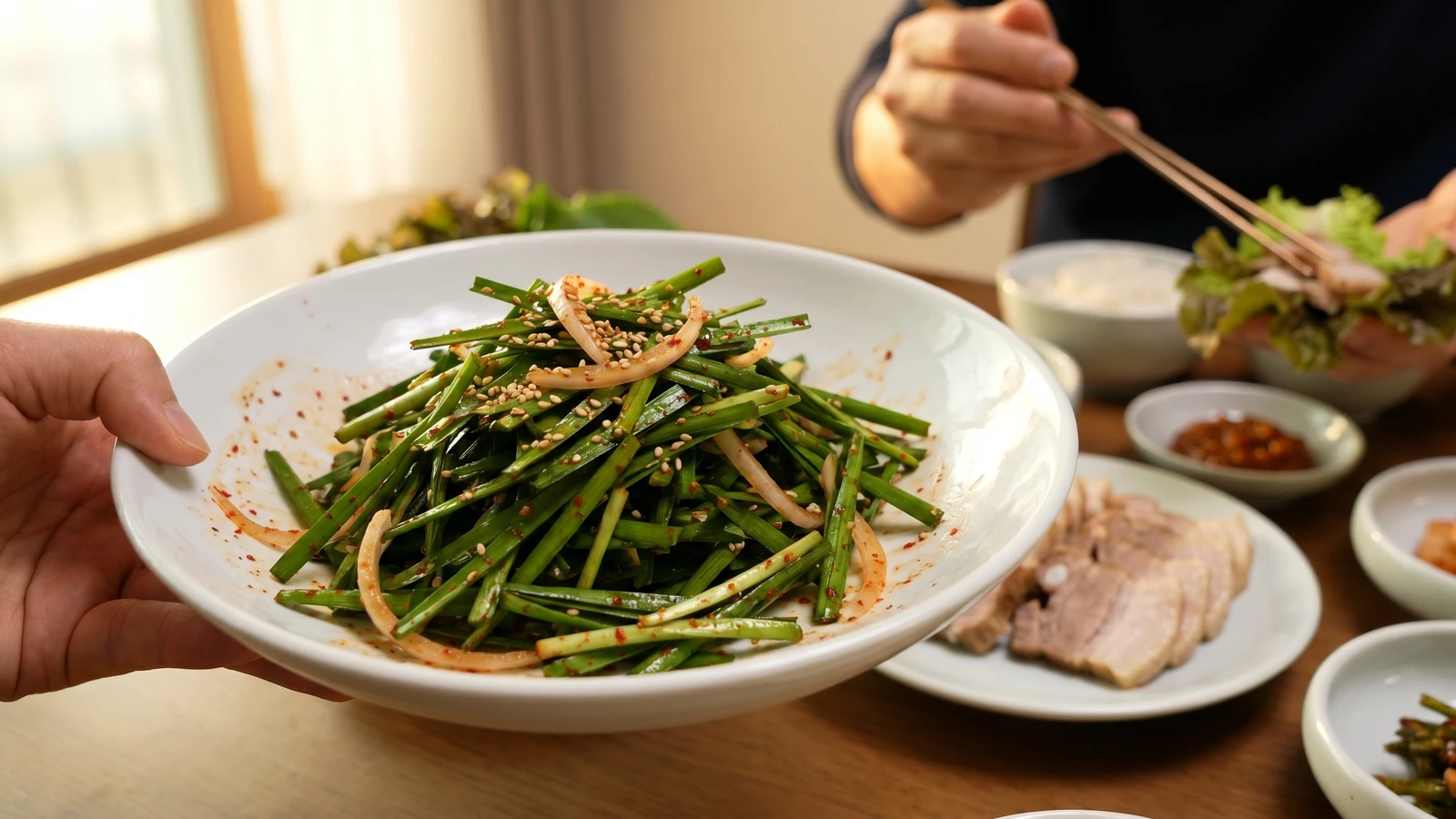
A fresh garlic chive muchim tossed at the last minute, sharp with soy and vinegar, lightly red with gochugaru, and made to stand beside bossam or grilled pork.
Buchu-muchim lives or dies in the last minute. Dress it too early and the chives collapse into a wet tangle before the meat reaches the table. Dress it with a heavy hand and all you taste is chili and salt. This dish asks for restraint, and restraint is not the same thing as being timid.
My teacher, Master Seong-nyeo, made us cut the buchu (garlic chives) to one finger length, no longer, no shorter. She said a side dish should be easy to lift with chopsticks, especially when there is pork, lettuce, and rice already crowding the hand. 눈동냥, 귀동냥, borrowing with the eyes and ears, taught me the rest: mix the seasoning first, toss the chives second, and stop before they bruise.
This is a table helper, not a showpiece. It belongs beside bossam (boiled pork wraps), samgyeopsal (grilled pork belly), and any quick meal that needs something green, sharp, and awake. Measure the soy, vinegar, and sesame oil the first time, then adjust by tasting one strand. 손맛 is real; I measure it anyway, so the next cook gets the same good bowl.
Buchu-muchim belongs to Korea's fresh muchim and geotjeori family, vegetables seasoned just before eating rather than fermented for storage. Garlic chives have long been a common garden and market green in Korea, and regional names still remain, including jeongguji in Gyeongsang markets. The dish is especially at home on pork tables, where the allium bite and light acidity cut through the richness of bossam and samgyeopsal.
Quantity
200g
washed, dried very well, cut into 2-inch lengths
Quantity
1/4
very thinly sliced
Quantity
1 tablespoon
Quantity
1 tablespoon
or use 1 more tablespoon soy sauce
Quantity
1 tablespoon
Quantity
1 tablespoon
preferably medium-coarse
Quantity
1 teaspoon
Quantity
1 teaspoon
Quantity
1 tablespoon
Quantity
1 tablespoon
Quantity
1 small clove
finely grated
Quantity
1/2 teaspoon
only if needed after tasting
| Ingredient | Quantity |
|---|---|
| buchu (Korean garlic chives)washed, dried very well, cut into 2-inch lengths | 200g |
| small onionvery thinly sliced | 1/4 |
| soy sauce | 1 tablespoon |
| fish sauceor use 1 more tablespoon soy sauce | 1 tablespoon |
| rice vinegar | 1 tablespoon |
| gochugaru (Korean chili flakes)preferably medium-coarse | 1 tablespoon |
| sugar | 1 teaspoon |
| maesil-cheong (green plum syrup) (optional) | 1 teaspoon |
| toasted sesame oil | 1 tablespoon |
| toasted sesame seeds | 1 tablespoon |
| garlicfinely grated | 1 small clove |
| fine sea salt (optional)only if needed after tasting | 1/2 teaspoon |
Rinse the buchu in a wide bowl of cold water, lifting it out so any grit stays behind. Dry it very well in a salad spinner or between clean kitchen towels. Water clinging to the chives thins the seasoning and makes the salad slump before it reaches the table.
Cut the buchu into 2-inch lengths. Slice the onion as thinly as you can, then soak it in cold water for 5 minutes and drain hard if it tastes harsh. The chives and onion should lift together with chopsticks, not hang in long strands or fall apart in tiny pieces.
In a large mixing bowl, stir together the soy sauce, fish sauce, rice vinegar, gochugaru, sugar, maesil-cheong if using, sesame oil, sesame seeds, and grated garlic. Mix this before the chives go in, because raw buchu bruises when you fuss with it. Taste the seasoning on the tip of a chive. It should be salty, lightly sweet, a little sharp, and not muddy.
Add the buchu and onion to the bowl. Lift and turn with your fingers or chopsticks 8 to 10 times, just until every strand is lightly coated. Do not squeeze. Do not knead. Garlic chives are not cabbage kimchi; salting and pressing them only steals their snap.
Taste one full bite with chive and onion together. Add up to 1/2 teaspoon fine sea salt only if it tastes flat, and toss once more. Serve immediately, especially with bossam or grilled pork. If the table is not ready, keep the cleaned chives and mixed seasoning separate, then combine them at the last minute.
1 serving (about 80g)
Culinary guides, cultural storytelling, and the editorial depth that makes cooking meaningful.
Discover Culinary ExplorerChef Jeong-sun
Fresh napa cabbage tossed with chili and fermented anchovy sauce, made for the hour when winter kimchi has gone too sour and the table needs something bright.

Chef Jeong-sun
The first flat cabbage of spring, torn by hand and tossed at the last minute with chili, fish sauce, garlic, and sesame so each leaf stays sweet and alive.

Chef Jeong-sun
A mountain-root salad with snap and bite: deodeok gently pounded, never shredded, then dressed in chili vinegar so its resinous sweetness still speaks clearly.

Chef Jeong-sun
Bellflower root torn by hand, salt-rubbed until its harsh edge softens, then dressed red and sharp so the bitterness remains clean beside rice, not hidden.