Culinary Explorer

A cooking platform built around craft, culture, and the stories behind what we eat.
Discover Culinary Explorer
Oi-jangajji (Soy-Pickled Cucumber)

Oi-jangajji (Soy-Pickled Cucumber)

Created by

Small summer cucumbers packed whole, shocked with boiling soy-vinegar brine, then re-poured after three days so the flesh stays crisp and the pickle tastes of cucumber, salt, and restraint.

Sauces & Condiments
Korean
Make Ahead
Batch Cooking
25 min
Active Time
10 min cook96 hr 35 min total
Yield1 large jar, about 8 to 10 banchan servings

Cucumbers announce summer by the basket. In the market they sit short and prickled, cheap enough to buy by the armful, firm enough that your thumbnail meets resistance. That is when oi-jangajji belongs. Cook the month you're standing in: if the cucumbers are fat, seedy, and soft at the ends, make a quick oi-muchim tonight and wait for better ones to pickle.

Jangajji is not a salad pickle you shake in a bowl and eat at once. It is a pantry habit. Pack the cucumbers whole, pour the brine on boiling hot, let soy, vinegar, and sugar cure them, then drain and boil the brine once more after three days. That second boil is not ceremony. It refreshes the brine, sharpens the seasoning, and keeps the cucumbers finishing their cure in a clean liquid.

You need a heatproof vessel, a small weight, and patience, not special skill. Notebook 52 says 1.2 kg cucumbers, 1 cup soy sauce, 1 cup vinegar, 1 cup water, and 3/4 cup sugar. 손맛 is real; I measure it anyway, so the next jar doesn't depend on the mood of your hand.

Jangajji is the family of Korean vegetables preserved in jang, the fermented pantry sauces and pastes that include ganjang (soy sauce), doenjang (soybean paste), and gochujang (chili paste). Joseon-era household manuals, including the late nineteenth-century Siuijeonseo, record vegetables kept in soy sauce or paste, a practical preservation method before refrigerators made summer abundance easy to store. Oi-jangajji belongs to that everyday line: small summer cucumbers cured whole in ganjang brine, then sliced, squeezed, and served as a salty banchan with rice.

The technique, the tradition, and the story behind every dish.

Discover Culinary Explorer

Ingredients

small Korean or Persian cucumbers

Quantity

1.2 kg (10 to 12)

firm, unwaxed, each 10 to 13 cm long

coarse sea salt

Quantity

2 tablespoons

for scrubbing, then rinsed off

regular soy sauce (ganjang)

Quantity

1 cup

rice vinegar

Quantity

1 cup

5% acidity

water

Quantity

1 cup

sugar

Quantity

3/4 cup

garlic cloves

Quantity

6

lightly smashed

fresh red or green chiles (optional)

Quantity

2

slit lengthwise

toasted sesame oil (optional)

Quantity

2 teaspoons

for dressing 2 sliced pickled cucumbers

toasted sesame seeds (optional)

Quantity

2 teaspoons

scallion (optional)

Quantity

1

finely chopped

gochugaru (Korean chili flakes) (optional)

Quantity

1 teaspoon

Equipment Needed

  • 2-liter heatproof glass jar, glazed onggi, or stainless bowl with lid
  • Small plate or fermentation weight
  • Medium saucepan
  • Clean tongs
  • Clean kitchen towel for squeezing slices

Instructions

  1. 1

    Scrub the cucumbers

    Choose cucumbers that feel hard from end to end. Rub them with the coarse salt to remove grit and tiny spines, then rinse well and dry completely. Trim 3 mm from both ends, especially the blossom end, because the enzymes there soften pickles. Leave the cucumbers whole. Whole flesh cures slowly and stays crisp.

  2. 2

    Pack the vessel

    Use a clean 2-liter heatproof glass jar, glazed onggi, or stainless bowl. If using glass, warm it with hot tap water and empty it before packing, so the boiling brine does not shock cold glass. Pack the cucumbers tightly with the garlic and chiles, leaving about 2.5 cm headspace for the brine and weight.

  3. 3

    Boil the brine

    Combine the soy sauce, rice vinegar, water, and sugar in a saucepan. Bring to a full boil, stirring until the sugar dissolves, then boil 2 minutes. Do not simmer it down; reducing makes the brine too salty. It should taste sharper and saltier than you want the finished pickle, because the cucumbers will release water as they cure.

    Use regular soy sauce if you can. Low-sodium soy makes a milder pickle and a weaker brine, so keep that version refrigerated and eat it within 2 weeks.
  4. 4

    Pour it hot

    Pour the boiling brine directly over the packed cucumbers until they are fully covered. The skins will shift from bright green to olive, and that is correct. Set a small plate or fermentation weight on top so no cucumber floats. Cool to room temperature, no longer than 2 hours, then cover and refrigerate. The hot pour is the crunch: it firms the skin and starts the cure before the cucumber can collapse.

  5. 5

    Cure three days

    Refrigerate the jar for 3 days. Once a day, check that every cucumber is under the brine and press the weight down with clean hands or clean tongs. The cucumbers will wrinkle and bend, but they should not feel mushy. Air is where spoilage starts, so do not let pieces sit above the liquid.

  6. 6

    Reboil the brine

    On day 3, drain the brine into a saucepan and keep the cucumbers, garlic, and chiles in a heatproof vessel. Bring the brine back to a full boil and boil 2 minutes, skimming any foam. Pour the hot brine back over the cucumbers, weight them again, cool to room temperature, and refrigerate. Do not pour boiling brine into a chilled glass jar; move the cucumbers to a warmed heatproof vessel first. The pickle is ready after 24 more hours and better on day 5.

  7. 7

    Slice and season

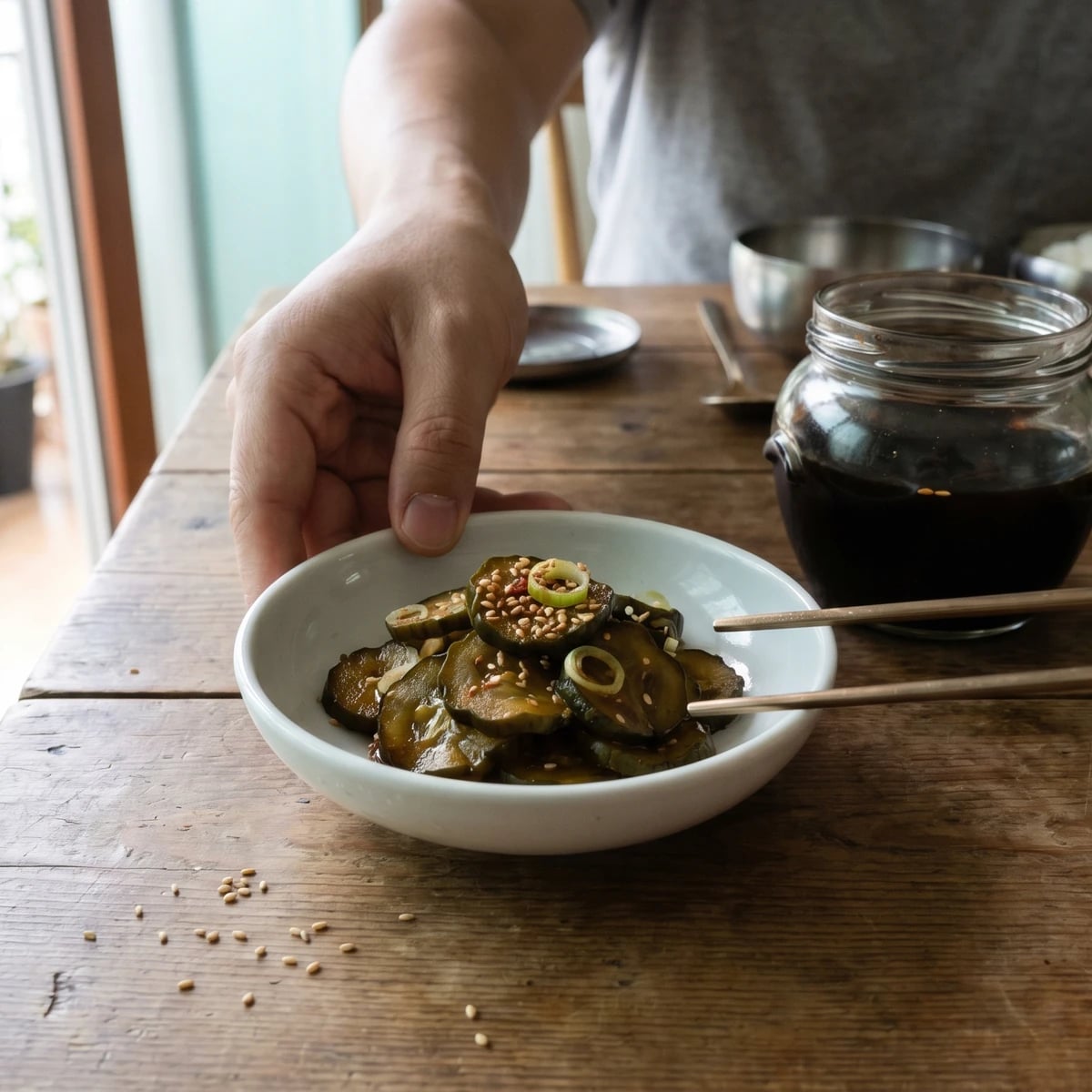
    Lift out only what you will eat. Slice the pickled cucumbers into thin coins or diagonal pieces. Taste one. If the salt bites too hard, soak the slices in cold water for 5 minutes, then squeeze hard in a clean towel until no brine drips. For 2 cucumbers, toss with 2 teaspoons sesame oil, 2 teaspoons sesame seeds, 1 chopped scallion, and 1 teaspoon gochugaru if you want a little warmth. The pickle should taste of cucumber first, soy and vinegar second.

  8. 8

    Store submerged

    Return any unused pickles to the brine with a clean utensil and keep them refrigerated. They keep 4 to 6 weeks if fully submerged. Discard the jar if you see mold, strong fizzing, or an off smell. This is a refrigerated pickle, not shelf-stable canning.

Chef Tips

  • Buy the cucumber by firmness, not prettiness. Korean oi or Persian cucumbers with thin skins and small seed cores are best; thick waxed cucumbers give you a watery jar and tough skin.
  • The hot pour and second boil are the dish's spine. You can use a modern refrigerator instead of a cool pantry and a clean glass jar instead of onggi, but don't skip the reboil or let the cucumbers float.
  • Do not cut the sugar to nothing. Sugar is not there to make candy; it rounds the soy and vinegar and helps the flesh cure without going leathery. Three-quarter cup is restrained for this amount.
  • For a less salty table, slice the pickle, soak it 5 to 10 minutes, and squeeze hard before seasoning. Fix the serving bowl, not the whole jar, because a weak brine shortens its life.

Advance Preparation

  • Start at least 4 days before you plan to serve. Day 5 to day 7 gives the best balance of crunch, salt, and soy-vinegar depth.
  • Undressed pickles keep 4 to 6 weeks refrigerated as long as they stay under the brine. Once sliced and seasoned as muchim, eat within 2 days.
  • You can make a half batch in a 1-liter jar using 600g cucumbers, 1/2 cup soy sauce, 1/2 cup rice vinegar, 1/2 cup water, and 6 tablespoons sugar. Keep the ratios steady.

Frequently Asked Questions

Nutrition Information

1 serving (about 140g)

Calories
90 calories
Total Fat
1 g
Saturated Fat
0 g
Trans Fat
0 g
Unsaturated Fat
1 g
Cholesterol
0 mg
Sodium
1100 mg
Total Carbohydrates
17 g
Dietary Fiber
1 g
Sugars
12 g
Protein
2 g

Note: Chef personas and recipes are created with AI assistance. Cook with care: follow safe food-handling practices, check doneness with a thermometer when needed, and adapt for allergies and your kitchen.

Where cooking meets culture.

Culinary guides, cultural storytelling, and the editorial depth that makes cooking meaningful.

Discover Culinary Explorer

More from Jangajji & Jeotgal: The Preserved Pantry

Browse the full collection