
Chef Lupita
Acitrón de Cidra Conventual
Puebla's convent-style acitrón, made from cidra peel instead of endangered biznaga, built through repeated syrup soakings until the cubes turn firm, translucent, and ready for rosca or chiles en nogada.
A cooking platform built around craft, culture, and the stories behind what we eat.
Created by
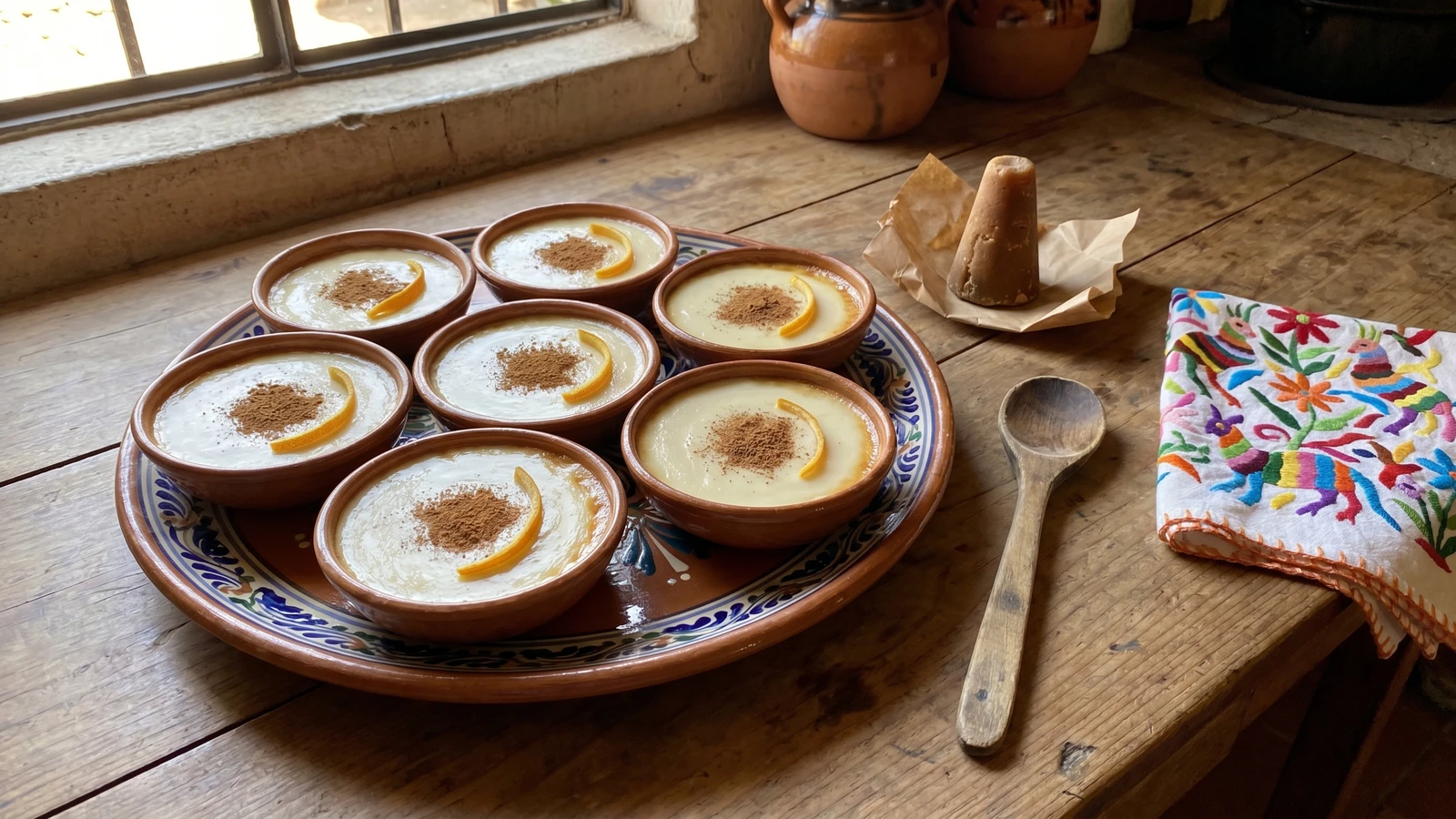
Querétaro's market custard of whole cow's milk, egg yolks, Mexican canela, and orange peel, stirred low until it turns glossy enough to serve warm or cold in clay tazones.
Querétaro, in the Bajío, is where this natilla belongs: Santiago de Querétaro, San Juan del Río, the counters around Mercado de la Cruz where milk sweets sit next to ate, charamuscas, and conservas. It is not a convent fantasy with gold leaf. It is a mercado custard, milk, egg yolk, canela, orange peel, stirred low in a pot by women who know that impatience curdles dessert faster than heat.
The geography here is dairy. Querétaro sits in a Bajío corridor of ranches and home dairies, so the milk matters. Use leche entera de vaca, not thin low-fat milk. Leche de cabra belongs to cajeta and other sweets; this natilla wants the clean, round body of cow's milk. Mexican canela should be thin and brittle, and the orange peel should have no white pith. If you taste bitterness, you cut badly. Don't blame the recipe.
I learned this style from a señora at Mercado de la Cruz who kept one hand on the wooden spoon and one eye on my face to see if I would rush. She said nothing dramatic, just no lo hiervas, don't let it boil. She was right. Natilla is a lesson in low heat, steady stirring, and knowing when the spoon is telling you enough. Saber cocinar es saber vivir. Cada estado, su propia cocina.
Natilla descends from Iberian egg-and-milk custards that came to New Spain during the colonial period, then changed in central Mexican kitchens according to local dairy, cane sugar, and market habits. In Querétaro, the dessert belongs less to the grand convent register than to the Bajío's home and dulcería economy, where 18th and 19th century dairy routes supplied milk for cajeta, leches, and custards from Querétaro through Guanajuato. Mexican canela, the thin Ceylon cinnamon favored in Mexico, reached colonial kitchens through Spanish trade networks, while citrus peel came from huertas planted across central Mexico and the Sierra Gorda.
Quantity
4 cups
fresh pasteurized whole cow's milk, not ultra-pasteurized
Quantity
1 stick, about 3 inches long
Quantity
2 wide strips
colored zest only, no white pith
Quantity
1/2 cup
Quantity
2 tablespoons
finely grated
Quantity
6
at room temperature
Quantity
1
at room temperature
Quantity
2 tablespoons
sifted
Quantity
1/4 teaspoon
Quantity
for serving
Quantity
for serving
| Ingredient | Quantity |
|---|---|
| leche entera de vacafresh pasteurized whole cow's milk, not ultra-pasteurized | 4 cups |
| Mexican canela stick | 1 stick, about 3 inches long |
| orange peelcolored zest only, no white pith | 2 wide strips |
| azúcar de caña | 1/2 cup |
| piloncillo clarofinely grated | 2 tablespoons |
| large egg yolksat room temperature | 6 |
| large whole eggat room temperature | 1 |
| fécula de maíz (maicena)sifted | 2 tablespoons |
| fine sea salt | 1/4 teaspoon |
| ground Mexican canela (optional) | for serving |
| thin orange peel strips (optional) | for serving |
Pour the leche entera de vaca into a heavy saucepan. Add the Mexican canela, orange peel, azúcar de caña, grated piloncillo, and salt. Set over medium-low heat and stir until the sugars dissolve and the milk trembles at the edge of the pot, 8 to 10 minutes. Do not boil it. Turn off the heat, cover, and let the canela and orange peel sit in the milk for 10 minutes. The peel should perfume the milk, not make it bitter.
In a medium bowl, whisk the egg yolks, whole egg, and sifted maicena until smooth and pale. No dry starch should remain at the bottom of the bowl. The maicena gives this natilla enough body to sit properly in a mercado cup. The yolks give it its finish.
Remove the canela stick and orange peel from the hot milk. Whisking constantly, ladle about 1 cup of hot milk into the egg mixture in a thin stream. Add another cup the same way. Now pour the warmed egg mixture back into the pot with the remaining milk. If you dump hot milk into eggs all at once, you get sweet scrambled egg. No me vengas con atajos.
Set the pot over low heat. Stir constantly with a wooden spoon, scraping the bottom and corners in slow figure eights. Cook 8 to 12 minutes, until the natilla turns glossy and coats the back of the spoon. Draw a finger through the coating. If the line holds, it is ready. If using a thermometer, stop at 175F to 180F (79C to 82C). Do not let it bubble. Low heat is the discipline here. Así se hace y punto.
Pass the natilla through a fine-mesh strainer into a pitcher. Do not skip this. The strainer catches any thread of cooked egg and gives the custard the smooth texture people expect from the dulcerías around Mercado de la Cruz. Divide the natilla among 6 small clay tazones or glass dulcería cups. Tap each cup lightly on the counter to level the surface.
Dust the surface with ground Mexican canela while the natilla is still tacky. For a warm serving, let the tazones rest 15 minutes, then add a thin strip of orange peel and take them to the table. For a cold serving, cool 30 minutes, cover, and refrigerate at least 4 hours. Serve in the same tazones. This is a market dessert, modest on the table and serious in the hand. Recetas probadas y garantizadas.
1 serving (about 205g)
Culinary guides, cultural storytelling, and the editorial depth that makes cooking meaningful.
Discover Culinary ExplorerChef Lupita
Puebla's convent-style acitrón, made from cidra peel instead of endangered biznaga, built through repeated syrup soakings until the cubes turn firm, translucent, and ready for rosca or chiles en nogada.

Chef Lupita
Ciudad de México's Tulyehualco alegría is popped huautli folded into piloncillo honey, pressed with peanuts, pepitas, and raisins, then cut into the rectangular bars that built a pueblo's identity.

Chef Lupita
Oaxaca's pre-Columbian amaranth bar, popped on a hot comal and bound with piloncillo, honey, and the sacred Zapotec grain that the Spanish tried, and failed, to outlaw.

Chef Lupita
Querétaro's mercado candy of popped amaranto pressed with dark piloncillo syrup, pepitas, pecans, and cacahuate, a Bajío sweet that respects the seed before it decorates the table.