
Chef Jeong-sun
Agwi-jjim (Braised Monkfish with Bean Sprouts)
Firm monkfish buried under crisp soybean sprouts, minari, and a red gochugaru sauce thickened at the end; Masan's market dish asks for heat, timing, and a steady hand.
A cooking platform built around craft, culture, and the stories behind what we eat.
Created by
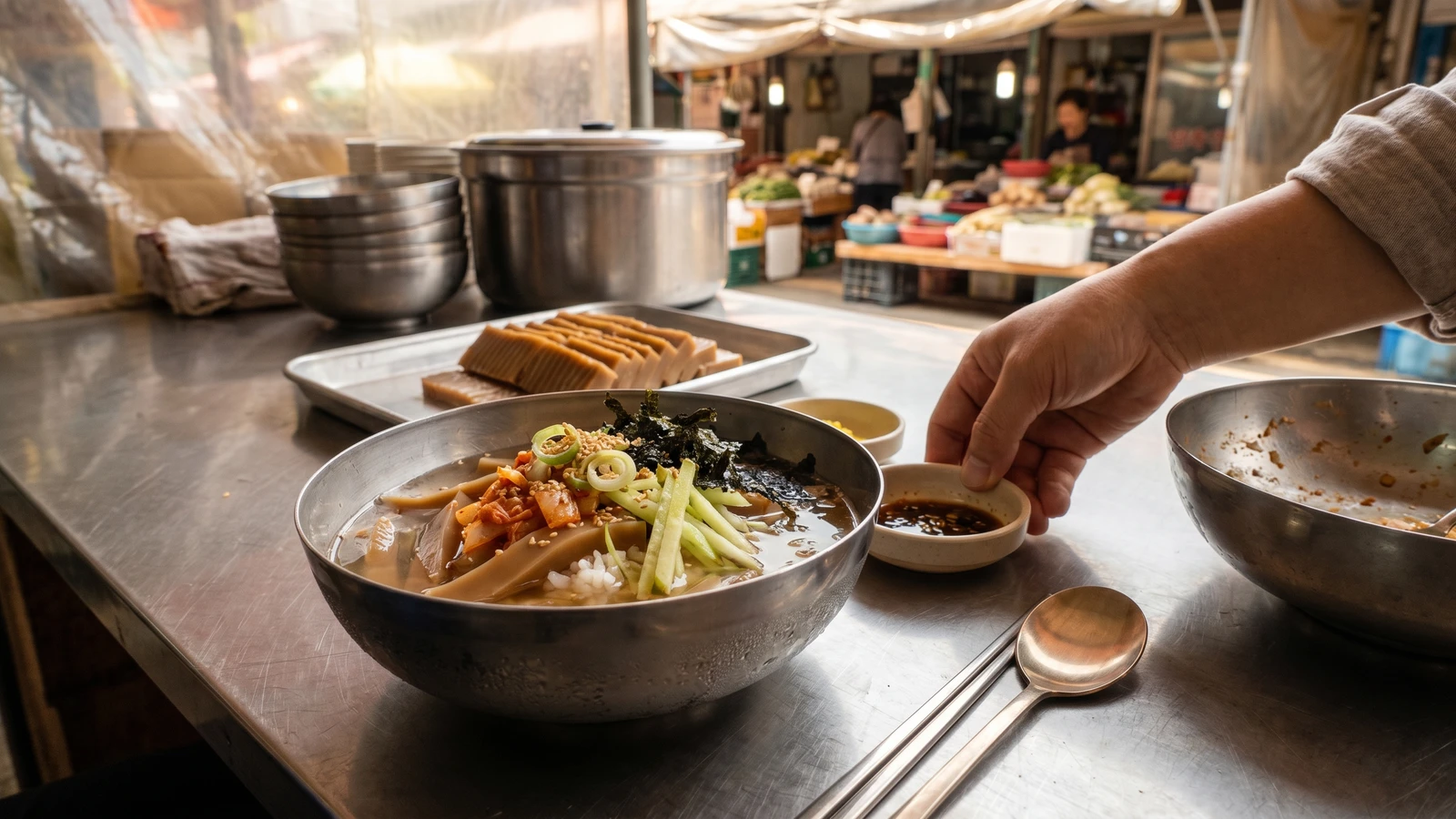
Cool anchovy-kelp broth, soft acorn jelly, and a little rice in one bowl, the Gangwon and Chungcheong summer meal that asks for clean knife work and restrained seasoning.
Muk-bap belongs to hot days and mountain markets, where acorn jelly sits in brown blocks and the broth is cold enough to make you drink from the bowl. It is not a dish that wins by richness. It wins by being clean, light, and correctly cut.
The muk (acorn jelly) must be sliced into strips that fit the spoon. Too thick, and it sits heavy. Too thin, and it breaks before it reaches your mouth. The broth should taste savory first, then faintly sharp from kimchi brine or vinegar, because the rice and jelly will soften every edge once they meet. Measure the seasoning before you call it simple. 손맛 is real; I measure it anyway.
Use store-bought dotorimuk (acorn jelly) without shame if it is fresh and springy. 시대가 바뀌면 음식도 바뀌어야 해요. When times change, food must change too. The safe corner to cut is buying the jelly. The corner you do not cut is the broth: pull the kelp before it turns bitter, chill it hard, and season it so each ingredient still tastes like itself.
Dotorimuk, acorn starch jelly, is strongly associated with Korea's mountain regions, especially Gangwon and Chungcheong, where acorns were gathered, leached, and ground into starch during lean seasons. Muk-bap grew from that practical food, turning sliced acorn jelly into a light meal with rice, broth, kimchi, and gim, and it remains common in market stalls and home kitchens rather than formal banquet cooking. Cold versions suit summer, while warm broth versions appear in colder months.
Quantity
500g
Quantity
1 1/2 cups
warm or room temperature
Quantity
5 cups
Quantity
12
heads and guts removed
Quantity
1 piece, about 4 inches square
Quantity
1
Quantity
1 tablespoon
Quantity
1/2 teaspoon, plus more if needed
Quantity
1 tablespoon
Quantity
2 tablespoons
strained
Quantity
3/4 cup
chopped small
Quantity
1 teaspoon
for seasoning kimchi
Quantity
1/2 teaspoon
Quantity
1/2 small
julienned
Quantity
2 sheets
crushed
Quantity
1
thinly sliced
Quantity
1 teaspoon
Quantity
2 tablespoons
for seasoned soy
Quantity
1 tablespoon
for seasoned soy
Quantity
1 teaspoon
for seasoned soy
Quantity
1 teaspoon
for seasoned soy
Quantity
1 small clove
minced
Quantity
1 teaspoon
finely chopped, for seasoned soy
| Ingredient | Quantity |
|---|---|
| dotorimuk (Korean acorn jelly) | 500g |
| cooked short-grain white ricewarm or room temperature | 1 1/2 cups |
| water | 5 cups |
| large dried anchovies (myeolchi)heads and guts removed | 12 |
| dried kelp (dasima) | 1 piece, about 4 inches square |
| dried shiitake mushroom (optional) | 1 |
| soup soy sauce (guk-ganjang) | 1 tablespoon |
| fine sea salt | 1/2 teaspoon, plus more if needed |
| rice vinegar | 1 tablespoon |
| well-fermented kimchi brine (optional)strained | 2 tablespoons |
| napa cabbage kimchichopped small | 3/4 cup |
| toasted sesame oilfor seasoning kimchi | 1 teaspoon |
| sugar | 1/2 teaspoon |
| cucumberjulienned | 1/2 small |
| roasted gimcrushed | 2 sheets |
| scallionthinly sliced | 1 |
| toasted sesame seeds | 1 teaspoon |
| soy saucefor seasoned soy | 2 tablespoons |
| waterfor seasoned soy | 1 tablespoon |
| gochugaru (Korean chili flakes)for seasoned soy | 1 teaspoon |
| toasted sesame oilfor seasoned soy | 1 teaspoon |
| garlicminced | 1 small clove |
| scallionfinely chopped, for seasoned soy | 1 teaspoon |
Put the water, anchovies, kelp, and dried shiitake if using in a pot over medium heat. When the water reaches a gentle simmer, pull out the kelp right away, because kelp left too long turns the broth slick and bitter. Simmer the anchovies and shiitake 10 minutes more, then strain. You should have about 4 cups of clear broth.
While the broth is still warm, stir in the soup soy sauce, sea salt, rice vinegar, and strained kimchi brine if using. Taste it now. It should be a little saltier and sharper than you want the finished bowl, because rice and acorn jelly will quiet it. Cool, then refrigerate until very cold, at least 1 hour.
Rinse the dotorimuk gently under cold water and pat it dry. Slice it into strips about 2 1/2 inches long, 1/2 inch wide, and 1/3 inch thick. This size matters: it fits on a spoon with rice and broth, and it holds together without feeling clumsy.
In one small bowl, mix the chopped kimchi with 1 teaspoon sesame oil and 1/2 teaspoon sugar. In another bowl, stir together the soy sauce, 1 tablespoon water, gochugaru, 1 teaspoon sesame oil, minced garlic, and chopped scallion for the seasoned soy. Keep these separate. Kimchi has its own sourness, and the seasoned soy is for the eater to adjust at the table.
Divide the rice between two deep bowls, using 3/4 cup rice per bowl. Lay the sliced acorn jelly over the rice, then ladle about 2 cups cold broth into each bowl. The rice should loosen in the broth, not mound above it.
Top each bowl with seasoned kimchi, cucumber, crushed gim, sliced scallion, and sesame seeds. Serve the seasoned soy on the side, adding 1 to 2 teaspoons per bowl first, then more only after tasting. Muk-bap should stay light enough to drink from the bowl.
1 serving (about 1050g)
Culinary guides, cultural storytelling, and the editorial depth that makes cooking meaningful.
Discover Culinary ExplorerChef Jeong-sun
Firm monkfish buried under crisp soybean sprouts, minari, and a red gochugaru sauce thickened at the end; Masan's market dish asks for heat, timing, and a steady hand.

Chef Jeong-sun
A quick Korean rice bowl built on contrast: warm rice, cold popping flying-fish roe, chopped vegetables, gim, sesame oil, and the crisp rice bottom a hot stone bowl gives you.
Chef Jeong-sun
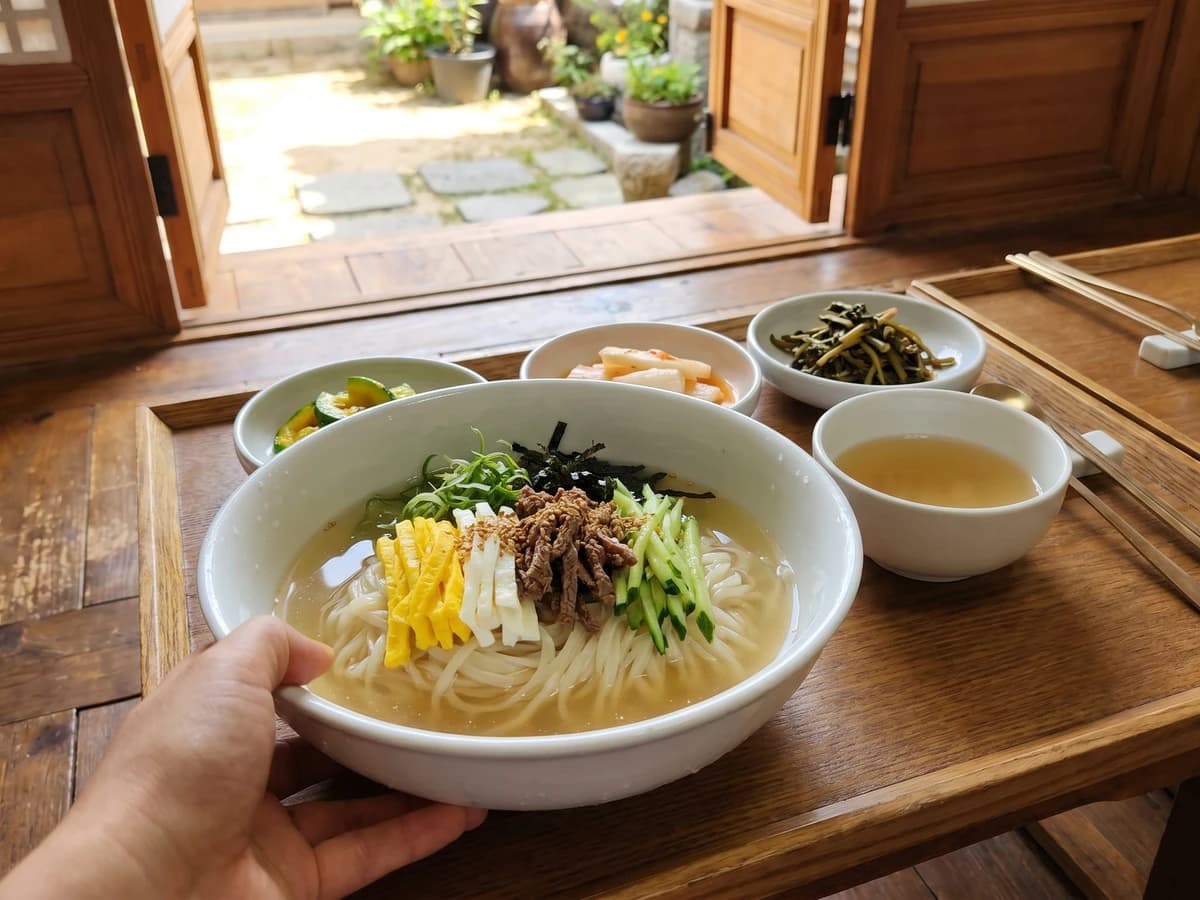
Andong's guest noodles, wheat and roasted soybean flour rolled thin, boiled and rinsed cold, then set in a clear chilled anchovy broth with careful strips of beef, egg, and cucumber.

Chef Jeong-sun
Andong's ritual-table rice served on an ordinary day: separate soy-sesame namul, warm rice, and clear radish soup, mixed without gochujang so every vegetable keeps its own voice.