
Chef Elsa
Allerheiligenstriezel
A rich, buttery braided bread that Austrian godfathers bring their godchildren on All Saints' Day. The golden six-strand braid is as much ritual as recipe, and the kitchen smells like love while it bakes.
A cooking platform built around craft, culture, and the stories behind what we eat.
Created by
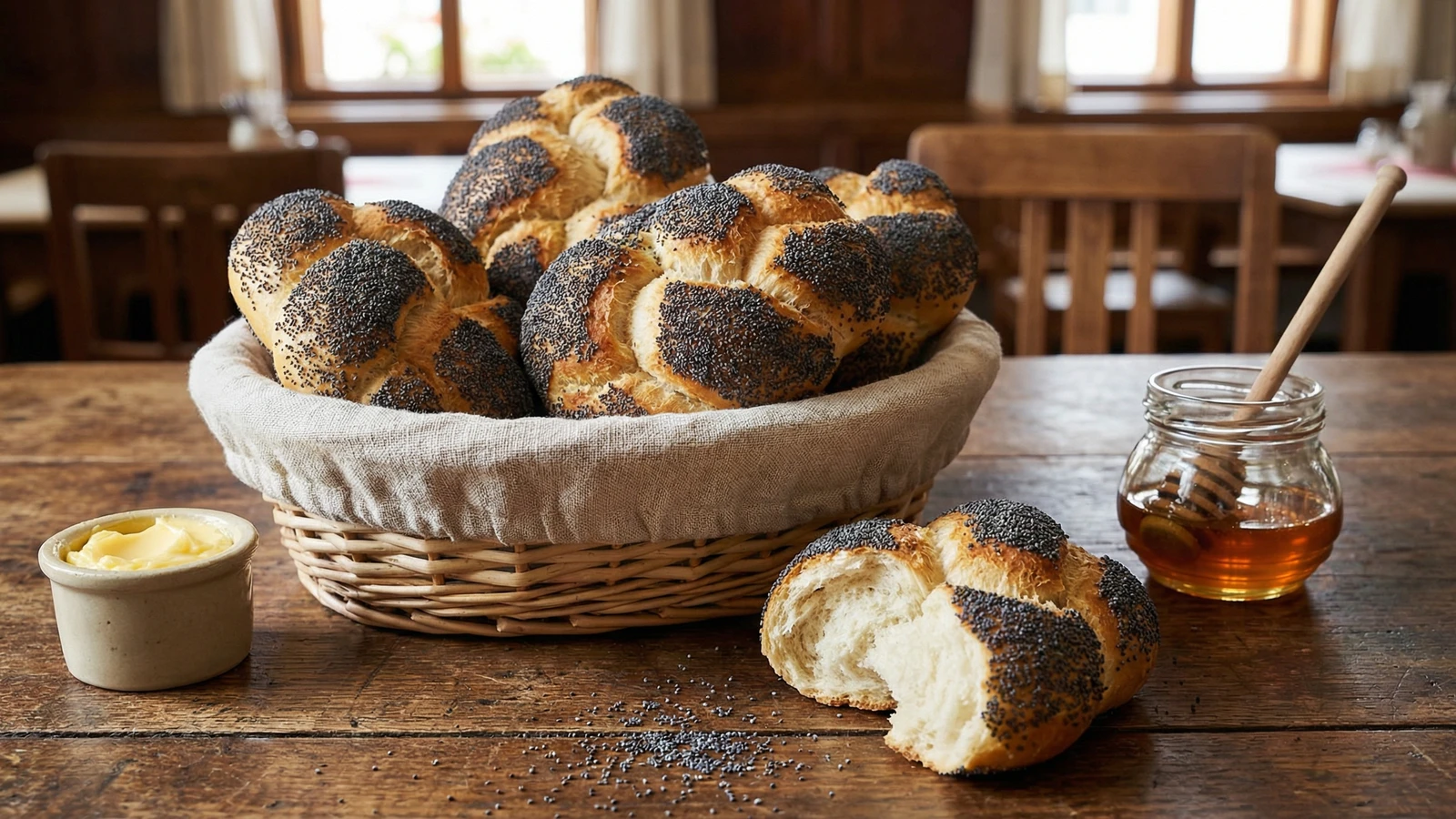
Upper Austrian braided poppy seed rolls with a soft, buttery crumb hidden under a crust of blue-black Mohn, the bread that carried salt workers down the Traun and still anchors every proper Jause.
Ifirst saw Mohnflesserl piled high in a basket at a bakery in Gmunden on one of those childhood trips through the Salzkammergut with Gretel and my grandmother Eva. I was maybe eight. The rolls were so dark with poppy seeds they looked almost black, twisted into loose braids, and when the baker broke one open for me the inside was white and soft and pulled apart in long, cottony strands. I couldn't believe the same roll could be two such different things at once: crunchy and seed-crusted on the outside, pillowy and tender within.
Mohnflesserl belong to Upper Austria the way Sachertorte belongs to Vienna. They're a Gebäck, a shaped bread roll, and the shape matters. The braid is loose, not tight. Three strands twisted together with enough space between them that the poppy seeds get into every crevice and the crust develops independently on each rope of dough. You coat the shaped rolls in poppy seeds before they go into the oven, pressing the seeds on generously so the entire surface turns blue-black. The seeds toast as the bread bakes and release that warm, nutty, almost sweet smell that fills the kitchen and tells you something good is about to come out of the oven.
The dough is a simple enriched yeast dough. Milk, butter, a little sugar, one egg. Nothing complicated. The braiding takes a few minutes of practice and then you'll have it for life. Gretel always said that a good Austrian cook should be able to shape a Flesserl with her eyes closed, and while I wouldn't go that far, I will say this: once your hands learn the twist, they remember it. Make a batch on a Sunday, freeze what you don't eat that day, and you'll have proper Austrian rolls all week.
The name Flesserl comes from Flößer, the raftsmen who transported salt on flat wooden rafts down the Traun river from the mines at Hallstatt and Bad Ischl through the Salzkammergut to the Danube. The braided shape of the roll is said to echo the twisted ropes used to lash the salt barrels to the rafts. Poppy seeds have been cultivated in the Waldviertel region of Lower Austria for centuries, and Mohn (poppy) appears across Austrian baking in everything from Mohnstrudel to Mohnzelten. The Mohnflesserl became the signature bread roll of Upper Austria, and bakeries in Linz and Gmunden still sell hundreds each morning.
Quantity
500g
Quantity
7g
Quantity
250ml
lukewarm
Quantity
50g
softened
Quantity
1 large
Quantity
30g
Quantity
8g
Quantity
80g
for coating
Quantity
1
mixed with 1 tablespoon milk for egg wash
| Ingredient | Quantity |
|---|---|
| plain flour (glattes Mehl) | 500g |
| dried yeast (or 20g fresh yeast) | 7g |
| whole milklukewarm | 250ml |
| unsalted buttersoftened | 50g |
| egg | 1 large |
| granulated sugar | 30g |
| fine salt | 8g |
| blue poppy seeds (Mohn)for coating | 80g |
| egg yolkmixed with 1 tablespoon milk for egg wash | 1 |
Warm the milk until it feels like a comfortable bath, around 37°C. If you're using fresh yeast, crumble it into the milk with a pinch of the sugar and stir until dissolved. For dried yeast, sprinkle it over the surface and let it sit for five minutes until it foams. If it doesn't foam, your yeast is dead and no amount of kneading will save the dough. Start again with fresh yeast.
Put the flour in a large bowl and make a well in the center. Pour in the yeast mixture, then add the softened butter, egg, sugar, and salt. Bring it together with a wooden spoon until it forms a shaggy mass, then turn it out onto a clean surface and knead by hand for ten minutes. The dough will be sticky at first. Resist the urge to add more flour. Keep working it. After ten minutes it should be smooth, elastic, and slightly tacky to the touch. When you poke it with your finger, it should spring back slowly. That's the gluten telling you it's ready.
Shape the dough into a ball and place it in a lightly oiled bowl. Cover with a clean tea towel and leave it somewhere warm for about an hour, until it has doubled in size. The top of a preheating oven works if your kitchen runs cold. Don't rush this. The yeast needs time to develop flavor, not just volume. A slow rise in a cooler spot actually produces better bread than a fast rise in a hot one.
Punch the dough down gently and turn it out onto a lightly floured surface. Divide it into eight equal pieces. Take one piece and divide it into three smaller portions. Roll each portion into a strand about 25 centimeters long, using your palms and working from the center outward. The strands should be even in thickness. If they keep springing back, let them rest for two minutes under the towel and try again. The gluten needs a moment to relax before it will cooperate.
Pinch three strands together firmly at one end. Braid them loosely, left over center, right over center, the same way you'd braid hair or challah. Keep the braid relaxed. You want gaps between the strands so the poppy seeds settle into the crevices and the dough has room to expand. Pinch the other end and tuck both ends underneath. The finished roll should look like a plump little rope, about 12 centimeters long. Repeat with the remaining dough.
Spread the poppy seeds in an even layer on a wide plate. Beat the egg yolk with a tablespoon of milk to make your egg wash. Brush each braided roll generously with the egg wash on all sides, then lay it in the poppy seeds and turn it, pressing gently, until every surface is coated in a thick layer of blue-black seeds. Don't be shy. The seeds are the whole identity of this bread. A thin, patchy coating is worse than no coating at all. Place the coated rolls on a baking tray lined with parchment, leaving space between them.
Cover the tray loosely with a tea towel and let the rolls prove for thirty minutes. They should puff up visibly but not double. Meanwhile, preheat your oven to 200°C (190°C fan). The oven needs to be fully hot when the rolls go in. A blast of heat in the first few minutes is what gives you that crackling crust.
Place a small oven-safe dish of water on the bottom rack of the oven. This creates a burst of humidity in the first minutes of baking that helps the crust develop properly. Slide the tray onto the middle rack and bake for 18 to 20 minutes. The rolls are done when the poppy seed crust is dark and fragrant and the bottom sounds hollow when you tap it. Pull them out and let them cool on a wire rack for at least ten minutes. The crumb is still setting inside and cutting too early will give you a gummy center.
Serve the Mohnflesserl warm or at room temperature with good butter, a pot of honey, and a slab of cheese if you're making a proper Jause. They're at their absolute best the day they're baked, when the crust still crackles when you tear into them and the crumb pulls apart in soft, fragrant strands. Mahlzeit!
1 serving (about 110g)
Culinary guides, cultural storytelling, and the editorial depth that makes cooking meaningful.
Discover Culinary ExplorerChef Elsa
A rich, buttery braided bread that Austrian godfathers bring their godchildren on All Saints' Day. The golden six-strand braid is as much ritual as recipe, and the kitchen smells like love while it bakes.

Chef Elsa
Austria's rye sourdough farmhouse loaf, dark-crusted and tangy, laced with hand-crushed Brotgewürz, the kind of bread that fills a kitchen with the smell of caraway and makes everything else on the table taste better.
Chef Elsa
Buttery Viennese crescents, golden with egg wash and soft as a Sunday morning, shaped the way Viennese bakers have shaped them for eight hundred years.

Chef Elsa
Vienna's five-petaled imperial roll, hand-folded into a star and baked until the crust shatters at first touch, with a crumb so soft and airy it barely weighs a thing.