
Chef Elsa
Allerheiligenstriezel
A rich, buttery braided bread that Austrian godfathers bring their godchildren on All Saints' Day. The golden six-strand braid is as much ritual as recipe, and the kitchen smells like love while it bakes.
A cooking platform built around craft, culture, and the stories behind what we eat.

Created by
Austria's rye sourdough farmhouse loaf, dark-crusted and tangy, laced with hand-crushed Brotgewürz, the kind of bread that fills a kitchen with the smell of caraway and makes everything else on the table taste better.
On those childhood trips to Austria with Gretel and my grandmother Eva, the bread was the first thing I noticed every morning. Thick slices of dark Bauernbrot on a wooden board at the Gasthaus breakfast table, a crust so solid you could knock on it, crumb that was dense and tangy and speckled with caraway seeds. I'd eat it with butter and nothing else. I didn't need anything else.
Bauernbrot means farmhouse bread, and it is exactly what it claims to be. This is the bread Austrian farming families have baked for centuries: rye-heavy, sourdough-leavened, scented with Brotgewürz, the signature spice blend of caraway, fennel, anise, and coriander that makes Austrian bread smell like Austria. You know it the moment someone cuts a loaf open. That warm, earthy, slightly sweet spice hits you before you've even reached for a slice.
The technique is simpler than most people expect. You build a levain the night before, mix a sticky rye dough the next morning, let time and the sourdough do their work, and bake it in a hot pot. There's no kneading to speak of, no complicated shaping. Rye dough doesn't want to be handled the way wheat does. It's heavier, stickier, and it plays by its own rules. Once you accept that, the bread practically makes itself.
Gretel always said that good bread is the foundation of a good table. She was right. A proper Bauernbrot lasts nearly a week, getting denser and more flavorful as it sits. Day one, you eat it with butter. Day three, you toast it. Day five, you make Brotsuppe or Knödel from the last of it. Nothing goes to waste. This is good Austrian home cooking at its most fundamental.
Rye bread has been the staple of Alpine Austria since the Middle Ages, when rye was one of the few grains that could survive the short growing seasons and harsh soils above 600 meters. The use of sourdough was a practical necessity: without commercial yeast, which didn't become widely available until the late 19th century, natural fermentation was the only way to leaven dense rye flour. Brotgewürz, the signature Austrian bread spice blend, varies by region. Caraway dominates everywhere, but Tyrolean bakers lean heavier on fennel, while Styrian versions sometimes add fenugreek. The spices were originally valued as much for their digestive properties as their flavor, helping the body process the heavy rye crumb.
Quantity
50g
Quantity
400g
divided: 100g for levain, 300g for dough
Quantity
200g
Quantity
380ml
divided: 100ml for levain, 280ml for dough
Quantity
12g
Quantity
1 tablespoon
Quantity
1 teaspoon
Quantity
1 teaspoon
Quantity
1 teaspoon
Quantity
for dusting
| Ingredient | Quantity |
|---|---|
| active rye sourdough starter (Sauerteig) | 50g |
| rye flour (Roggenmehl)divided: 100g for levain, 300g for dough | 400g |
| strong bread flour | 200g |
| warm waterdivided: 100ml for levain, 280ml for dough | 380ml |
| fine sea salt | 12g |
| caraway seeds (Kümmel) | 1 tablespoon |
| fennel seeds (Fenchel) | 1 teaspoon |
| anise seeds (Anis) | 1 teaspoon |
| coriander seeds (Koriander) | 1 teaspoon |
| rye flour | for dusting |
The night before you bake, stir together 50g of your rye sourdough starter with 100g rye flour and 100ml warm water in a medium bowl. Mix until no dry flour remains. Cover with a plate or damp cloth and leave it on the counter overnight, eight to twelve hours. By morning it should be bubbly, domed, and smell sour and yeasty, like a brewery in the best possible way. This is your Sauerteig. It's the engine of the whole loaf. If it hasn't risen or bubbled, your starter isn't active enough. Feed it for another day or two before you try again.
Measure the caraway, fennel, anise, and coriander seeds into a dry pan. Toast them over medium heat for about two minutes, shaking the pan often, until you can smell them from across the kitchen. The caraway will go slightly darker. The coriander will start to pop. Tip them into a mortar and crush them lightly, just enough to crack the seeds open. You're not making powder. You want rough, uneven pieces that will release their oils slowly as the bread bakes and give you those little bursts of flavor when you bite through the crumb.
In a large bowl, combine the remaining 300g rye flour with the 200g bread flour and the salt. Add all of the overnight levain and 280ml warm water. Stir everything together with a wooden spoon or your hand until you have a shaggy, sticky mass. Rye dough does not behave like wheat dough. It's tackier, heavier, and it will never develop the same stretch. That's normal. Don't add more flour because it feels wrong. Add the crushed Brotgewürz and work it through the dough until the spices are evenly distributed. Mix for another three to four minutes. The dough should be cohesive and thick, pulling away from the sides of the bowl in a reluctant, sticky way.
Cover the bowl with a damp cloth and let the dough rest at room temperature for three to four hours. It won't double the way a white bread dough does, but you should see it rise by about a third, with small bubbles visible on the surface and around the edges. The dough will feel lighter and slightly more aerated when you press it gently. In a cold kitchen this takes longer. In summer it may be faster. Watch the dough, not the clock.
Dust your work surface generously with rye flour. Scrape the dough out of the bowl onto it. Wet your hands. Rye dough sticks to everything dry, but it respects wet hands. Shape it into a round boule by tucking the edges underneath, turning the ball as you go, building tension on the surface. It doesn't need to be perfect. Bauernbrot is farmhouse bread. It should look like a person made it, not a machine. Dust the top and bottom with rye flour and place it seam side up in a well-floured banneton or a bowl lined with a heavily floured linen cloth.
Cover the shaped loaf loosely and let it proof for sixty to ninety minutes at room temperature. It should grow noticeably but not dramatically. When you press the surface gently with a floured finger, the dough should spring back slowly and leave a slight indentation. If it springs back fast, give it more time. If the dent stays completely, you've gone too far, but don't worry. A slightly overproofed Bauernbrot is still a good Bauernbrot. Thirty minutes before the loaf is ready, place your Dutch oven with its lid into the oven and preheat to 250°C (480°F).
Carefully turn the proofed loaf out of the banneton onto a sheet of baking paper. It should land seam side down. Score the top with a sharp knife or razor blade: a cross, a single slash, a square, whatever speaks to you. The score isn't decoration. It controls where the loaf expands so it doesn't tear unpredictably in the oven. Lower the loaf on its paper into the screaming hot Dutch oven. Put the lid on. Bake at 250°C for twenty minutes with the lid on. The trapped moisture gives the crust its thick, dark, crackled character. Remove the lid, reduce the temperature to 210°C (410°F), and bake for another thirty to thirty-five minutes until the crust is deeply bronzed, almost mahogany, and the loaf sounds hollow when you tap the bottom. Let it cool completely on a wire rack. This is the hardest part. The crumb is still setting as it cools. Cut into it too early and you'll have a gummy center. Give it at least two hours. Three is better.
1 serving (about 78g)
Culinary guides, cultural storytelling, and the editorial depth that makes cooking meaningful.
Discover Culinary ExplorerChef Elsa
A rich, buttery braided bread that Austrian godfathers bring their godchildren on All Saints' Day. The golden six-strand braid is as much ritual as recipe, and the kitchen smells like love while it bakes.
Chef Elsa
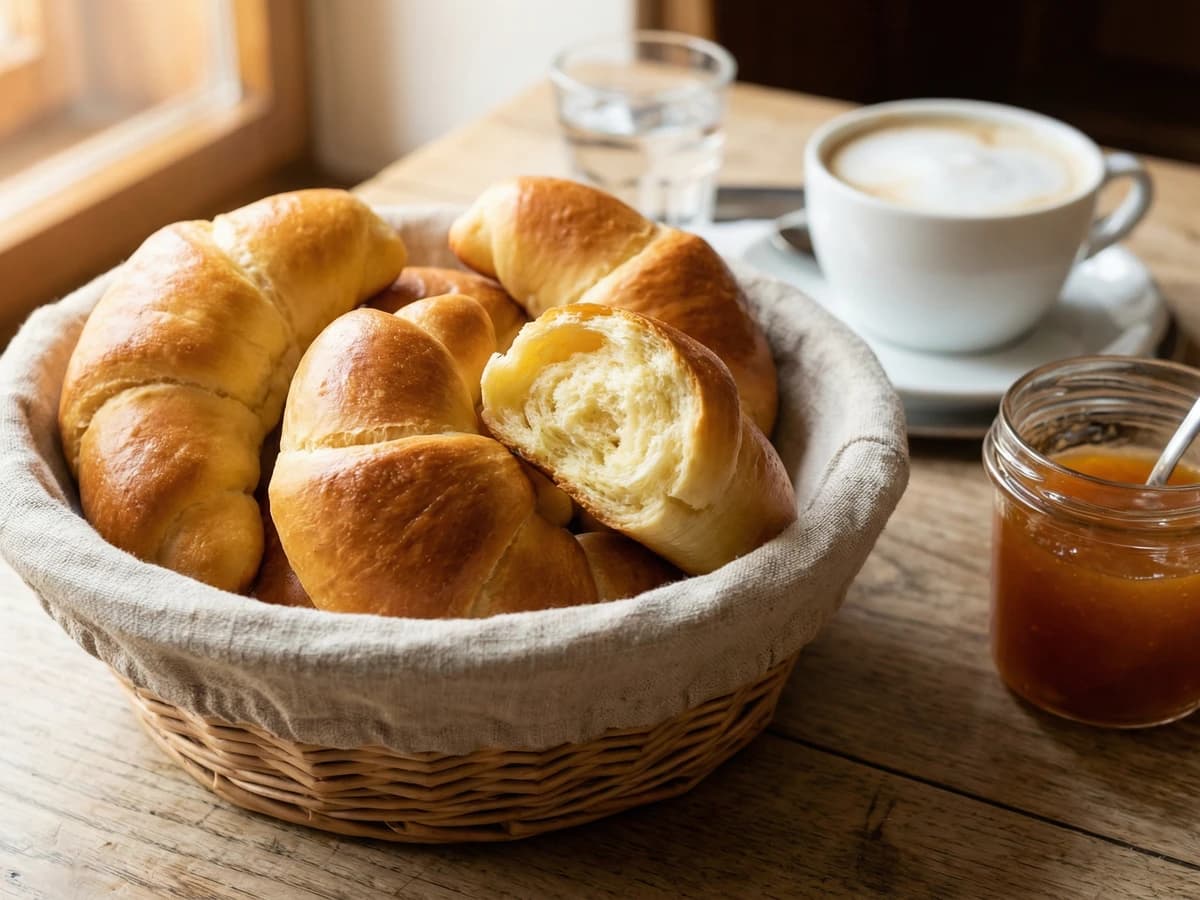
Buttery Viennese crescents, golden with egg wash and soft as a Sunday morning, shaped the way Viennese bakers have shaped them for eight hundred years.

Chef Elsa
Vienna's five-petaled imperial roll, hand-folded into a star and baked until the crust shatters at first touch, with a crumb so soft and airy it barely weighs a thing.

Chef Elsa
Tyrolean Advent bread so dense with rum-soaked pears, figs, walnuts, and warming spices that the dough is barely holding things together. Baked on St. Thomas's Day, patient until Christmas.