
Chef Lupita
Aguascalientes Beef Tongue Pozole (Pozole de Lengua)
Aguascalientes' Bajio pozole de lengua, built with cacahuazintle hominy, tender beef tongue, chile ancho and guajillo, with xoconostle brightness and table garnishes.
A cooking platform built around craft, culture, and the stories behind what we eat.
Created by
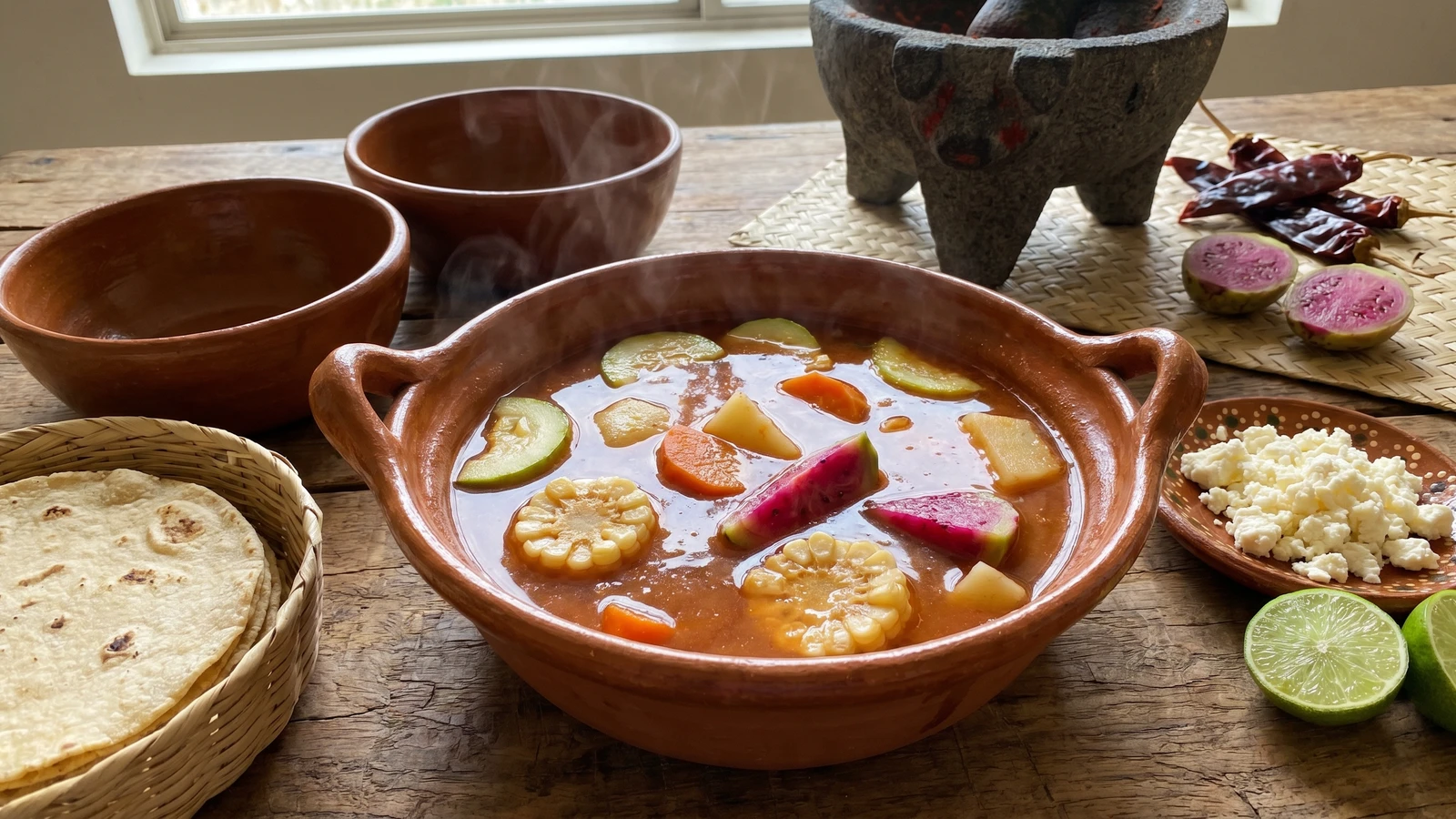
Southwest Guanajuato's Caldo de Zorra is an acidic xoconostle broth from Manuel Doblado, built with guajillo, chilcuague, corn, vegetables, and the patience of Bajio home kitchens.
Guanajuato, southwest Bajio, Manuel Doblado. That is where this broth lives. Caldo de Zorra belongs to the rainy season, when the fields soften, the nopaleras give xoconostles, and the market basket comes home with corn, squash, potatoes, tomato, and herbs. This is not a heavy meat stew. It is a sharp, clean broth where the acidic tuna of the xoconostle does the work.
The defining ingredient is xoconostle, the sour cactus fruit that too many cooks outside the Bajio confuse with sweet tuna. No. Xoconostle is tart, almost mineral, and it gives the broth its spine. The chile guajillo gives color. The chilcuague, that small Bajio root with a numbing heat, gives a prickle that belongs to Guanajuato and the Sierra Gorda corridor. If you cannot find chilcuague, I will tell you how to cook without it, but do not pretend the result is the same.
I learned this style of broth from cocineras between Leon, Manuel Doblado, and the Querétaro side of the old Camino Real de Tierra Adentro. They cook what the milpa and the mercado give them: cacahuazintle when there is good corn, calabacita when it is tender, epazote because beans and corn understand epazote better than any imported herb. The pot is humble only if you do not know how to read it.
Serve it in barro, with hand-pressed corn tortillas and queso ranchero on the table if your family eats it that way. No cheddar. No sour cream. No flour tortillas here. Cada estado, su propia cocina.
Caldo de Zorra is associated with Manuel Doblado in southwest Guanajuato, a Bajio municipality shaped by rain-fed agriculture, cattle country, and the old Camino Real de Tierra Adentro. Xoconostle was used in central Mexican cooking before the Spanish conquest, valued less for sweetness than for acidity, preservation, and balance in broths and salsas. The dish shows the criollo-mestizo Bajio register clearly: native cactus fruit, corn, epazote, and chile alongside later market vegetables that became daily food across Guanajuato's ranch and hacienda kitchens.
Quantity
6 medium
peeled, seeds removed, flesh cut into wedges
Quantity
2 ears
cut into 2-inch rounds
Quantity
3 tablespoons
Quantity
4
stemmed and seeded
Quantity
1 small piece, about 1 inch
or 1/2 teaspoon finely grated dried chilcuague
Quantity
3 ripe
Quantity
1/2 medium, plus 1/4 onion
divided
Quantity
3
unpeeled
Quantity
2 medium
peeled and cut into thick rounds
Quantity
2 small
peeled and cut into large chunks
Quantity
2
cut into thick half-moons
Quantity
1 cup
trimmed and cut into 2-inch pieces
Quantity
1/2 cup
Quantity
2 sprigs
Quantity
6 cups
Quantity
1 1/2 teaspoons, plus more to taste
Quantity
for serving
crumbled
Quantity
for serving
warmed
Quantity
for serving
| Ingredient | Quantity |
|---|---|
| xoconostlespeeled, seeds removed, flesh cut into wedges | 6 medium |
| fresh cacahuazintle corn or tender field corncut into 2-inch rounds | 2 ears |
| manteca de cerdo | 3 tablespoons |
| dried chile guajillostemmed and seeded | 4 |
| dried chilcuague rootor 1/2 teaspoon finely grated dried chilcuague | 1 small piece, about 1 inch |
| Roma tomatoes | 3 ripe |
| white oniondivided | 1/2 medium, plus 1/4 onion |
| garlic clovesunpeeled | 3 |
| carrotspeeled and cut into thick rounds | 2 medium |
| potatoespeeled and cut into large chunks | 2 small |
| Mexican calabacitascut into thick half-moons | 2 |
| green beanstrimmed and cut into 2-inch pieces | 1 cup |
| cooked garbanzos (optional) | 1/2 cup |
| fresh epazote | 2 sprigs |
| water or light vegetable broth | 6 cups |
| kosher salt | 1 1/2 teaspoons, plus more to taste |
| queso ranchero (optional)crumbled | for serving |
| hand-pressed corn tortillas (optional)warmed | for serving |
| lime halves (optional) | for serving |
Cut off the ends of each xoconostle and peel away the tough outer skin with a small knife. Slice them open and scrape out the seed center, keeping the firm sour flesh. Cut the flesh into wedges. Taste one small piece. It should be tart and clean, not sweet. If it tastes like dessert fruit, you bought tuna, not xoconostle.
Heat a dry comal over medium. Toast the chile guajillo for 15 to 20 seconds per side, just until the skin darkens slightly and smells fruity. Do not let it blacken. Guajillo turns bitter fast when abused. Place the toasted chiles in a bowl and cover with hot water for 15 minutes.
On the same comal, roast the tomatoes, 1/2 onion, and unpeeled garlic until they are blistered in spots and softened. Peel the garlic. Drain the softened guajillos and blend them with the tomatoes, roasted onion, peeled garlic, chilcuague, and 1 cup of the water until very smooth. Strain if your blender leaves bits of chile skin. This is a broth, not a coarse salsa.
Melt the manteca de cerdo in a 5-quart clay cazuela or heavy pot over medium heat. Pour in the blended chile base carefully. It will sputter. Fry for 7 to 9 minutes, stirring often, until the color deepens to brick red and the fat begins to shine at the edges. La manteca es el sabor. This frying step gives the broth body without making it heavy.
Add the remaining 5 cups water or light vegetable broth, the 1/4 onion, salt, corn rounds, carrots, and potatoes. Bring to a steady simmer, then lower the heat so the pot moves gently. Cook for 25 minutes, until the corn smells sweet and the potatoes are almost tender. A hard boil breaks the vegetables and muddies the broth.
Add the xoconostle wedges, calabacitas, green beans, garbanzos if using, and epazote. Simmer 18 to 22 minutes more. The xoconostle should soften but keep its shape, and the broth should taste bright before it tastes salty. That acidity is the point. Not all Mexican food is hot. This one is sour, earthy, and clean.
Remove the spent onion and epazote stems. Taste the broth. Add salt only until the xoconostle sharpness comes forward. If the broth tastes flat, it usually needs salt, not more chile. If the chilcuague is strong, let the pot rest off heat for 10 minutes so its numbing edge settles into the broth.
Ladle the broth into deep clay bowls with corn, vegetables, and xoconostle in every serving. Put crumbled queso ranchero, warm hand-pressed corn tortillas, and lime halves on the table. The cheese is added by the diner, not melted into the pot. Recetas probadas y garantizadas.
1 serving (about 570g)
Culinary guides, cultural storytelling, and the editorial depth that makes cooking meaningful.
Discover Culinary ExplorerChef Lupita
Aguascalientes' Bajio pozole de lengua, built with cacahuazintle hominy, tender beef tongue, chile ancho and guajillo, with xoconostle brightness and table garnishes.

Chef Lupita
Veracruz's Gulf coast rice from Alvarado, built with seafood stock, tomato, chile chipotle, epazote, shrimp, fish, jaiba, and pulpo, served loose and brothy in a clay cazuela.

Chef Lupita
Costa Chica's wet salt-beef stew, built from chile costeño, guajillo, tomato, manteca, yuca, plantain, and masa dumplings, the ranching pot of Cuajinicuilapa and Pinotepa.

Chef Lupita
Michoacán's P'urhépecha atápakua is a masa-thickened sauce and stew at once, built with pork, chile guajillo, and hierbabuena added only at the end.