Culinary Explorer

A cooking platform built around craft, culture, and the stories behind what we eat.
Discover Culinary Explorer
Laulau (Hawaiian Pork and Salted Butterfish in Lūʻau Leaf)

Laulau (Hawaiian Pork and Salted Butterfish in Lūʻau Leaf)

Created by

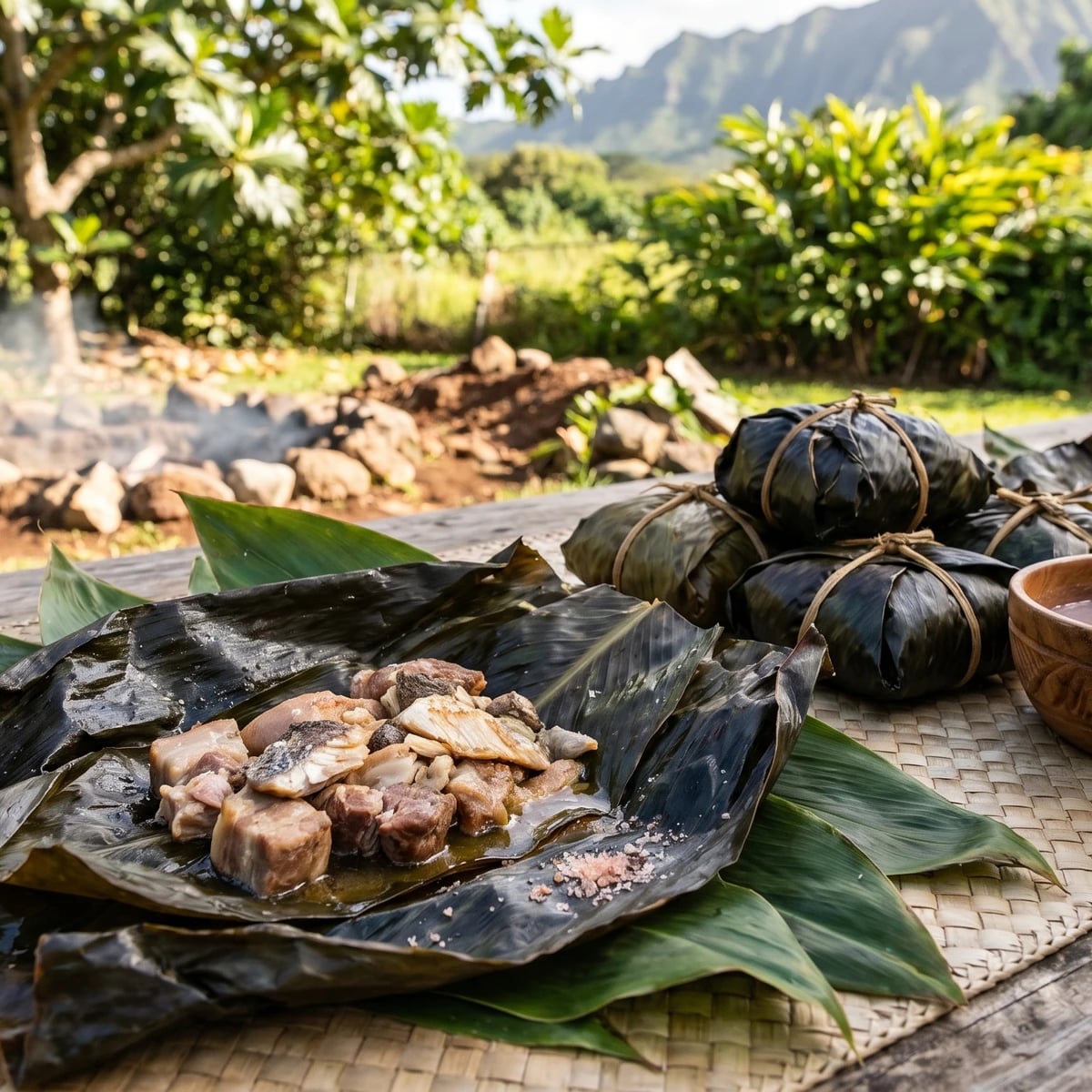
Hawaiʻi's deep leaf bundle: pork and salted butterfish wrapped in lūʻau leaf, sealed in ti, and cooked slow until the taro leaf turns silky and the meat gives.

Main Dishes
Polynesian, Hawaiian
Celebration
Special Occasion
Make Ahead
45 min
Active Time
3 hr cook3 hr 45 min total
Yield6 laulau bundles

Back home in Hawaiʻi, Hāloa sits at the edge of this bundle before the pork does. Hāloa is our elder brother, the kalo, the taro plant our people trace kinship to, and laulau is one way Hawaiʻi wraps that kin close: lūʻau leaf, the young taro leaf, around pork and salted butterfish, then lāʻī, ti leaf, around the whole thing for the imu, the Hawaiian earth oven.

I learned laulau from aunties who didn't measure much, just looked at the leaf and knew. Too small, add another. Too thin, stack it deeper. No blame the taro if it bites your throat because you rushed it. Raw taro leaf carries that sharpness, so you cook it all the way until the green goes dark, soft, and glossy, and the fat from the puaʻa, the pork, runs through the salted fish and leaf.

This is Hawaiian food, not a generic plate from some blurry ocean. Still, the cousins are right there. Sāmoa has palusami, Tonga has lū sipi and lū pulu, the Cook Islands have rukau, Tahiti has fāfā. Same leaf-and-richness gesture, each island its own hand. One ocean, one canoe, one root, but no mushing the cousins together.

If you have an imu, lay these bundles beside the kālua puaʻa and let the ground do the work. If you don't, we bring it forward into a Dutch oven or tight roasting pan, honest and unfussy. Eat what you have. Keep the leaf, keep the time, keep the respect.

Laulau belongs to Hawaiʻi, where lūʻau leaf, pork, and salted fish were wrapped in lāʻī and cooked in the imu for chiefly and family gatherings long before the dish became a plate-lunch staple. The leaf parcel has cousins across the Polynesian Triangle, including Sāmoan palusami, Tongan lū, Cook Islands rukau, and Tahitian fāfā, all tied to taro as a canoe crop carried by voyagers across the Pacific. After mission and plantation life changed Hawaiian eating, laulau kept moving, from imu ceremony to foil-wrapped home kitchens and lunch counters, proof that deep food can live in the everyday.

The technique, the tradition, and the story behind every dish.

Discover Culinary Explorer

Ingredients

pork shoulder (puaʻa)

Quantity

2 pounds

cut into 12 chunks

salted butterfish or salted black cod

Quantity

6 ounces

cut into 6 small pieces

young taro leaves (lūʻau leaf)

Quantity

36 to 48

thick stems and ribs removed

ti leaves (lāʻī)

Quantity

12

thick center ribs trimmed, or use banana leaves plus foil

paʻakai ʻalaea (Hawaiian red sea salt)

Quantity

1 tablespoon

or coarse sea salt, plus more to taste

water

Quantity

1 cup

Equipment Needed

  • Heavy 7-quart Dutch oven or deep roasting pan with a tight lid
  • Kitchen twine or strips of softened ti leaf
  • Tongs for handling hot bundles

Instructions

  1. 1

    Soak the fish

    Rinse the salted butterfish, then soak it in cool water for 20 to 30 minutes if it is very salty. Taste a tiny flake. You want it boldly seasoned, not harsh, because that salt will season the pork and leaf from inside the bundle.

  2. 2

    Season the pork

    Pat the pork dry and toss it with the paʻakai ʻalaea. The pork should look lightly sanded with salt, not crusted. Let it sit while you ready the leaves, so the seasoning starts moving into the meat.

  3. 3

    Ready the leaves

    Strip the thick stems and ribs from the lūʻau leaf so it folds without tearing. Wipe the lāʻī clean and soften each ti leaf over a warm burner or in hot water until it bends easy. Raw taro leaf can bite the throat, so remember the law here: the bundle must cook until the leaf is fully dark, silky, and tender.

    If using frozen lūʻau leaf, thaw and squeeze it gently dry. Frozen leaf is no shame. It just needs the same full cook.
  4. 4

    Build the bundle

    Lay 6 to 8 lūʻau leaves in a cross, smaller leaves in the middle, larger leaves outside. Put 2 chunks of pork and 1 piece of salted butterfish in the center. Fold the taro leaves over the filling like you're closing a hand around food for somebody you love, tight enough to hold, not so tight the leaf splits.

  5. 5

    Wrap in ti

    Set the lūʻau bundle on 2 softened ti leaves, glossy side in, and fold them around it to seal. Tie with kitchen twine, strips of ti, or wrap in foil if you're cooking in the oven. The ti leaf perfumes and protects; the foil is just the weeknight helper.

  6. 6

    Cook it slow

    For an oven version, set the bundles seam-side down in a heavy Dutch oven or roasting pan, add 1 cup water, cover tight, and cook at 325F for 3 hours. Don't keep opening it. The leaf needs time to give up its bite, the pork needs time to soften, and the butterfish needs time to melt its salt through the whole bundle.

    For an imu, place the ti-wrapped bundles in a covered pan or basket beside the kālua puaʻa and cook until the leaves are fully tender and the pork gives no fight, usually 3 to 4 hours depending on the oven.
  7. 7

    Rest and open

    Let the laulau rest 15 minutes before opening. Peel back the ti, then split the lūʻau leaf at the table. The leaf should be deep green-black and glossy, the pork soft enough to press apart with a spoon, the butterfish tucked through it in salty, rich flakes.

Chef Tips

  • Butterfish in Hawaiʻi usually means salted black cod or sablefish. If you can't find it, use a small piece of salted salmon or leave the fish out and season the pork a little more. Eat what you have, no need make it precious.
  • Never undercook lūʻau leaf. That throat itch is the taro telling you it isn't done yet. Give it more time, not more heat.
  • Laulau belongs with poi or rice, maybe lomi salmon and kālua puaʻa if you're feeding plenty people. Plate lunch kept it alive too, and I no look down on that. Deep food can ride in a takeout box and still be loved.
  • No ti leaves nearby? Banana leaves plus foil will carry you. You lose some of the Hawaiian fragrance, but the bundle still feeds the table.

Advance Preparation

  • Build the laulau bundles up to 1 day ahead and refrigerate them covered. Cook straight from cold, adding 15 to 20 minutes to the oven time.
  • Cooked laulau keeps 3 days in the fridge. Reheat covered with a splash of water until the leaf turns glossy again and the pork is hot through.
  • For a gathering, cook the day before, chill the bundles unopened, then warm them gently in a covered pan so the leaf stays tender.

Frequently Asked Questions

Nutrition Information

1 serving (about 200g)

Calories
405 calories
Total Fat
28 g
Saturated Fat
9 g
Trans Fat
0 g
Unsaturated Fat
19 g
Cholesterol
115 mg
Sodium
1750 mg
Total Carbohydrates
5 g
Dietary Fiber
3 g
Sugars
2 g
Protein
33 g

Note: Chef personas and recipes are created with AI assistance. Cook with care: follow safe food-handling practices, check doneness with a thermometer when needed, and adapt for allergies and your kitchen.

Where cooking meets culture.

Culinary guides, cultural storytelling, and the editorial depth that makes cooking meaningful.

Discover Culinary Explorer

More from The Earth Oven: One Oven, Many Names

Browse the full collection