Culinary Explorer

A cooking platform built around craft, culture, and the stories behind what we eat.
Discover Culinary Explorer
Kvashena Kapusta (квашена капуста, Ukrainian fermented cabbage)

Kvashena Kapusta (квашена капуста, Ukrainian fermented cabbage)

Created by

Cabbage looks like nothing until salt wakes it up: the bowl turns glossy, the jar starts to hiss, and winter suddenly has something green and sharp to bite.

Sauces & Condiments
Ukrainian
Make Ahead
Batch Cooking
Budget Friendly
30 min
Active Time
0 min cook30 min total
Yield1 large jar, about 2 litres

Cabbage looks like the plainest thing in the market until salt gets its hands on it. Then it softens, shines, gives up its own juice, and starts to fizz in the jar like it has opinions. Kvashena kapusta is not vinegar cabbage. It is alive first, sour second, and useful all winter.

The one thing that decides it is the salt. Twenty grams per kilo of cabbage, weighed, then massaged until the smell changes from raw brassica to something sweeter and greener. Aunt Nadia wrote only "rub until it cries," which is completely annoying and also completely accurate. The cabbage must make enough brine to cover itself.

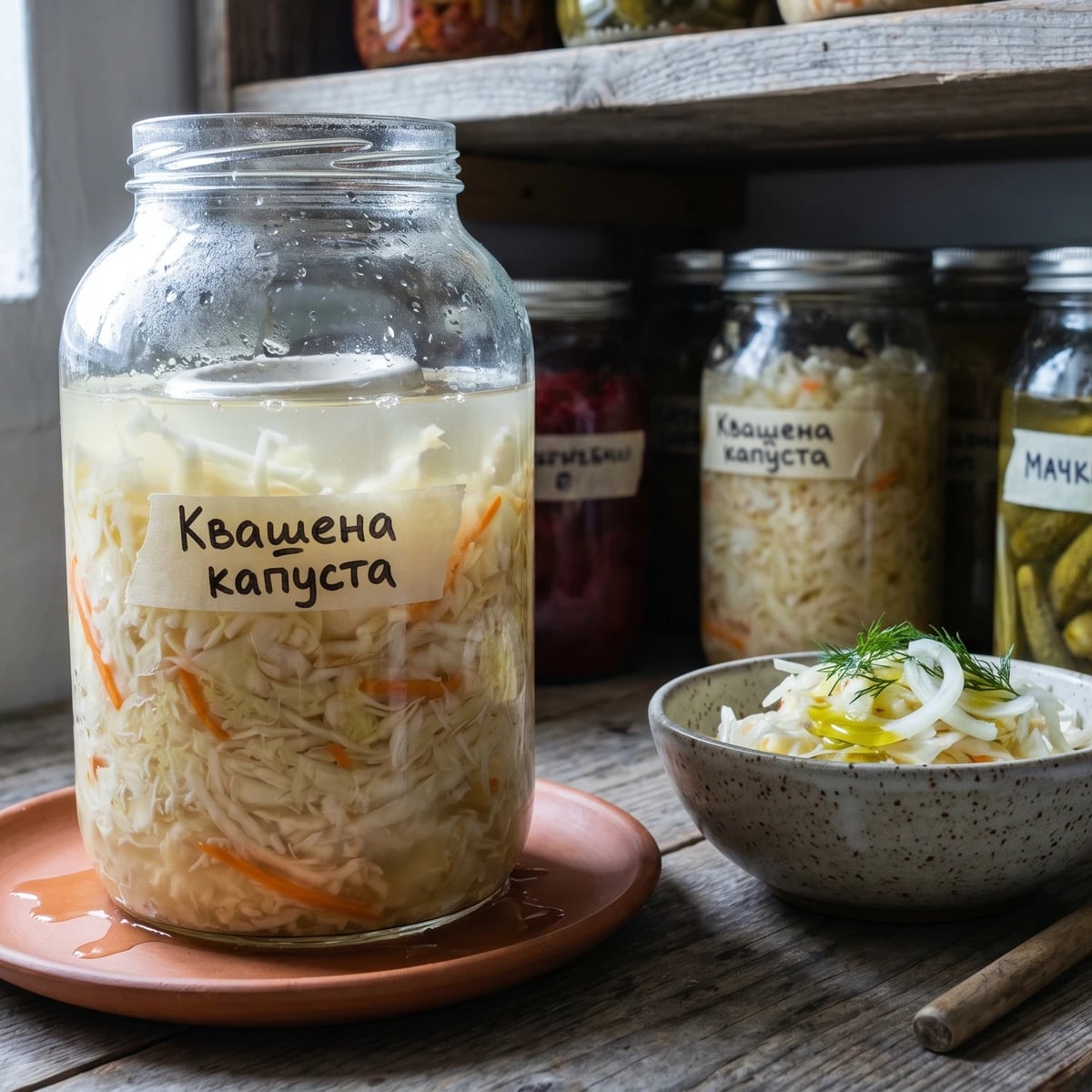
After that, you only keep it under its own brine and listen. A quiet pop, a little hiss, cloudy juice, the smell clean and sour, these are good signs. Set the jar on a plate because it will leak. The loud shelf always does.

Eat it cold with unrefined sunflower oil and onion, stir it into kapusniak, tuck it beside potatoes, or fry it with mushrooms for varenyky filling. Make a big jar. There is no tradition of a small one.

Kvashena kapusta belongs to Ukraine's winter preservation table, especially in the northern and central cabbage-growing regions, but it travelled everywhere because a barrel of sour cabbage could feed a household long after the gardens froze. Before glass jars, whole heads and shredded cabbage fermented in wooden barrels in cold pantries and litnya kuhnia, the summer kitchen, then fed soups, fillings, salads, and holiday tables. Soviet-era cookbooks often flattened this work into a standard pickle, but village cooks still argue properly about carrot, caraway, apple, cranberry, and how sour is sour enough.

The technique, the tradition, and the story behind every dish.

Discover Culinary Explorer

Ingredients

white cabbage

Quantity

2 kg

outer leaves reserved, core removed and finely shredded

fine sea salt or pickling salt

Quantity

40g

2 percent of the cabbage weight

carrot (optional)

Quantity

1 medium

coarsely grated

caraway seeds (optional)

Quantity

1 teaspoon

bay leaf (optional)

Quantity

1

sour apple (optional)

Quantity

1 small

thinly sliced

unrefined sunflower oil (optional)

Quantity

to serve

onion (optional)

Quantity

1 small

thinly sliced, to serve

fresh dill (optional)

Quantity

to serve

chopped

Equipment Needed

  • A large mixing bowl
  • A 2-litre glass fermentation jar or small crock
  • A fermentation weight or small clean jar
  • A digital scale
  • A wooden tamper or clean fist

Instructions

  1. 1

    Weigh and shred

    Pull off two clean outer cabbage leaves and keep them for the top. Quarter the cabbage, cut away the tough core, then shred the leaves as finely as your patience allows. Weigh the shredded cabbage after trimming, because the salt belongs to the cabbage you are actually fermenting.

  2. 2

    Salt the cabbage

    Sprinkle over 20g salt for every kilo of shredded cabbage. For 2 kg, that is 40g. Toss it through with your hands and leave it for a short rest, just until the cabbage starts to look wet and glossy instead of dry and stubborn.

    Do not use iodized table salt if you can avoid it; it can make ferments taste harsh. Fine sea salt or pickling salt dissolves cleanly.
  3. 3

    Rub until juicy

    Massage, squeeze, and fold the cabbage in the bowl until it softens and releases enough brine to puddle at the bottom. The sound changes from squeaky leaves to wet handfuls. The smell changes too: less raw cabbage, more green apple and field. Add the carrot, caraway, bay, or apple now if you are using them.

  4. 4

    Pack the jar

    Pack the cabbage hard into a clean jar or crock, a few handfuls at a time, pressing down with your fist or a wooden tamper so the brine rises above the cabbage. Pour in every drop from the bowl. Lay the reserved cabbage leaf over the surface, then add a fermentation weight or a small clean jar filled with water to keep everything submerged.

  5. 5

    Ferment and listen

    Set the jar on a plate, cover it loosely, and leave it at cool room temperature out of direct sun. Open or press it down once a day so trapped gas can escape and the cabbage stays below the brine. After a few days the brine will cloud, bubbles will climb, and the jar may hiss when touched. Good. It is working.

    Anything under brine is safe; anything floating above it is trouble. If a stray shred rises and dries out, lift it away with clean fingers and press the rest back down.
  6. 6

    Taste and chill

    Start tasting when it smells cleanly sour and the cabbage has gone from salty to tangy. Some kitchens get there in five days, cold ones take longer. When it is sour enough for your table, seal the jar and move it to the fridge or a cold pantry. Serve cold, dressed with green sunflower oil, onion, and dill, or cook it into soups and fillings.

Chef Tips

  • The 2 percent salt is the step that does not forgive guessing. Weigh the cabbage, then weigh the salt. After that, your hands can take over.
  • If there is not enough brine after massaging, press harder and wait before adding anything. Cabbage usually gives in. If it truly stays dry, add a little 2 percent brine, 20g salt dissolved in 1 litre water, just to cover.
  • Carrot makes it sweeter and golden, caraway makes it more northern, apple makes it fragrant. All are welcome. None are compulsory.
  • White surface film can happen and usually smells yeasty, not rotten; skim it off and keep the cabbage submerged. If it smells putrid, turns slimy, or grows fuzzy mould through the brine, throw that batch away and start again.
  • For the table, dress it at the last minute with unrefined sunflower oil. That green-gold oil is Ukraine in a bottle of oil, and it makes the sour cabbage taste rounder.

Advance Preparation

  • Ferment at room temperature for about 5 to 14 days, depending on the warmth of your kitchen and how sour you like it.
  • Once chilled, kvashena kapusta keeps for months as long as the cabbage stays under brine.
  • Make it at least a week before you want it for salads, kapusniak, or varenyky filling.

Frequently Asked Questions

Nutrition Information

1 serving (about 100g)

Calories
50 calories
Total Fat
3 g
Saturated Fat
0 g
Trans Fat
0 g
Unsaturated Fat
3 g
Cholesterol
0 mg
Sodium
720 mg
Total Carbohydrates
5 g
Dietary Fiber
2 g
Sugars
3 g
Protein
1 g

Note: Chef personas and recipes are created with AI assistance. Cook with care: follow safe food-handling practices, check doneness with a thermometer when needed, and adapt for allergies and your kitchen.

Where cooking meets culture.

Culinary guides, cultural storytelling, and the editorial depth that makes cooking meaningful.

Discover Culinary Explorer

More from Kvashennia, Sauces & Condiments

Browse the full collection