
Chef Jeong-sun
Albaechu-mul-kimchi (Baby Cabbage Water Kimchi)
Tender baby napa cabbage in a clear pear-garlic brine, lightly fermented until the broth turns clean and bright, the summer kimchi a beginner can make without a kimjang floor.
A cooking platform built around craft, culture, and the stories behind what we eat.
Created by
A clean, pale fish sauce made by salting spring sand lance until time pulls out an amber seasoning, gentle enough for white kimchi and firm enough to season a whole winter's jars.
Kkanari-aekjeot begins in spring, not in the kimchi bowl. Sand lance comes into the west-coast markets while the water is still cold, small and silver, the kind of fish people walk past if nobody taught them what it becomes. Buy it fresh or don't buy it. A fish sauce made from tired fish will remember that tiredness for a year.
This is not an evening condiment. Tonight you clean a jar, weigh fish and salt, and make a promise to your future kimchi. Kkanari-aekjeot is cleaner and paler than anchovy sauce, which is why many central and west-coast kitchens reach for it when a young cabbage kimchi, nabak-kimchi, or pale seasoning should not be darkened. The whole method is 25 percent salt, no loose water in the jar, and time enough for the fish to collapse into amber liquid.
Master Seong-nyeo never let us call fish sauce just seasoning. A tablespoon can decide whether a cabbage kimchi tastes alive or muddy. Write it down. Memory is a borrowed bowl. Once your own batch is good, mark the fish weight, salt weight, room temperature, and month, because next spring's fish will not be exactly this spring's fish.
Aekjeot (액젓) is the liquid drawn from jeotgal, salted fermented seafood, a preservation family that has belonged to Korean home and market cooking for centuries. Kkanari, sand lance caught in spring in the West Sea, became especially associated with west-coast producers from Incheon and Gyeonggi down through Chungcheong and Jeolla, where small oily fish were salted whole and aged for kimjang seasoning. Kimjang was inscribed by UNESCO in 2013, but kkanari-aekjeot itself is practical jeotgal culture, not court cuisine: a clean, light fish sauce made to season cabbage without making it heavy.
Quantity
1 kg
kept cold until salting
Quantity
1 liter
for rinsing brine
Quantity
20 g
for rinsing brine
Quantity
250 g
divided for packing
Quantity
1 tablespoon
for wiping the jar
Quantity
75 g
only for emergency covering brine
Quantity
25 g
only for emergency covering brine
| Ingredient | Quantity |
|---|---|
| very fresh whole sand lance (kkanari, 까나리)kept cold until salting | 1 kg |
| cold waterfor rinsing brine | 1 liter |
| coarse sea saltfor rinsing brine | 20 g |
| Korean coarse sea salt (cheonilyeom, 천일염), non-iodizeddivided for packing | 250 g |
| soju or high-proof clear spirit (optional)for wiping the jar | 1 tablespoon |
| boiled and cooled water (optional)only for emergency covering brine | 75 g |
| extra coarse sea salt (optional)only for emergency covering brine | 25 g |
Buy sand lance in spring, the day it was landed if your market allows it. The fish should be whole, firm, silver, and cold, with no sour smell and no broken bellies leaking into the bag. Fish sauce forgives time after the salt goes in. It forgives almost nothing before that.
Dissolve 20 g salt in 1 liter cold water. Swish the sand lance through this lightly salted water for 20 seconds, just long enough to remove sand and loose scales, then lift the fish out and drain in a colander for 30 minutes. Do not soak it. Extra water weakens the salt ratio, and the salt ratio is what keeps this safe.
Weigh the drained fish. For 1 kg fish, use 250 g coarse sea salt, exactly 25 percent of the fish weight. If your fish weighs 900 g after draining, use 225 g salt. Notebook 42 has this number underlined. Less than that is not restraint; it is spoilage dressed in hope.
Wash a 2 liter onggi crock or wide-mouth glass jar very clean, dry it completely, and wipe the inside with soju if you like. Scatter 30 g of the measured salt on the bottom. Toss the drained fish with 170 g salt in a stainless bowl, then pack it into the jar without crushing it. Cover the surface evenly with the remaining 50 g salt. The bottom salt starts the brine below, the mixed salt reaches every fish, and the top salt protects the surface while the fish begins to release liquid.
Set a clean glass or ceramic fermentation weight directly on the salted fish. Cover the jar with a loose lid or a clean cloth tied tight enough to keep insects out, but not sealed airtight. Keep it at 18 to 22 C for the first week, away from direct sun. After 24 to 48 hours, the fish should have released enough liquid to rise around the weight. If dry fish is still exposed after 48 hours, dissolve 25 g salt in 75 g boiled and cooled water and add only enough of this 25 percent brine to cover the top.
For the first week, check the jar once a day, press the weight down gently, and wipe salt crust from the rim with a clean cloth. After that, check once a month. The smell will be strong, briny, and fishy at first, then deeper and more savory as the fish collapses and amber liquid rises. Age at least 6 months; 10 to 12 months gives a rounder sauce. If you see fuzzy mold, or if the jar smells rotten, rancid, or like sewage, discard it. 정성이 첫째예요. Sincerity comes first, and here sincerity means patience and cleanliness.
When the sauce has aged at least 6 months, lift off the weight and ladle the liquid and softened fish into a fine-mesh sieve lined with doubled cheesecloth over a nonreactive pot. Let it drip for 1 hour. Do not squeeze hard unless you accept a cloudier sauce, because pressing forces fine bones and sediment through the cloth. Refrigerate the strained liquid 8 to 12 hours so the heavy sediment settles, then pour the clear amber sauce off the top.
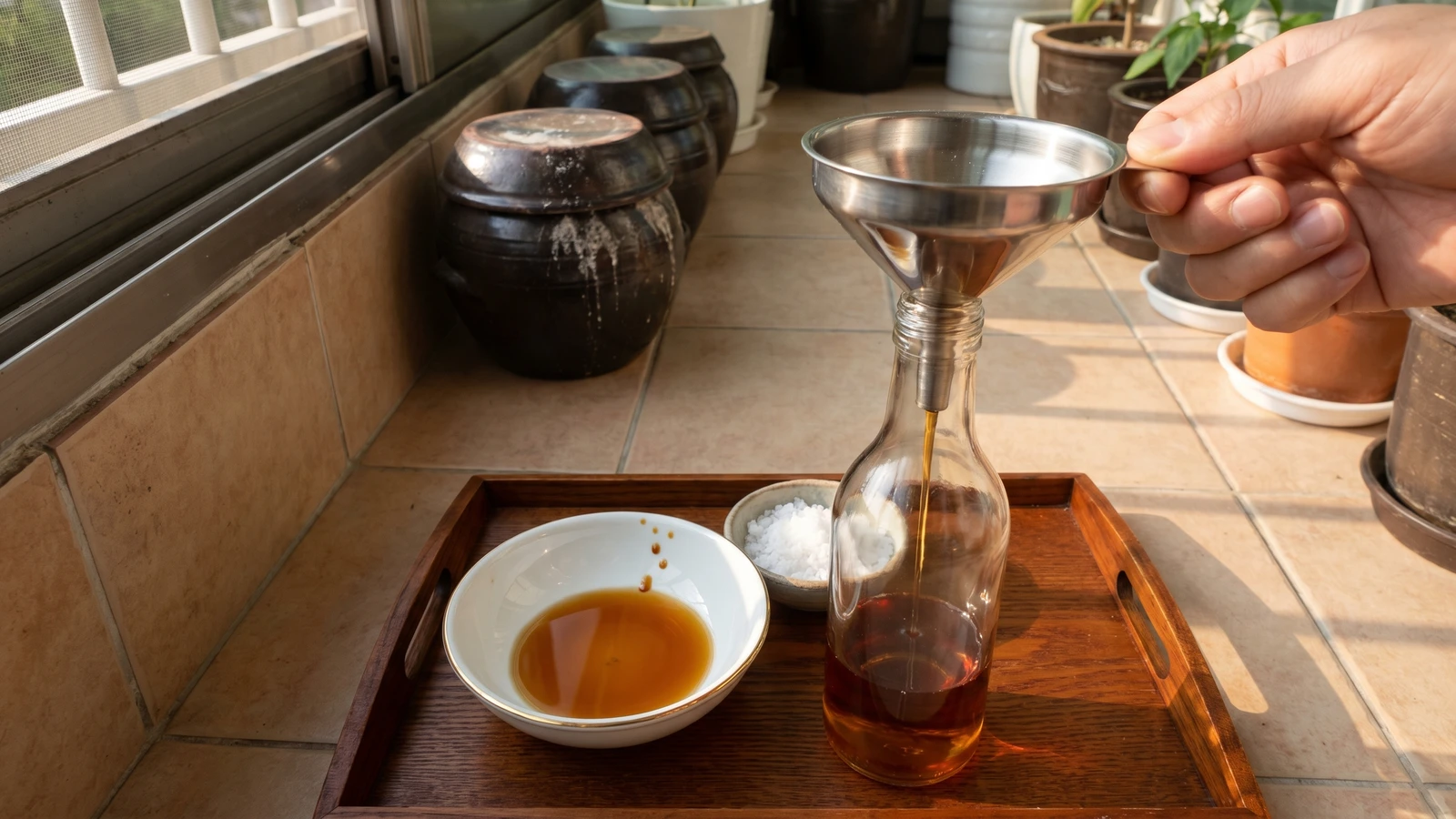
Heat the strained sauce to 85 C / 185 F and hold it there for 5 minutes, skimming any foam from the surface. Do not boil it hard, or the clean edge that makes kkanari-aekjeot useful in pale kimchi turns harsh and dark. Pour into sterilized glass bottles, cap, cool, and refrigerate. Let the bottled sauce rest 1 week before using so the salt and aroma settle.
For kimchi seasoning, start with 1 1/2 tablespoons, about 22 ml, for every 1 kg salted and drained napa cabbage, then adjust by 1 teaspoon at a time. For muchim, the quick seasoned vegetable dishes, start with 1/2 teaspoon for a 200 g bowl of greens. Kkanari-aekjeot should make the dish taste fuller, not fishier. Let the cabbage or vegetable still taste like itself.
1 serving (about 18g)
Culinary guides, cultural storytelling, and the editorial depth that makes cooking meaningful.
Discover Culinary ExplorerChef Jeong-sun
Tender baby napa cabbage in a clear pear-garlic brine, lightly fermented until the broth turns clean and bright, the summer kimchi a beginner can make without a kimjang floor.

Chef Jeong-sun
The kimchi from before chili, salted napa cabbage packed with radish, pear, jujube, and pine nuts in a clear brine that turns quietly tart in the jar.

Chef Jeong-sun
A pale summer cucumber kimchi, split and stuffed with radish and chives, then held in a cool pear brine so the cucumber stays clean, crunchy, and plainly itself.

Chef Jeong-sun
Flat spring bomdong cabbage, lightly brined and tucked into a clear pear-radish kimchi broth, made without chili and eaten young while the leaves still taste like spring.