
Chef Jeong-sun
Agwi-jjim (Braised Monkfish with Bean Sprouts)
Firm monkfish buried under crisp soybean sprouts, minari, and a red gochugaru sauce thickened at the end; Masan's market dish asks for heat, timing, and a steady hand.
A cooking platform built around craft, culture, and the stories behind what we eat.

Created by
A cold bowl of thin somyeon in aged kimchi brine and clear broth, sharp enough to wake a tired table and plain enough to make from what the refrigerator already has.
Kimchimari-guksu lives or dies by the liquid. People empty a spoonful of kimchi juice into water and call it finished; then they blame the kimchi when the bowl tastes flat. Strain the brine, thin it with a clean broth, season it sharper than you would drink, and chill it hard. The noodles will steal salt and sourness the moment they land.
This is the fridge-clearing bowl, not apology food. In a Korean house, kimchi that has gone too sour for eating straight has not failed; it has changed jobs. My mother used it for jjigae, bokkeumbap, and on hot, tired nights, noodles like this, somyeon rinsed cold until it squeaked and slipped into the red brine. It asks for one honest jar of aged kimchi and twenty minutes of care.
Measure the brine because every jar is different. Notebook 31 says 8 parts clear broth to 3 parts kimchi brine for this bowl, with 2 teaspoons sugar and 1 tablespoon vinegar only when the kimchi needs brightening. 손맛 (hand-taste) is real; I measure it anyway. That way the next bowl tastes like this one, not like luck.
Kimchimari-guksu belongs to the northern Korean cold-noodle family, especially the Pyongyang habit of setting noodles in chilled kimchi or dongchimi (radish water kimchi) brine rather than a heavy sauce. Its name uses 말다 (malda), the verb for putting rice or noodles into liquid, as in kimchi-mari-bap, rice in kimchi broth. The Korean War of 1950-1953 carried many northern noodle customs south with displaced families, and today the dish also survives as a practical home bowl for using aged baechu-kimchi and its brine.
Quantity
2 1/2 cups
Quantity
6 large
heads and guts removed
Quantity
1 piece, about 3 inches square
Quantity
3/4 cup
strained from the jar
Quantity
1 cup
thinly sliced
Quantity
1 tablespoon
divided after tasting
Quantity
2 teaspoons
Quantity
1 teaspoon soup soy sauce, or 1/2 teaspoon fine sea salt
Quantity
1 teaspoon
Quantity
1 teaspoon, plus 1/2 teaspoon more for serving
Quantity
200g
Quantity
4 cups for chilling, plus 4 small cubes for serving if needed
Quantity
1/2 small
julienned
Quantity
1
halved
Quantity
1 sheet
cut into thin strips
Quantity
1
thinly sliced
| Ingredient | Quantity |
|---|---|
| water | 2 1/2 cups |
| dried anchovies (myeolchi)heads and guts removed | 6 large |
| dried kelp (dasima) | 1 piece, about 3 inches square |
| well-fermented baechu-kimchi brinestrained from the jar | 3/4 cup |
| well-fermented baechu-kimchithinly sliced | 1 cup |
| rice vinegardivided after tasting | 1 tablespoon |
| sugar or maesil-cheong (Korean green plum syrup) | 2 teaspoons |
| soup soy sauce (guk-ganjang), or fine sea salt | 1 teaspoon soup soy sauce, or 1/2 teaspoon fine sea salt |
| toasted sesame oil | 1 teaspoon |
| toasted sesame seeds | 1 teaspoon, plus 1/2 teaspoon more for serving |
| dried somyeon (thin wheat noodles) | 200g |
| ice (optional) | 4 cups for chilling, plus 4 small cubes for serving if needed |
| cucumberjulienned | 1/2 small |
| hard-boiled egghalved | 1 |
| roasted gim (seaweed)cut into thin strips | 1 sheet |
| scallionthinly sliced | 1 |
Put 2 1/2 cups water, the anchovies, and the kelp in a 2-quart pot. Bring it to a quiet simmer over medium heat. Pull the kelp out as soon as the water trembles, because kelp left to boil gives bitterness and a slick body this clean bowl does not want. Simmer the anchovies 8 minutes more, strain, and measure 2 cups broth. Set the bowl of broth in ice water and stir until cold, 10 to 15 minutes.
Whisk together the 2 cups cold broth, 3/4 cup strained kimchi brine, sugar, and soup soy sauce. Add 2 teaspoons of the vinegar first, taste, then add the last teaspoon only if the broth tastes dull. It should be a little too sharp and salty to drink plain, because somyeon will mute it. If it bites too hard, add cold water 1 tablespoon at a time, no more than 4 tablespoons. If it tastes flat, add 1 tablespoon more kimchi brine.
Slice the kimchi across the leaves into 1/4-inch strips. Toss it with the sesame oil, 1 teaspoon toasted sesame seeds, and half the scallion. This separate seasoning matters: the topping should taste like kimchi, nutty and sharp, not like cabbage pulled wet from the jar.
Julienne the cucumber, halve the egg, cut the gim, and chill two stainless bowls if you have them. Everything waits except the noodles. Once somyeon is cooked, you rinse, drain, and serve without wandering away.
Bring a large pot of water to a rolling boil and add the somyeon, stirring right away so the strands do not clump. When the pot rises, splash in 1/2 cup cold water; repeat once if it rises again. Cook 3 to 4 minutes total, until a strand has no chalky center but still has a little spring.
Drain the noodles and rinse under cold running water, rubbing them between your hands for 60 to 90 seconds. When the water runs mostly clear and the noodles feel cold and springy, drain hard. This washing removes surface starch; without it the broth turns cloudy and the noodles go soft.
Divide the noodles between the chilled bowls and coil them with chopsticks or clean hands. Pour about 1 1/4 cups seasoned broth around each portion, or 1 cup broth plus 2 small ice cubes if your kitchen is hot. Top each bowl with half the dressed kimchi, cucumber, egg, gim, remaining scallion, and the extra sesame. Eat at once, before the somyeon drinks the broth.
1 serving (about 800g)
Culinary guides, cultural storytelling, and the editorial depth that makes cooking meaningful.
Discover Culinary ExplorerChef Jeong-sun
Firm monkfish buried under crisp soybean sprouts, minari, and a red gochugaru sauce thickened at the end; Masan's market dish asks for heat, timing, and a steady hand.

Chef Jeong-sun
A quick Korean rice bowl built on contrast: warm rice, cold popping flying-fish roe, chopped vegetables, gim, sesame oil, and the crisp rice bottom a hot stone bowl gives you.
Chef Jeong-sun
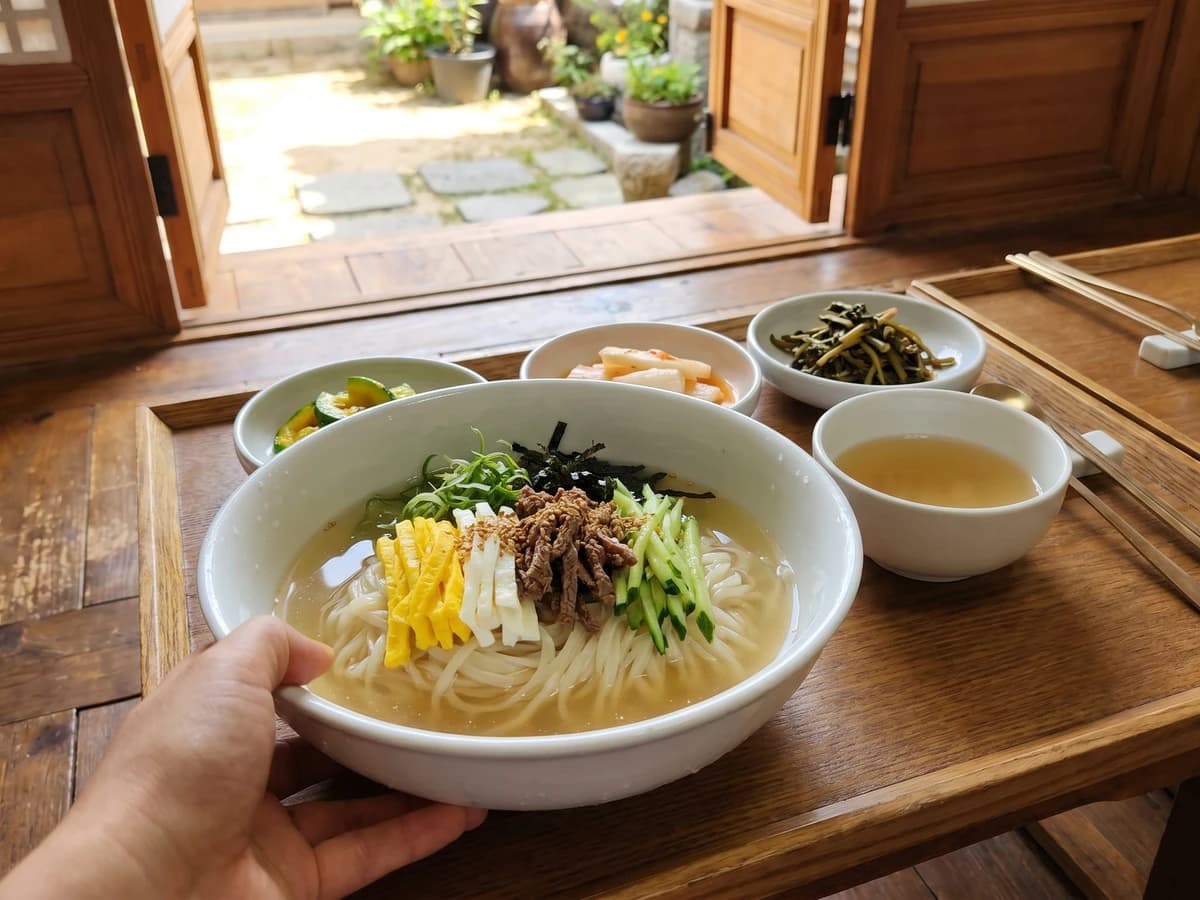
Andong's guest noodles, wheat and roasted soybean flour rolled thin, boiled and rinsed cold, then set in a clear chilled anchovy broth with careful strips of beef, egg, and cucumber.

Chef Jeong-sun
Andong's ritual-table rice served on an ordinary day: separate soy-sesame namul, warm rice, and clear radish soup, mixed without gochujang so every vegetable keeps its own voice.