
Chef Jeong-sun
Agwi-jjim (Braised Monkfish with Bean Sprouts)
Firm monkfish buried under crisp soybean sprouts, minari, and a red gochugaru sauce thickened at the end; Masan's market dish asks for heat, timing, and a steady hand.
A cooking platform built around craft, culture, and the stories behind what we eat.

Created by
Dark acorn and buckwheat noodles in a cold anchovy-kelp broth, set with separately seasoned greens and cucumber so the acorn's faint bitterness stays honest and clear.
Dotori-guksu begins in the mountain market, after acorns have been gathered and leached, when the same vendors who sell dotori-muk (acorn jelly) also have dark noodles tied in bundles. The color is not decoration. Acorn gives the noodle a faint bitterness and a clean, earthy edge, and that taste is the reason for the bowl. If you bury it under a red sauce, you've missed the thing you came for.
This is a weeknight bowl, but it asks for order. Make the broth first and chill it hard; season the greens in their own small bowl; salt the cucumber and squeeze it; cook the noodles last. The work is not much, but cold noodles punish delay. Have every topping ready before the noodles touch the water.
Notebook 37, from my teacher's kitchen, says bitterness is not a mistake unless the cook is careless. I understood it only after she made me taste the plain noodle before the broth. The broth should be light enough to carry the acorn, the greens should taste like greens, and the sesame should finish the bowl without making it oily. 손맛 (hand-taste) is real; I measure it anyway, so you can cook the same quiet bowl twice.
Acorn foods in Korea are older than written recipes; Korean prehistoric sites have yielded acorn remains, and later mountain households leached acorns to remove tannins before grinding them into starch for dotori-muk (acorn jelly), cakes, and noodles. Dotori-guksu belongs to that mountain pantry, especially in regions such as Gangwon-do and Chungcheong-do, where acorn powder or starch was mixed with buckwheat and wheat to make a dark, slightly bitter noodle that stretched scarce grain. After the Korean War and the hard years around it, many foods once tied to shortage stayed on the table because people had learned to like their flavor, and acorn noodles now appear in market shops and trailhead restaurants by choice.
Quantity
7 cups
Quantity
1 piece, about 4 inches square
Quantity
14
heads and guts removed
Quantity
1/2 medium
sliced thick
Quantity
1
Quantity
2 tablespoons plus 1 teaspoon
divided
Quantity
1 tablespoon plus 1 teaspoon
divided
Quantity
1 teaspoon
Quantity
3/4 teaspoon
divided
Quantity
360g
Quantity
1, about 200g
julienned
Quantity
150g
tough stems trimmed
Quantity
1/2 small clove
minced to a paste
Quantity
2 teaspoons
divided
Quantity
3 teaspoons
divided, some lightly crushed
Quantity
8
thinly sliced
Quantity
2
thinly sliced
Quantity
2
halved
Quantity
1 sheet
cut into thin strips
Quantity
1 cup
| Ingredient | Quantity |
|---|---|
| cold water | 7 cups |
| dried kelp (dasima) | 1 piece, about 4 inches square |
| large dried anchovies (myeolchi)heads and guts removed | 14 |
| onionsliced thick | 1/2 medium |
| dried shiitake mushroom (optional) | 1 |
| soup soy sauce (guk-ganjang)divided | 2 tablespoons plus 1 teaspoon |
| rice vinegardivided | 1 tablespoon plus 1 teaspoon |
| maesil-cheong (green plum syrup) or sugar | 1 teaspoon |
| fine sea saltdivided | 3/4 teaspoon |
| dried dotori-guksu (acorn-buckwheat noodles) | 360g |
| English cucumberjulienned | 1, about 200g |
| chwinamul, minari, or spinachtough stems trimmed | 150g |
| garlicminced to a paste | 1/2 small clove |
| toasted sesame oildivided | 2 teaspoons |
| toasted sesame seedsdivided, some lightly crushed | 3 teaspoons |
| perilla leaves (kkaennip)thinly sliced | 8 |
| scallionsthinly sliced | 2 |
| hard-boiled eggs (optional)halved | 2 |
| roasted gim (optional)cut into thin strips | 1 sheet |
| ice cubes (optional) | 1 cup |
Put the water, kelp, anchovies, onion, and dried shiitake, if using, in a pot over medium heat. When the water reaches a steady simmer, pull out the kelp. Leave it too long and the broth turns slick and bitter, which is not the bitterness we want here. Simmer the anchovies, onion, and mushroom for 10 minutes more, then strain. You should have about 5 1/2 cups of clean broth.
While the broth is still warm, stir in 2 tablespoons soup soy sauce, 1 tablespoon rice vinegar, the maesil-cheong or sugar, and 1/4 teaspoon salt. Taste it once warm, then again when cold. Cold dulls salt and acid, so the broth should taste a little more direct than you think it should. Set the pot in an ice bath for 25 to 30 minutes, or chill it in the refrigerator until very cold.
Toss the julienned cucumber with 1/2 teaspoon salt and let it stand 10 minutes. Squeeze it gently, just enough to remove excess water, then season with 1 teaspoon rice vinegar and 1/2 teaspoon sesame oil. This keeps the cucumber crisp and stops it from watering down the broth.
Blanch the chwinamul, minari, or spinach in boiling water just until bright and flexible: 20 seconds for minari, 40 seconds for spinach, about 1 minute for tender chwinamul. Rinse cold, squeeze dry, and cut into 2-inch lengths. Season in its own bowl with 1 teaspoon soup soy sauce, the garlic, 1 teaspoon sesame oil, and 1 teaspoon sesame seeds. Taste one stem. It should be clean and nutty, not salty. Season each namul (seasoned vegetable) alone before it meets the noodles, or every green loses its own voice.
Slice the perilla leaves and scallions, halve the eggs if using, and cut the gim into thin strips. Crush the remaining 2 teaspoons sesame seeds lightly between your fingers or in a small mortar. Crushed sesame gives aroma without making the bowl oily.
Bring a large pot of water to a hard boil and add the dotori-guksu. Stir right away so the noodles do not settle and stick. Cook according to the package, usually 4 to 6 minutes. Acorn and buckwheat make a tender noodle; one careless extra minute can make it break instead of chew.
Drain the noodles and rinse under cold running water, rubbing them between your hands until the surface starch is gone and the noodles feel cool and clean. Drain hard. Do not let them sit in water, because they will drink it and turn dull.
Divide the noodles among four chilled bowls and coil them loosely. Pour about 1 1/4 cups cold broth into each bowl. Add a small handful of seasoned greens, a neat pile of cucumber, perilla, scallion, egg if using, gim if using, and crushed sesame. Add a few ice cubes only if the broth is not cold enough. Serve at once, with extra vinegar and soup soy sauce at the table, not gochujang. The acorn's taste is the point.
1 serving (about 520g)
Culinary guides, cultural storytelling, and the editorial depth that makes cooking meaningful.
Discover Culinary ExplorerChef Jeong-sun
Firm monkfish buried under crisp soybean sprouts, minari, and a red gochugaru sauce thickened at the end; Masan's market dish asks for heat, timing, and a steady hand.

Chef Jeong-sun
A quick Korean rice bowl built on contrast: warm rice, cold popping flying-fish roe, chopped vegetables, gim, sesame oil, and the crisp rice bottom a hot stone bowl gives you.
Chef Jeong-sun
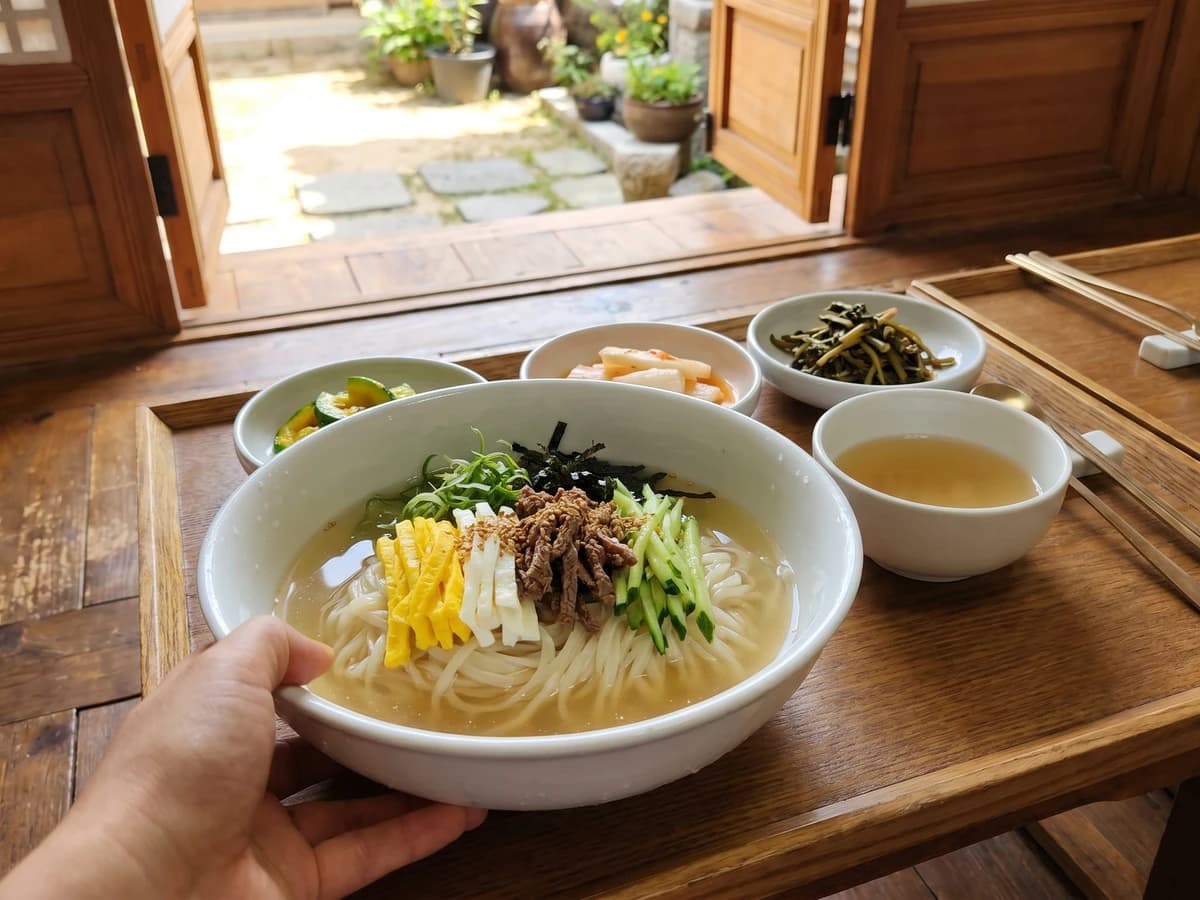
Andong's guest noodles, wheat and roasted soybean flour rolled thin, boiled and rinsed cold, then set in a clear chilled anchovy broth with careful strips of beef, egg, and cucumber.

Chef Jeong-sun
Andong's ritual-table rice served on an ordinary day: separate soy-sesame namul, warm rice, and clear radish soup, mixed without gochujang so every vegetable keeps its own voice.