
Chef Jeong-sun
Agwi-jjim (Braised Monkfish with Bean Sprouts)
Firm monkfish buried under crisp soybean sprouts, minari, and a red gochugaru sauce thickened at the end; Masan's market dish asks for heat, timing, and a steady hand.
A cooking platform built around craft, culture, and the stories behind what we eat.

Created by
Cold somyeon tossed fast with chopped kimchi, cucumber, and a measured sweet-tart gochujang sauce; the summer noodle that asks for hard rinsing, quick hands, and no leftovers.
Bibim-guksu belongs to the days when the market cucumbers are firm and cheap, and the kitchen feels too hot for a pot of soup. In my mother's house, this was not a planned meal. It appeared when rice was gone, kimchi was sour enough to bite back, and two hungry people were standing near the stove pretending not to be hungry.
People think the work is in the sauce. It isn't. The noodles carry or ruin this dish. Somyeon must boil just until the hard center is gone, then be rubbed under cold water until the starch leaves your fingers. If you only splash them, the sauce turns dull and sticky. If you rinse properly and drain hard, the sauce coats every strand.
Go easy with gochujang. Bibim-guksu is not a punishment bowl of red paste; it should be sweet, tart, salty, and hot enough to wake you up, with kimchi and cucumber still tasting like themselves. Notebook 38 gives 2 tablespoons gochujang for 200 grams of noodles, then vinegar and kimchi brine carry the sharpness. 손맛 (hand-taste) is real; I measure it anyway. Toss it the hour you eat it, and bring it to the table while the noodles still feel cold.
Bibim-guksu is part of Korea's broad family of guksu, noodles that carried festive meaning because long strands symbolized long life, though wheat noodles were not everyday food for many households before the twentieth century. After the Korean War, wheat flour from U.S. aid and later industrial production made dried somyeon cheap and widely available, and home cooks turned it into quick mixed noodle bowls seasoned with gochujang, vinegar, sesame oil, and well-fermented kimchi. The dish has no palace record to borrow; its authority is the summer home table and the bunsikjeom (casual snack shop) counter.
Quantity
200g
Quantity
1 cup, plus 2 tablespoons brine
chopped
Quantity
1 small, about 100g
julienned
Quantity
1/8 teaspoon
Quantity
2 tablespoons
Quantity
2 tablespoons
Quantity
2 teaspoons
Quantity
1 tablespoon sugar or 1 1/2 tablespoons maesil-cheong
Quantity
1 teaspoon
Quantity
1 small clove
finely minced
Quantity
2 teaspoons
Quantity
2 teaspoons
divided
Quantity
1
halved
Quantity
1 sheet
cut into thin strips
Quantity
1
thinly sliced
| Ingredient | Quantity |
|---|---|
| dried somyeon (thin wheat noodles) | 200g |
| ripe napa cabbage kimchichopped | 1 cup, plus 2 tablespoons brine |
| cucumberjulienned | 1 small, about 100g |
| fine sea salt | 1/8 teaspoon |
| gochujang (Korean red chili paste) | 2 tablespoons |
| rice vinegar or apple vinegar | 2 tablespoons |
| soy sauce | 2 teaspoons |
| sugar or maesil-cheong (green plum syrup) | 1 tablespoon sugar or 1 1/2 tablespoons maesil-cheong |
| gochugaru (Korean chili flakes) (optional) | 1 teaspoon |
| garlicfinely minced | 1 small clove |
| toasted sesame oil | 2 teaspoons |
| toasted sesame seedsdivided | 2 teaspoons |
| hard-boiled egg (optional)halved | 1 |
| roasted gim (seaweed)cut into thin strips | 1 sheet |
| scallion (optional)thinly sliced | 1 |
Put the julienned cucumber in a small bowl with the 1/8 teaspoon salt and toss. Let it stand 8 minutes, then squeeze it lightly and pour off the water. This is not to make a pickle. It keeps the cucumber crisp and stops it from thinning the sauce later.
In a wide mixing bowl, stir together the gochujang, vinegar, kimchi brine, soy sauce, sugar or maesil-cheong, gochugaru if using, garlic, sesame oil, and 1 teaspoon of the sesame seeds. Taste it now. It should be sharper and a little stronger than you want the finished noodles, because cold somyeon will dull the seasoning.
Bring 2 1/2 liters water to a hard boil in a large pot. Add the somyeon and stir right away so the strands do not cling. When the foam rises, add 1/2 cup cold water; when it rises again, add another 1/2 cup cold water. Cook 3 to 4 minutes total, until the noodle has no hard white core but still has bite.
Drain the noodles and rinse under cold running water, rubbing the strands between both hands until the water runs mostly clear and the noodles feel cold and slippery, not gummy. If the kitchen is hot, swish them in ice water for 30 seconds. Drain hard for a full minute. Wet noodles make a weak bowl.
Add the drained noodles to the sauce and toss with tongs or a gloved hand, lifting from the bottom until every strand is coated. Add the chopped kimchi and squeezed cucumber and toss again, gently this time. Taste one mouthful. If it is flat, add 1 teaspoon vinegar. If it is harsh, add 1/2 teaspoon sugar. If it is too thick to coat, add 1 tablespoon cold water or kimchi brine. Make small corrections; a tablespoon of gochujang is not a correction, it is a new dish.
Divide the noodles into two bowls while they are still cold. Top with the halved egg, gim strips, scallion if using, and the remaining 1 teaspoon sesame seeds. Bibim-guksu should be eaten the hour it is mixed. After that the noodles swell, the cucumber weeps, and the sauce loses its clean edge.
1 serving (about 500g)
Culinary guides, cultural storytelling, and the editorial depth that makes cooking meaningful.
Discover Culinary ExplorerChef Jeong-sun
Firm monkfish buried under crisp soybean sprouts, minari, and a red gochugaru sauce thickened at the end; Masan's market dish asks for heat, timing, and a steady hand.

Chef Jeong-sun
A quick Korean rice bowl built on contrast: warm rice, cold popping flying-fish roe, chopped vegetables, gim, sesame oil, and the crisp rice bottom a hot stone bowl gives you.
Chef Jeong-sun
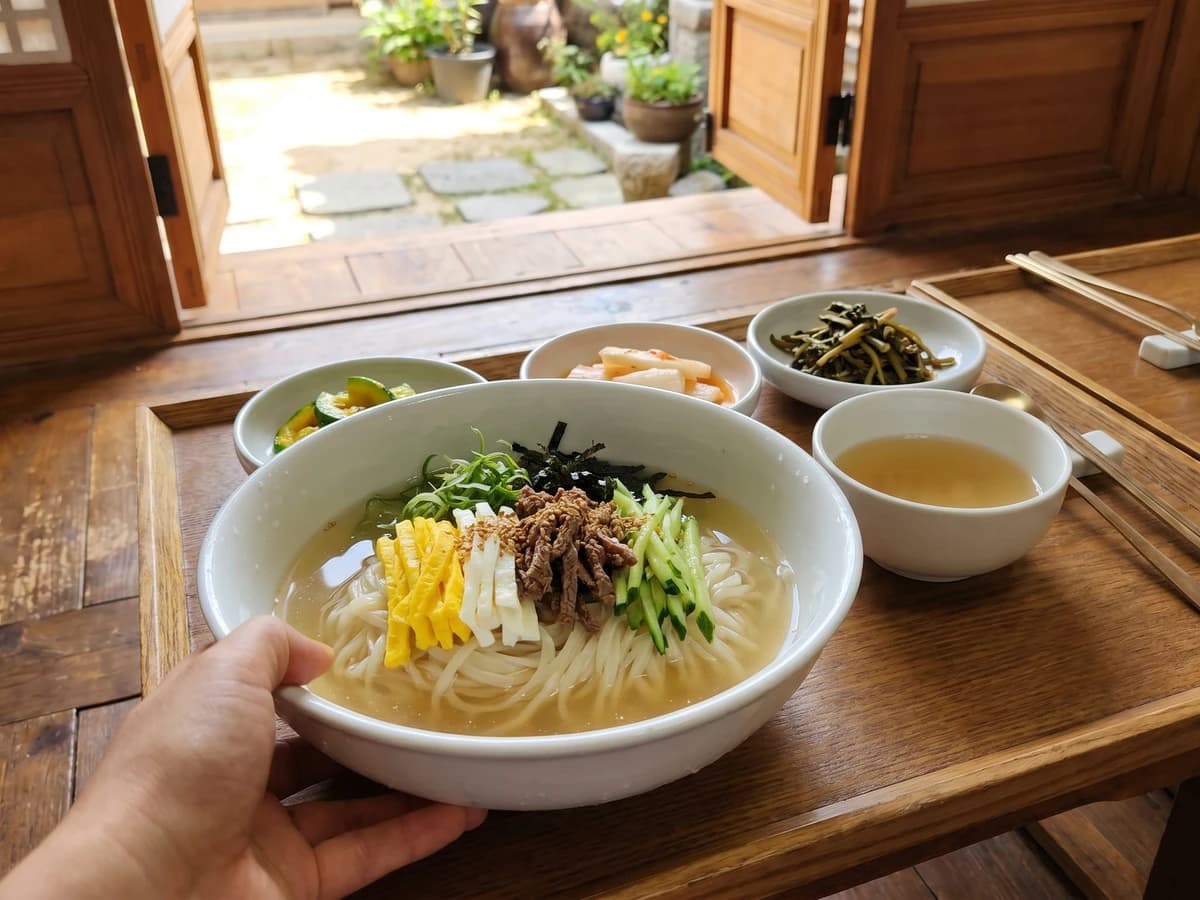
Andong's guest noodles, wheat and roasted soybean flour rolled thin, boiled and rinsed cold, then set in a clear chilled anchovy broth with careful strips of beef, egg, and cucumber.

Chef Jeong-sun
Andong's ritual-table rice served on an ordinary day: separate soy-sesame namul, warm rice, and clear radish soup, mixed without gochujang so every vegetable keeps its own voice.