
Chef Jeong-sun
Andong Geonjin-guksu (Rinsed Banquet Noodles)
Andong's guest noodles, wheat and roasted soybean flour rolled thin, boiled and rinsed cold, then set in a clear chilled anchovy broth with careful strips of beef, egg, and cucumber.
A cooking platform built around craft, culture, and the stories behind what we eat.
Created by
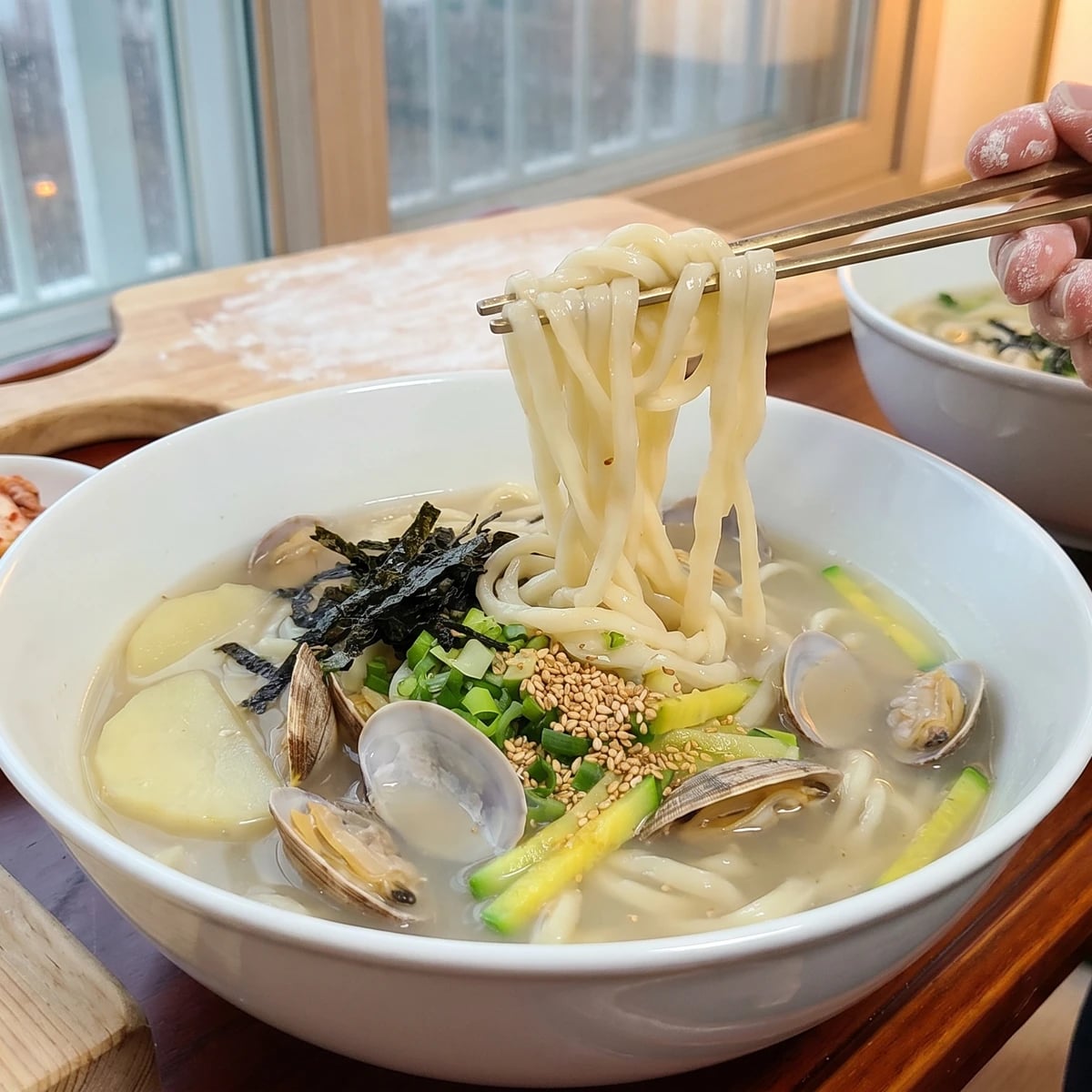
A weeknight bowl of hand-cut wheat noodles in clean anchovy-clam broth, with zucchini, potato, and scallion, the flour on the noodles turning the soup gently silky.
Kalguksu lives or dies under the knife. The broth matters, yes, but the dish gets its name from the cutting: kal means knife, guksu means noodles. Roll the dough thin enough, dust it well, fold it without fear, and cut steady strands. Uneven is not failure. Careless is failure.
My teacher Master Seong-nyeo made us stand beside the table and watch the dough before we touched it. 눈동냥, 귀동냥, borrowing with the eyes and ears. Too dry and it cracks at the fold. Too wet and it sticks to the knife. The right dough feels firm and quiet under your palm, then relaxes after resting. That rest is not waiting. It is work the flour does while you wash the board and set the broth.
This is comfort food, but it is not lazy food. Tonight it asks you for one honest broth and one clean bit of knife work. The safe shortcut is the broth: anchovy and kelp will carry a weeknight pot, clams make it deeper, chicken makes it richer. The corner you don't cut is the noodle. Hand-cut strands carry their own flour into the pot, and that is why kalguksu becomes soft and silky instead of just noodles floating in soup.
Season with restraint. The bowl should taste of wheat, shellfish, zucchini, potato, and scallion, each still itself. 손맛 is real, the hand-taste your grandmother trusted. I still measure it, so it can be handed on.
Kalguksu is named for its method, not for a single region: kal means knife, and the wheat dough is rolled flat, folded, and cut by hand. Wheat flour was once less common than grains such as rice, buckwheat, and millet in Korea, so wheat noodles carried a sense of occasion before imported flour and postwar food aid made them everyday market food in the twentieth century. Coastal versions often use clams or seafood, inland homes use anchovy or chicken broth, and both belong honestly to the dish.
Quantity
2 1/2 cups, plus more for dusting
Quantity
1/2 teaspoon
for the dough
Quantity
3/4 cup, plus 1 to 2 tablespoons only if needed
for the dough
Quantity
1 teaspoon
Quantity
8 cups
for broth
Quantity
1 piece, about 4 inches square
Quantity
12
heads and guts removed
Quantity
450g
scrubbed and soaked in salted water
Quantity
1 medium
peeled and cut into 1/4-inch half-moons
Quantity
1/2 medium
thinly sliced
Quantity
1 small
cut into matchsticks
Quantity
2 cloves
minced
Quantity
1 tablespoon
Quantity
1 teaspoon, plus more as needed
for broth
Quantity
1/4 teaspoon
freshly ground
Quantity
2
thinly sliced
Quantity
1 teaspoon
Quantity
1 teaspoon
Quantity
1 sheet
cut into thin strips
| Ingredient | Quantity |
|---|---|
| all-purpose flour | 2 1/2 cups, plus more for dusting |
| fine sea saltfor the dough | 1/2 teaspoon |
| waterfor the dough | 3/4 cup, plus 1 to 2 tablespoons only if needed |
| neutral oil | 1 teaspoon |
| waterfor broth | 8 cups |
| dried kelp (dasima) | 1 piece, about 4 inches square |
| large dried anchovies (myeolchi)heads and guts removed | 12 |
| fresh small clamsscrubbed and soaked in salted water | 450g |
| potatopeeled and cut into 1/4-inch half-moons | 1 medium |
| onionthinly sliced | 1/2 medium |
| zucchini (aehobak)cut into matchsticks | 1 small |
| garlicminced | 2 cloves |
| soup soy sauce (guk-ganjang) | 1 tablespoon |
| fine sea saltfor broth | 1 teaspoon, plus more as needed |
| black pepperfreshly ground | 1/4 teaspoon |
| scallionsthinly sliced | 2 |
| toasted sesame oil (optional) | 1 teaspoon |
| toasted sesame seeds (optional) | 1 teaspoon |
| roasted gim (seaweed) (optional)cut into thin strips | 1 sheet |
Stir the flour and 1/2 teaspoon salt in a wide bowl. Add 3/4 cup water and the oil, then mix with chopsticks or your fingers until shaggy. Knead 8 to 10 minutes, pressing with the heel of your hand, until the dough is firm and smooth. If dry flour will not gather after 3 minutes, add water 1 teaspoon at a time. Do not make it soft. A soft dough is easy now and troublesome under the knife.
Wrap the dough or cover it tightly with an overturned bowl and rest it 30 minutes at room temperature. This rest lets the flour hydrate and the gluten relax, so the dough rolls thin instead of springing back at you. If you are making dinner after work, make the dough first, then build the broth while it rests.
Scrub the clams well. Soak them in 4 cups cold water mixed with 1 tablespoon salt for 20 to 30 minutes, then lift them out of the water instead of pouring the grit back over them. Rinse once. Throw away any clam that is cracked or stays open when tapped.
Put 8 cups water, the kelp, and the prepared anchovies in a large pot. Bring it just to a simmer over medium heat, then pull the kelp out right away. Kelp left to boil turns the broth slick and bitter. Simmer the anchovies 10 minutes more, then lift them out. Add the clams and simmer 3 to 5 minutes, just until they open. Lift the clams into a bowl and cover them so they do not toughen while the noodles cook.
Flour the board generously and divide the dough in half. Roll one half into a thin sheet, about 1/16 inch thick, turning and dusting as needed so it never sticks. Dust the top with flour, fold it loosely into thirds or quarters, and do not press the folds flat. The flour between the folds keeps the layers separate and later thickens the soup.
Use a sharp knife to cut the folded dough into strands about 1/4 inch wide. Shake them open with your fingers and toss with a little more flour so they do not cling. Repeat with the second half of dough. Uneven hand-cut noodles are welcome. Thick lumps are not, because they cook outside before the center is done.
Bring the broth back to a boil. Add the potato, onion, garlic, soup soy sauce, 1 teaspoon salt, and black pepper. Cook 4 minutes, until the potato edges begin to turn translucent. Taste the broth now. It should be savory but a little light, because the noodles will add flour and the clams will return with their salt.
Shake off any heavy clumps of flour from the noodles, but do not rinse them. Drop the noodles into the boiling broth a handful at a time, stirring gently after each addition so they do not knot together. Boil 5 to 7 minutes, until the noodles are tender with a little chew and the broth has turned lightly silky. Add the zucchini for the last 2 minutes so it stays green and sweet.
Return the opened clams and any clean juices from their bowl to the pot. Simmer 1 minute, only to warm them through. Taste and adjust with 1/4 teaspoon salt at a time if needed. Do not chase saltiness with soy sauce here, or the clear broth turns muddy and the clams disappear.
Ladle the noodles, broth, vegetables, and clams into deep bowls. Finish with scallions, a few gim strips, sesame seeds, and a small thread of sesame oil if you like. Serve immediately, with kimchi beside it. Kalguksu waits badly; the noodles keep drinking, and a proper bowl becomes a paste if left sitting.
1 serving (about 650g)
Culinary guides, cultural storytelling, and the editorial depth that makes cooking meaningful.
Discover Culinary Explorer
Chef Jeong-sun
Andong's guest noodles, wheat and roasted soybean flour rolled thin, boiled and rinsed cold, then set in a clear chilled anchovy broth with careful strips of beef, egg, and cucumber.

Chef Jeong-sun
Cold somyeon tossed fast with chopped kimchi, cucumber, and a measured sweet-tart gochujang sauce; the summer noodle that asks for hard rinsing, quick hands, and no leftovers.

Chef Jeong-sun
Hamhung's chewy starch noodles tossed cold in a measured sweet-hot gochujang sauce, not drowned in it, finished with crisp pear, cucumber, sesame, and either skate hoe or cold beef.

Chef Jeong-sun
Dark acorn and buckwheat noodles in a cold anchovy-kelp broth, set with separately seasoned greens and cucumber so the acorn's faint bitterness stays honest and clear.