
Chef Jeong-sun
Agwi-jjim (Braised Monkfish with Bean Sprouts)
Firm monkfish buried under crisp soybean sprouts, minari, and a red gochugaru sauce thickened at the end; Masan's market dish asks for heat, timing, and a steady hand.
A cooking platform built around craft, culture, and the stories behind what we eat.

Created by
The Jeonju bowl recorded before memory could blur it: rice cooked in soybean-sprout water, vegetables seasoned one by one, beef and hwangpo-muk arranged so the gochujang binds instead of buries.
Bibimbap is not a pile of rice wearing too much red sauce. Jeonju's bowl is the correction: rice with the quiet sweetness of soybean-sprout water, namul (seasoned vegetables) kept separate until the last moment, beef, hwangpo-muk (yellow mung bean jelly), and a measured spoon of gochujang. If everything tastes the same after you mix it, the cook has buried the work.
Master Seong-nyeo used to put out bowls until the table looked too crowded for one dish. Spinach alone, sprouts alone, bracken alone, roots alone. She made me taste each one before it met the rice. 눈동냥, 귀동냥 (borrowing with the eyes and ears) first, then the knife. Carrot wants only salt and oil; bracken wants soy and time; soybean sprouts want their own cooking water saved for the rice. That is why this bowl tastes like many things becoming one, not one seasoning poured over many things.
I won't tell you this is weeknight-fast. Tonight it asks for knife work, little bowls, and patience with the pan. The safe corners are these: cook the beef instead of serving raw yukhoe unless your butcher sold it for raw eating, use a rice cooker, and prepare the namul a day ahead. The corners you don't cut are the separate seasoning and the restrained gochujang.
Bibimbap appears in the late Joseon cookbook Siuijeonseo, generally dated to the late nineteenth century, as rice mixed with vegetables, meat, and seasonings, also known by the older name goldongban. Jeonju, in North Jeolla, became the version with the strongest local identity: rice cooked with soybean-sprout water or beef broth, Jeolla namul, hwangpo-muk colored with gardenia, and, in restaurant bowls, often raw seasoned beef (yukhoe). Jinju and Haeju also carry important regional styles, which is why bibimbap should be read as a family of bowls, not one restaurant formula.
Quantity
2 cups (360g)
rinsed, soaked 30 minutes, and drained
Quantity
4 cups
for cooking soybean sprouts
Quantity
350g
trimmed and rinsed
Quantity
2 1/4 teaspoons
divided
Quantity
1 tablespoon
for rubbing doraji
Quantity
200g
trimmed
Quantity
150g
rinsed and cut into 2-inch lengths
Quantity
150g
cut into 2-inch lengths
Quantity
1 small (about 250g)
julienned
Quantity
1 small (about 120g)
julienned
Quantity
6
soaked in warm water 30 minutes, stems removed, and julienned
Quantity
200g
cut into thin matchsticks
Quantity
200g
cut into batons
Quantity
4
Quantity
1 sheet
cut into thin strips
Quantity
1/4 cup (70g)
Quantity
1 tablespoon
Quantity
1 tablespoon
Quantity
1 teaspoon
Quantity
3 tablespoons
divided
Quantity
5 tablespoons
divided
Quantity
2 tablespoons
divided
Quantity
4 cloves
minced, divided
Quantity
1 teaspoon
divided
Quantity
2 tablespoons
divided
Quantity
1/8 teaspoon
| Ingredient | Quantity |
|---|---|
| short-grain white ricerinsed, soaked 30 minutes, and drained | 2 cups (360g) |
| waterfor cooking soybean sprouts | 4 cups |
| soybean sprouts (kongnamul)trimmed and rinsed | 350g |
| fine sea saltdivided | 2 1/4 teaspoons |
| coarse saltfor rubbing doraji | 1 tablespoon |
| spinachtrimmed | 200g |
| water-packed gosari (bracken fern)rinsed and cut into 2-inch lengths | 150g |
| peeled doraji (bellflower root)cut into 2-inch lengths | 150g |
| zucchinijulienned | 1 small (about 250g) |
| carrotjulienned | 1 small (about 120g) |
| dried shiitake mushroomssoaked in warm water 30 minutes, stems removed, and julienned | 6 |
| beef sirloin or top roundcut into thin matchsticks | 200g |
| hwangpo-muk (yellow mung bean jelly) (optional)cut into batons | 200g |
| pasteurized egg yolks or fried eggs | 4 |
| gim (roasted seaweed) (optional)cut into thin strips | 1 sheet |
| gochujang (Korean chili paste) | 1/4 cup (70g) |
| rice syrup, maesil-cheong, or honey | 1 tablespoon |
| pear juice or water | 1 tablespoon |
| rice vinegar (optional) | 1 teaspoon |
| soy sauce or Korean soup soy sauce (guk-ganjang)divided | 3 tablespoons |
| toasted sesame oildivided | 5 tablespoons |
| neutral oildivided | 2 tablespoons |
| garlicminced, divided | 4 cloves |
| sugardivided | 1 teaspoon |
| toasted sesame seedsdivided | 2 tablespoons |
| freshly ground black pepper | 1/8 teaspoon |
Rinse the rice until the water runs mostly clear, then soak it in clean water for 30 minutes. Drain it in a sieve for 10 minutes. If you are using dried shiitake, soak them in warm water now too. Soaked, drained rice cooks evenly, and that matters here because the rice has to carry soybean-sprout water without turning wet.
Bring 4 cups water and 1 teaspoon fine sea salt to a boil. Add the soybean sprouts and boil uncovered for 6 minutes, stirring once, until they are crisp-tender. Boil uncovered the whole time; changing your mind halfway is how sprouts get that harsh smell. Lift the sprouts into a bowl and reserve the cooking water. Season the sprouts with 1 teaspoon sesame oil, 1/2 teaspoon minced garlic, 1/4 teaspoon fine sea salt, and 1 teaspoon sesame seeds. Taste one. It should be nutty and clean, not salty.
Put the drained rice in a rice cooker with 2 cups reserved soybean-sprout water and 1/4 teaspoon fine sea salt, then cook on the regular white-rice setting. For stovetop rice, bring the same mixture to a lively simmer in a heavy pot, cover tightly, reduce the heat to low, cook 15 minutes, then rest off the heat 10 minutes. The sprout water puts Jeonju's flavor inside the rice, not just on top of it.
Stir together the gochujang, rice syrup, pear juice, 1 tablespoon sesame oil, rice vinegar if using, and 1 teaspoon sesame seeds. The sauce should loosen enough to fold through rice but still sit on a spoon. Start each bowl with 1 tablespoon sauce. If the first bite tastes only of gochujang, the sauce has swallowed the dish.
Blanch the spinach in boiling water for 30 seconds, then rinse under cold water and squeeze firmly until no water drips when you press it. Cut into 2-inch lengths. Season in its own bowl with 1 teaspoon soy sauce, 1 teaspoon sesame oil, 1/2 teaspoon minced garlic, and 1 teaspoon sesame seeds. Spinach carries water like a sleeve carries rain, so squeeze it well or it will loosen the whole bowl.
Heat 1 teaspoon neutral oil in a skillet over medium heat. Add the gosari, 1 teaspoon minced garlic, 1 tablespoon soy sauce, and 3 tablespoons water. Cook 6 to 8 minutes, turning often, until the stems are tender and the liquid is almost gone. Finish with 1 teaspoon sesame oil and 1 teaspoon sesame seeds. Bracken needs soy and time; if you rush it, it stays woody.
Rub the doraji with 1 tablespoon coarse salt for 1 minute, then rinse twice and squeeze dry. Heat 1 teaspoon neutral oil in the skillet. Add the doraji, 1/2 teaspoon minced garlic, 1/4 teaspoon fine sea salt, and 2 tablespoons water. Cook 3 to 4 minutes, until the bitterness softens but the root still has a little snap. Finish with 1 teaspoon sesame oil.
Toss the julienned zucchini with 1/4 teaspoon fine sea salt and let it stand 10 minutes, then squeeze lightly. Cook it in 1 teaspoon neutral oil over medium heat for 2 minutes, just until glossy and flexible, then finish with 1/2 teaspoon sesame oil. Wipe the pan. Cook the carrot separately with 1 teaspoon neutral oil and 1/8 teaspoon fine sea salt for 2 minutes, then finish with 1/2 teaspoon sesame oil. The knife work stays visible after mixing, so cut carefully.
Cook the shiitake first: heat 1 teaspoon neutral oil, add the mushrooms, 1 teaspoon soy sauce, and 1/4 teaspoon sugar, and stir-fry 3 minutes. Finish with 1 teaspoon sesame oil and move them to their own bowl. Mix the beef with 1 tablespoon soy sauce, 1 teaspoon sesame oil, 1 teaspoon minced garlic, 1/2 teaspoon sugar, and the black pepper. Heat 1 teaspoon neutral oil and cook the beef 2 to 3 minutes, just until browned. Jeonju restaurants often serve yukhoe (raw seasoned beef), but at home you cook it unless the beef was sold specifically for raw eating.
If using hwangpo-muk, dress it gently with 1 teaspoon soy sauce, 1/2 teaspoon sesame oil, and 1/2 teaspoon sesame seeds. Use open fingers, not chopsticks, because mung bean jelly breaks if you toss it hard. If using pasteurized egg yolks, keep them cold until assembly. If using fried eggs, cook them now, with the yolks still soft if your table likes them that way.
Fluff the hot rice and divide it among 4 wide bowls. Arrange the soybean sprouts, spinach, gosari, doraji, zucchini, carrot, shiitake, beef, and hwangpo-muk in separate arcs over the rice. Set an egg yolk or fried egg in the center. Add gim strips if using, 1 tablespoon gochujang sauce per bowl, 1/2 teaspoon sesame oil per bowl, and a final scatter of sesame seeds. The separation is not decoration. It lets each ingredient speak before the spoon brings them together.
At the table, fold the bowl from the bottom with a spoon until the rice, vegetables, beef, egg, and sauce are evenly joined. Do not pound it into paste. Taste, then add up to 1 teaspoon more sauce if the bowl needs it. Bibimbap means mixed rice, yes, but it should still taste like rice, sprouts, greens, roots, mushrooms, and beef. 손맛 is real; I measure it anyway, so the next bowl does not have to be guessed back into being.
1 serving (about 625g)
Culinary guides, cultural storytelling, and the editorial depth that makes cooking meaningful.
Discover Culinary ExplorerChef Jeong-sun
Firm monkfish buried under crisp soybean sprouts, minari, and a red gochugaru sauce thickened at the end; Masan's market dish asks for heat, timing, and a steady hand.

Chef Jeong-sun
A quick Korean rice bowl built on contrast: warm rice, cold popping flying-fish roe, chopped vegetables, gim, sesame oil, and the crisp rice bottom a hot stone bowl gives you.
Chef Jeong-sun
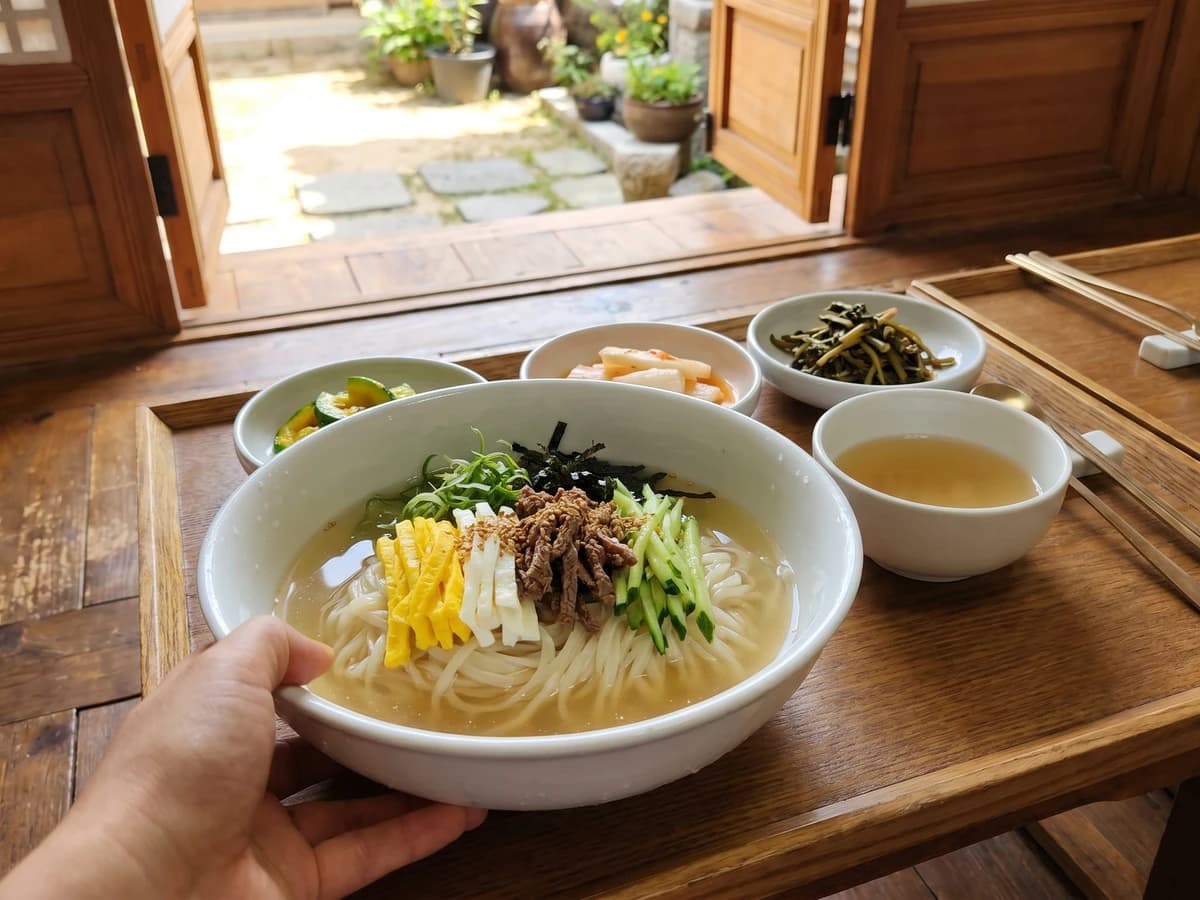
Andong's guest noodles, wheat and roasted soybean flour rolled thin, boiled and rinsed cold, then set in a clear chilled anchovy broth with careful strips of beef, egg, and cucumber.

Chef Jeong-sun
Andong's ritual-table rice served on an ordinary day: separate soy-sesame namul, warm rice, and clear radish soup, mixed without gochujang so every vegetable keeps its own voice.