
Chef Klaus
Apfelmus
The apple-harvest preserve of the German kitchen, cooked low until the fruit collapses, then kept smooth, tart, and ready for potato pancakes or warm Mehlspeisen.
A cooking platform built around craft, culture, and the stories behind what we eat.
Created by
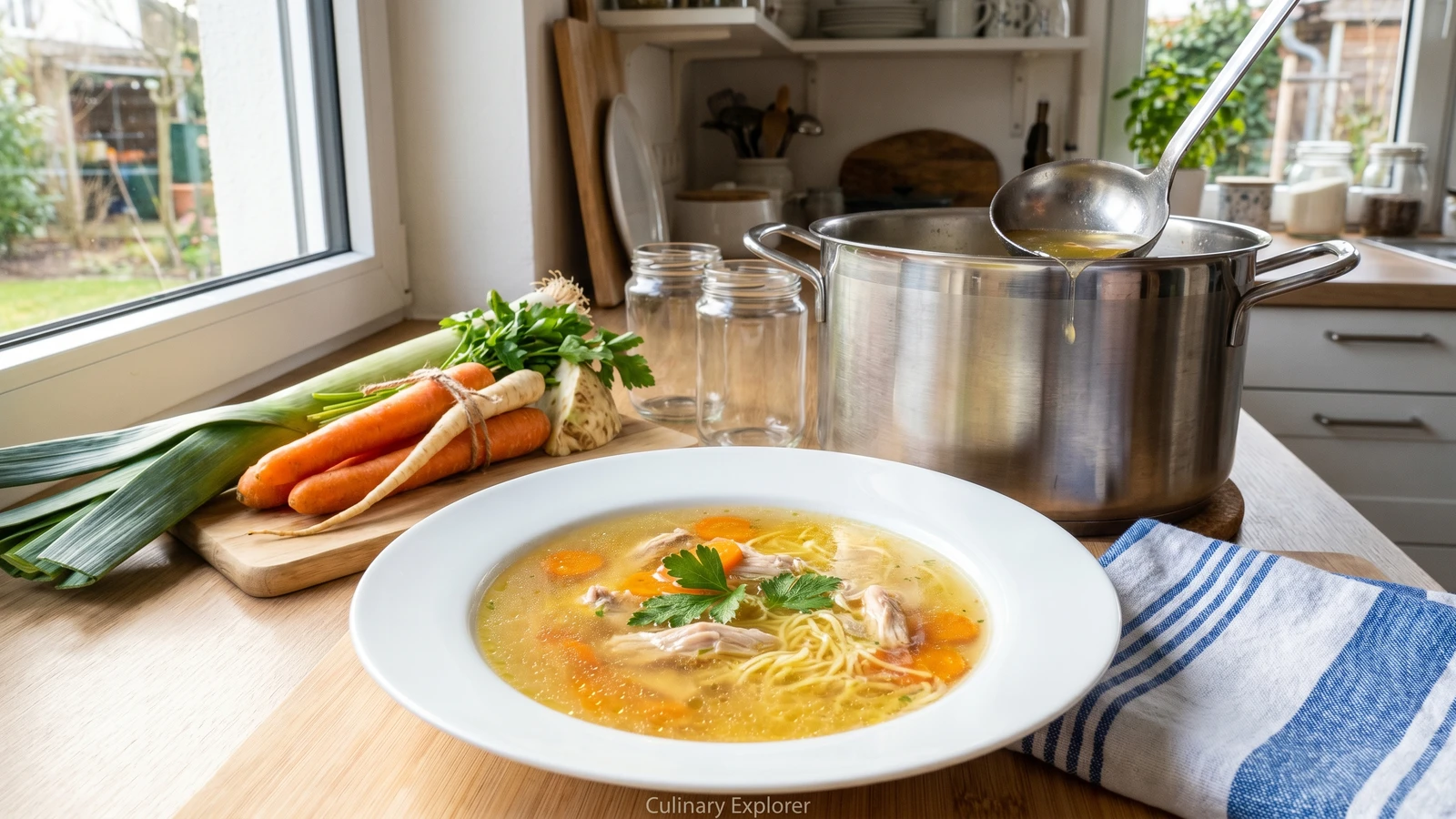
A whole soup hen, a bundle of roots, and a quiet pot: the clear German broth that sits under Hühnerfrikassee, noodle soup, and half the light sauces worth making.
Hühnerbrühe is the pot behind the pot. You make it ahead, you freeze it in portions, and suddenly a Wednesday soup, a Sunday Hühnerfrikassee, or a pale sauce for vegetables has a backbone. It belongs everywhere in Germany because every region had old hens, roots, and a stove, but it changes by the kitchen: in the north a clearer broth for rice, fish-adjacent soups, and pale sauces; in the south often deeper with parsley root, celeriac, and a few noodles or Flädle, thin pancake strips, floating in it. Im Norden anders, im Süden anders.
The bird matters. A Suppenhuhn, an older soup hen, gives better broth than a young roasting chicken because the tougher connective tissue melts slowly into the pot and gives body. The breast meat won't be the prize here. The broth is. Weggeworfen wird nichts: the meat goes into fricassee or salad, the skin and bones give what they have, and the vegetables do their quiet work.
The single technique is this: never let it boil hard. Bring it up slowly, skim the grey foam, then hold it at a lazy tremble for hours. A rolling boil breaks fat and protein into the liquid and gives you a cloudy, greasy broth; a low simmer lets the flavour move out cleanly while the fat rises where you can lift it away. Runter mit der Temperatur.
Salt comes late. If you salt hard at the beginning, the broth reduces and corners you. Season at the end, after straining, when you know what you have. Würzen, Fett, Salz zum Schluss. Nicht aus dem Glas.
German Hühnerbrühe comes from the older household practice of keeping laying hens until their egg years slowed, then sending the tough bird to the soup pot where long simmering made it useful. The bundled Suppengrün, usually carrot, leek, celeriac, and parsley root, became a standard market shorthand in German kitchens in the 19th and 20th centuries because it matched the root-cellar larder and the weekly soup pot. Regional service changes the broth more than the method: northern kitchens often keep it very clear and plain, while southern tables turn it into Flädlesuppe with sliced pancakes or serve it with fine egg noodles.
Quantity
1, about 1.5 to 2kg
Quantity
3.5 liters
Quantity
2
scrubbed and cut into large pieces
Quantity
1
split, washed well, and cut into large pieces
Quantity
200g
peeled and cut into large pieces
Quantity
1
scrubbed and cut into large pieces
Quantity
1
halved with skin left on
Quantity
1 small bunch
Quantity
2
Quantity
8
Quantity
4
Quantity
1 teaspoon, plus more to finish
| Ingredient | Quantity |
|---|---|
| whole Suppenhuhn (soup hen) | 1, about 1.5 to 2kg |
| cold water | 3.5 liters |
| carrotsscrubbed and cut into large pieces | 2 |
| leeksplit, washed well, and cut into large pieces | 1 |
| celeriacpeeled and cut into large pieces | 200g |
| parsley root or parsnipscrubbed and cut into large pieces | 1 |
| onionhalved with skin left on | 1 |
| flat-leaf parsley stems | 1 small bunch |
| bay leaves | 2 |
| black peppercorns | 8 |
| allspice berries | 4 |
| salt | 1 teaspoon, plus more to finish |
Put the soup hen in a large stockpot and cover it with the cold water. Start cold because the slow climb pulls soluble protein and flavour out of the bird before the outside tightens; drop the hen into hot water and you seal the surface like a bad poach. Bring it up slowly over medium heat.
As grey foam gathers on the surface, skim it off with a ladle or fine skimmer. That foam is coagulated protein, and if you let the pot boil it back in, the broth turns dull and cloudy. Take ten minutes here. A clear broth begins before the vegetables go in.
Add the carrots, leek, celeriac, parsley root, onion, parsley stems, bay leaves, peppercorns, allspice, and the teaspoon of salt. The onion skin gives a quiet gold colour, the celeriac and parsley root give the German soup taste, and the small early salt helps draw flavour without making the final broth too salty.
Lower the heat until the surface only trembles, then cook uncovered or partly covered for 3 to 3 1/2 hours. Runter mit der Temperatur. A hard boil pounds fat into the liquid and makes grease you cannot skim cleanly; a low simmer lets the collagen dissolve and the fat rise to the top.
Lift out the hen carefully and let it cool until you can handle it. Pull off the usable meat while it is still warm, because cold chicken clings to the bone and tears badly. Save the meat for Hühnerfrikassee, chicken salad, or a clear noodle soup. Weggeworfen wird nichts.
Strain the broth through a fine sieve into a clean pot or bowl, without pressing hard on the vegetables. Pressing forces cloudy pulp into the broth, and the vegetables have already given what they owe. Let the broth stand, skim off the fat, then taste and salt it properly at the end. Würzen, Fett, Salz zum Schluss.
Cool the broth quickly if you are not using it right away. Set the pot in a sink of cold water and stir now and then so the heat leaves fast, then refrigerate within two hours. The next day the fat cap lifts off cleanly, and the broth underneath should be clear, golden, and steady enough to carry a soup.
1 serving (about 250g)
Culinary guides, cultural storytelling, and the editorial depth that makes cooking meaningful.
Discover Culinary ExplorerChef Klaus
The apple-harvest preserve of the German kitchen, cooked low until the fruit collapses, then kept smooth, tart, and ready for potato pancakes or warm Mehlspeisen.

Chef Klaus
The northern marinated herring that belongs to the cold larder: salt fish, vinegar, onion, and time doing the work before bread or potatoes ever reach the table.

Chef Klaus
A proper Bratensoße begins with the brown bits in the pan, not a packet: bones roasted dark, wine scraped clean, stock reduced until it coats the spoon.

Chef Klaus
Plain mushrooms browned hard, then loosened with stock and cream. The sauce is mild, pale, quick, and honest, made for Schnitzel, Spätzle, or a weeknight pork cutlet.