
Chef Jeong-sun
Agwi-jjim (Braised Monkfish with Bean Sprouts)
Firm monkfish buried under crisp soybean sprouts, minari, and a red gochugaru sauce thickened at the end; Masan's market dish asks for heat, timing, and a steady hand.
A cooking platform built around craft, culture, and the stories behind what we eat.

Created by
The Hamhung cold noodle with teeth: chewy starch noodles tossed fast with spicy vinegared skate, pear, cucumber, and mustard oil, carried south by families who could not go home.
Hoe-guksu lives or dies by chew and sharpness. The noodles must fight back under the teeth, and the raw fish must be clean, cold, and cut thin enough to season all the way through. If either one is lazy, the bowl turns heavy.
My teacher made me rinse naengmyeon noodles until my fingers ached. I thought she was being severe. She was, but she was also right. Starch noodles keep a slippery coat unless you rub them under cold water, and that coat steals the sauce. Rinse until the noodles feel firm and squeaky, then drain them hard. That is the difference between a bowl that tosses cleanly and one that clumps like wet thread.
Traditionally this bowl belongs to Hamhung and the northern coast, where raw skate or flatfish met sweet-potato starch noodles and a fierce cho-gochujang (vinegared chili sauce). At home tonight, buy only fish you would eat raw without apology. If good skate is not in your market, use sashimi-grade fluke, halibut, or sea bream and write down what you used. Memory is a borrowed bowl.
Hoe-naengmyeon and hoe-guksu are closely tied to Hamhung in today's North Korea, where chewy starch noodles and spicy raw fish toppings developed alongside the region's cold noodle culture. After the Korean War, refugees from Hamhung and nearby northern coastal areas carried the dish south, especially into Seoul, Sokcho, and Busan, where skate or flatfish dressed in vinegar and chili became the defining topping. It is the sharper sibling of bibim-naengmyeon, with less broth and more chew, acid, and heat.
Quantity
200g
sweet-potato or potato starch
Quantity
180g
skin removed
Quantity
1 tablespoon
Quantity
1/4 teaspoon
Quantity
1/2 Korean cucumber or 1 small Persian cucumber
julienned
Quantity
1/4 teaspoon
Quantity
1/2
peeled and cut into thin matchsticks
Quantity
1
halved
Quantity
2 tablespoons
Quantity
1 1/2 tablespoons
Quantity
2 tablespoons
Quantity
1 tablespoon
or 2 teaspoons sugar
Quantity
1 tablespoon
Quantity
1 tablespoon
Quantity
2 teaspoons
Quantity
1 teaspoon
plus more to serve
Quantity
1 small clove
finely grated
Quantity
1 teaspoon
plus more for serving
Quantity
1/2 teaspoon
grated
Quantity
1 teaspoon
Quantity
2 tablespoons
for loosening the bowl
| Ingredient | Quantity |
|---|---|
| Hamhung-style naengmyeon noodlessweet-potato or potato starch | 200g |
| sashimi-grade skate wing, fluke, halibut, or sea breamskin removed | 180g |
| rice vinegar, for the fish | 1 tablespoon |
| fine sea salt, for the fish | 1/4 teaspoon |
| Korean cucumber or Persian cucumberjulienned | 1/2 Korean cucumber or 1 small Persian cucumber |
| fine sea salt, for salting the cucumber | 1/4 teaspoon |
| Korean pear or Asian pearpeeled and cut into thin matchsticks | 1/2 |
| hard-boiled egghalved | 1 |
| gochugaru (Korean chili flakes) | 2 tablespoons |
| gochujang (Korean chili paste) | 1 1/2 tablespoons |
| rice vinegar | 2 tablespoons |
| maesil-cheong (green plum syrup)or 2 teaspoons sugar | 1 tablespoon |
| soy sauce | 1 tablespoon |
| cold beef broth or water | 1 tablespoon |
| toasted sesame oil | 2 teaspoons |
| Korean mustard paste (yeongyeoja)plus more to serve | 1 teaspoon |
| garlicfinely grated | 1 small clove |
| toasted sesame seedsplus more for serving | 1 teaspoon |
| gingergrated | 1/2 teaspoon |
| sugar (optional) | 1 teaspoon |
| cold dongchimi brine or cold beef broth (optional)for loosening the bowl | 2 tablespoons |
Put two stainless bowls in the freezer for at least 20 minutes. This is a cold noodle dish with very little broth, so the bowl itself has to help keep the noodles tight and lively.
Keep the fish cold while you work. Slice it across the grain into pieces about 5 cm long, 1 cm wide, and 3 mm thick. Thin slices season quickly and stay tender; thick pieces taste raw in the wrong way, with sauce only on the outside.
Toss the sliced fish with 1 tablespoon rice vinegar and 1/4 teaspoon salt. Cover and refrigerate 20 minutes while you make the sauce. This short cure firms the surface and gives the seasoning a clean place to hold. It does not make unsafe fish safe.
Toss the julienned cucumber with 1/4 teaspoon salt and let it stand 10 minutes. Squeeze it gently, just until it stops dripping. Unsalted cucumber waters down the sauce, and hoe-guksu has no patience for watery dressing.
In a large mixing bowl, stir together the gochugaru, gochujang, 2 tablespoons rice vinegar, maesil-cheong, soy sauce, cold broth or water, sesame oil, mustard paste, garlic, sesame seeds, and ginger. Taste it before it touches the noodles. It should be sharp first, then spicy, then lightly sweet. Add the extra 1 teaspoon sugar only if the vinegar is biting without balance.
Drain off any liquid from the cured fish. Fold the fish through 2 tablespoons of the sauce and return it to the refrigerator while you cook the noodles. Seasoning the fish alone first lets it read as fish, not as a red garnish hiding in the noodles.
Bring a large pot of water to a hard boil. Shake loose the starch noodles and boil according to the package, usually 2 to 4 minutes. Stir constantly for the first minute so they do not knot together. These noodles overcook fast, and once they go soft they do not forgive you.
Drain the noodles and rinse under cold running water, rubbing them between both hands until they are cold, firm, and squeaky. This takes 1 to 2 minutes, not a polite splash. Drain hard, then squeeze lightly by handfuls so the sauce will cling instead of sliding off.
Add the cold noodles to the remaining sauce and toss with gloved hands until every strand is coated. If the noodles feel stiff, add 1 to 2 tablespoons cold dongchimi brine or cold beef broth, one spoon at a time. The bowl should look glossy, not soupy.
Divide the noodles between the chilled bowls. Top each with the seasoned fish, salted cucumber, pear matchsticks, half an egg, and a pinch of sesame seeds. Serve at once with more mustard and vinegar at the table, so each person can sharpen the bowl to their own mouth.
1 serving (about 530g)
Culinary guides, cultural storytelling, and the editorial depth that makes cooking meaningful.
Discover Culinary ExplorerChef Jeong-sun
Firm monkfish buried under crisp soybean sprouts, minari, and a red gochugaru sauce thickened at the end; Masan's market dish asks for heat, timing, and a steady hand.

Chef Jeong-sun
A quick Korean rice bowl built on contrast: warm rice, cold popping flying-fish roe, chopped vegetables, gim, sesame oil, and the crisp rice bottom a hot stone bowl gives you.
Chef Jeong-sun
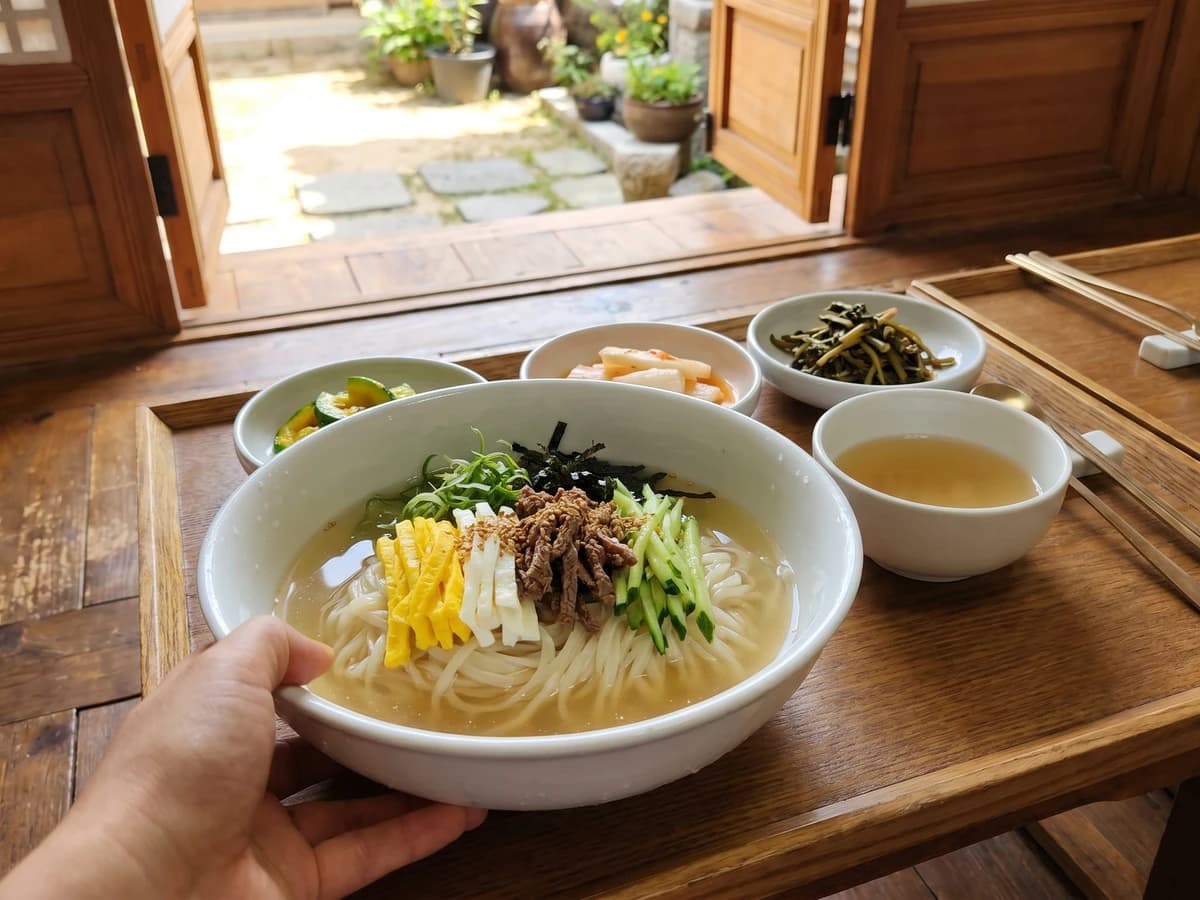
Andong's guest noodles, wheat and roasted soybean flour rolled thin, boiled and rinsed cold, then set in a clear chilled anchovy broth with careful strips of beef, egg, and cucumber.

Chef Jeong-sun
Andong's ritual-table rice served on an ordinary day: separate soy-sesame namul, warm rice, and clear radish soup, mixed without gochujang so every vegetable keeps its own voice.