Culinary Explorer

A cooking platform built around craft, culture, and the stories behind what we eat.
Discover Culinary Explorer
Helado de Mango Ataulfo Sinaloense

Helado de Mango Ataulfo Sinaloense

Created by

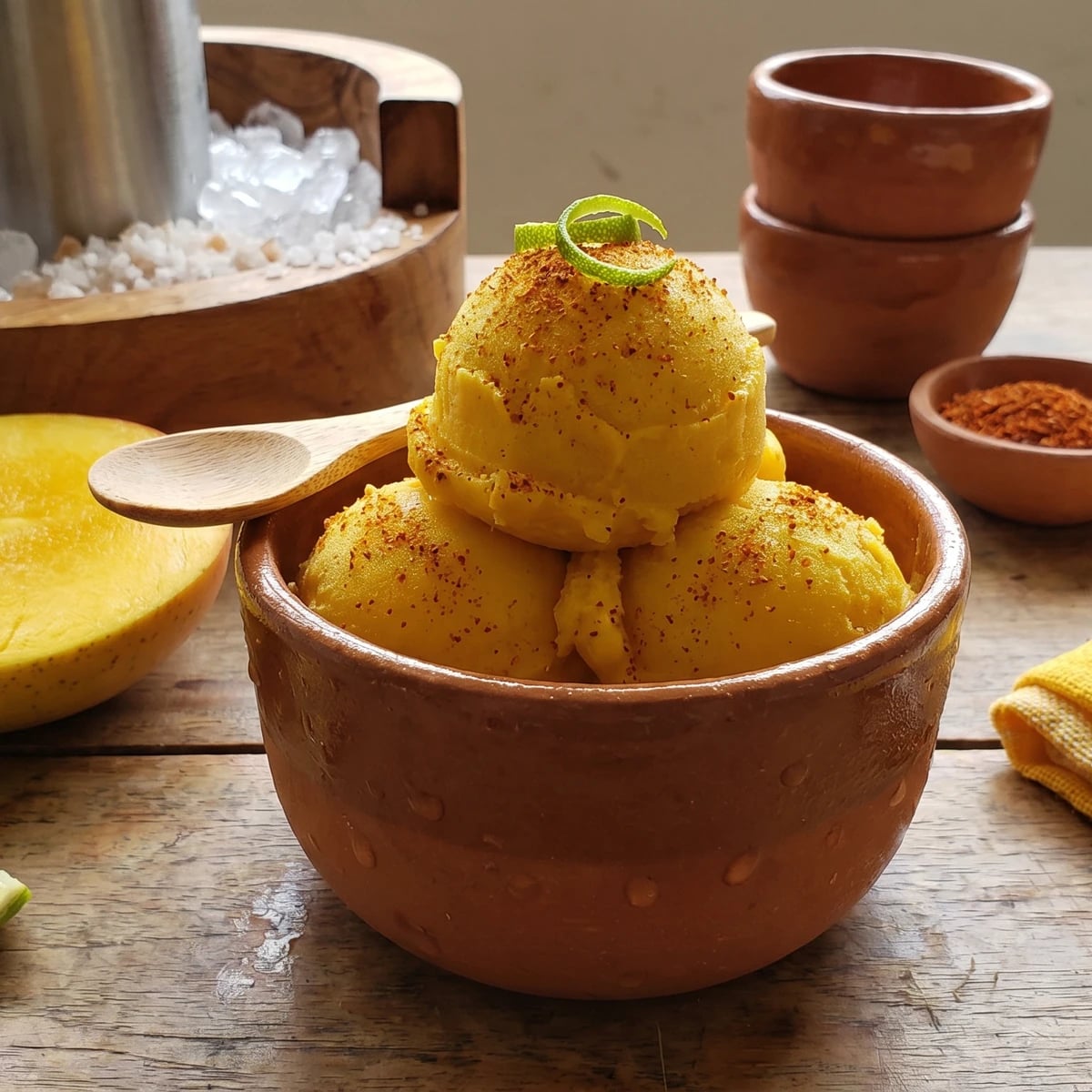
Sinaloa's ataulfo mango churned in a wooden garrafa with rock salt and ice, the way the paleteros of Mazatlan have been making it for a hundred years. No cream needed. The mango carries everything.

Desserts
Mexican
Picnic
Outdoor Dining
Comfort Food
30 min
Active Time
45 min cook1 hr 15 min total
Yield6 to 8 servings (about 1.5 quarts)

This is from Sinaloa. From Mazatlan and from the smaller mango towns inland, El Rosario, Escuinapa, where the ataulfo orchards run from the foothills of the Sierra Madre Occidental down toward the Pacific. Sinaloa is the country's mango state. Michoacan grows more by volume, but Sinaloa grows the ataulfo, the small yellow one with thin skin and a flat pit, and the ataulfo is the only mango that should ever be turned into helado.

The ataulfo is low in fiber. That is the whole reason this recipe works without cream, without eggs, without stabilizers. The flesh blends to a silk that other mangos cannot reach. Manila comes close. Tommy atkins, kent, the big red ones in the American supermarkets, are stringy and watery and have no business in a sorbet. If your market does not carry ataulfo, wait until they do. Cook what is in season, not what is on the shelf.

This is paletero food. Helado de garrafa is what the paleteros of Mazatlan and Culiacan have been making for over a century in wooden buckets packed with rock salt and ice, cranked by hand on the sidewalk in front of their shops. The wooden garrafa makes a denser, slower-frozen helado than any modern machine because the crank pulls in less air. If you do not have a garrafa, an ice cream maker will work. A blender will not. There is no shortcut to that texture.

My mother did not make this. She was from Jalisco and her ice cream was vanilla with cajeta. But the page in her notebook from a trip to Mazatlan in 1991 has three lines on it in pencil: "Mango ataulfo. Lima. Sal de grano y hielo. Nada mas." That was the entire recipe. She did not need more and neither do you. Recetas probadas y garantizadas. Cada estado, su propia cocina, and this one belongs to Sinaloa.

The mango is not native to Mexico. It arrived from the Philippines via the Manila galleon trade beginning in the 16th century, taking root first in the Pacific coastal states where the climate matched its origins. The ataulfo variety was developed in the 1960s in Tapachula, Chiapas, by a grower named Ataulfo Morales Nolasco, and was later carried north to Sinaloa where it found its commercial home; Mexico granted the variety appellation of origin protection in 2003, the first fruit in the country to receive such designation. Helado de garrafa, the salt-and-ice hand-cranked technique used here, predates electric refrigeration in Mexico by decades and was the standard method in Sinaloa's paleterias well into the second half of the 20th century, with many family-run shops in Mazatlan and Culiacan still churning by hand today as a matter of pride and texture.

The technique, the tradition, and the story behind every dish.

Discover Culinary Explorer

Ingredients

ripe mangos ataulfo

Quantity

8 (about 3 pounds whole, 2 pounds flesh)

peeled and pitted

granulated cane sugar (azucar estandar)

Quantity

1 cup

water

Quantity

1/2 cup

fresh lime juice

Quantity

1/3 cup (about 4 Mexican limes)

fine sea salt

Quantity

1 pinch

whole milk, very cold (optional)

Quantity

1 cup

for a softer mantecado-style helado

crushed ice

Quantity

8 to 10 pounds

for the garrafa

coarse rock salt (sal de grano)

Quantity

3 to 4 cups

for the garrafa

chile piquin powder (optional)

Quantity

for serving

lime wedges (optional)

Quantity

for serving

Tajin (optional)

Quantity

for serving

Equipment Needed

  • Traditional wooden garrafa with metal inner cylinder, or a hand-crank or electric ice cream maker
  • Coarse rock salt (sal de grano), not table salt
  • Sharp paring knife for the mangos
  • High-powered blender
  • Fine-mesh strainer (optional, only if your mangos have any fibrous patches)
  • Lidded freezer container for storage

Instructions

  1. 1

    Choose your mangos

    The mango ataulfo is the small yellow one with thin skin and a flat pit. Sinaloa grows the best ones in Mexico, mostly around El Rosario and Escuinapa. Press gently with your thumb. The fruit should give like a ripe avocado, not squish. The skin should be deep golden, sometimes freckled. Green-shouldered ataulfos are not ready. If you only find them green, leave them on the counter for two or three days until the perfume hits you when you walk into the kitchen. That perfume is the recipe. No me vengas con atajos.

  2. 2

    Make the light syrup

    Combine the sugar and water in a small saucepan over medium heat. Stir until the sugar dissolves, then bring to a gentle simmer for two minutes. Pull it off the heat and let it cool completely. A warm syrup will cook the mango and dull the floral quality you are working so hard to protect. Cool means cool, not lukewarm.

  3. 3

    Peel and pit the mango

    Stand each mango on its stem end. The pit runs flat and long through the center. Slice down on either side of the pit. Score the flesh in a cross-hatch through to the skin and turn the half inside out. Cut the cubes off into a bowl. Trim whatever flesh you can off the pit. Save the pits. You can simmer them in water with sugar for an aguas de mango later. Nothing wastes in this kitchen.

    The ataulfo is low in fiber, which is exactly why it makes a clean helado. Other mango varieties (manila, kent, tommy atkins) leave a stringy texture even after blending. They are not interchangeable. This is a Sinaloa recipe and the ataulfo is the chile of the dish.
  4. 4

    Blend the base

    Put the mango flesh, cooled syrup, lime juice, and pinch of salt into a blender. Blend until completely smooth, about a minute. Taste. The base should taste a little too sweet and a little too bright at room temperature. Cold dulls flavor by about 20 percent. If it tastes balanced now, it will taste flat once frozen. Adjust with another squeeze of lime if it leans too sugary. If you want the softer mantecado style they make in the paleterias of Mazatlan, blend in the cold milk now. For pure sorbet, skip it. Both are correct.

  5. 5

    Chill the base

    Pour the base into a bowl, cover, and refrigerate until very cold, at least one hour, ideally two. A warm base will not churn properly. The colder it goes into the garrafa, the smoother the texture comes out.

  6. 6

    Set up the garrafa

    Pour the cold base into the metal inner cylinder of a traditional wooden garrafa (or a hand-crank ice cream maker, or the canister of an electric machine). Seal it. Set the cylinder into the wooden bucket. Pack crushed ice and coarse rock salt in alternating layers around the cylinder, about three parts ice to one part salt. Pack it tight, all the way to the top. The salt drops the ice's freezing point below 32 degrees Fahrenheit, which is the only way water ice can pull heat out of the base and freeze it. This is the physics the paleteros of Mazatlan have been using for over a century. La sal hace el frio.

  7. 7

    Churn by hand

    Turn the crank steadily. Slow and even, not fast. You should feel light resistance at first. After about 15 minutes the resistance builds as the base around the walls of the cylinder freezes and gets scraped into the center. Keep going for 30 to 40 minutes total. Add more ice and salt as the level drops, draining off the salty meltwater through the spigot every ten minutes or so. The helado is ready when the crank gets hard to turn and the texture inside feels like dense, smooth softserve.

    If you are using an electric machine, churn 25 to 30 minutes until thick. The wooden garrafa makes a better helado because the slow, uneven crank pulls in less air, giving you a denser texture, but a machine will get you 85 percent of the way there. A blender alone will not. That is not helado. That is a smoothie someone froze.
  8. 8

    Firm up and serve

    Scrape the helado into a chilled container with a tight lid. Press a piece of parchment directly onto the surface, then cover. Freeze for at least two hours to firm up before serving. Scoop into small clay bowls or short glass cups. Dust with chile piquin or Tajin and a squeeze of lime. The salt-chile-lime trinity is how this is eaten on the malecon in Mazatlan and how it should be eaten anywhere else. Saber cocinar es saber vivir.

Chef Tips

  • Buy the mangos two or three days before you plan to make this. Ataulfos in the supermarket are almost always under-ripe. Let them sit on the counter, stem-side down, until the skin is deeply golden and the perfume fills the kitchen. Refrigerating before ripe will kill the floral character. Patience is part of the recipe.
  • If you do not have a garrafa, a hand-crank or electric ice cream maker is the next-best option. A no-churn shortcut (freezing the puree in a pan and scraping it with a fork every hour) gives you a granita, not a helado. That is a different dish. Call it what it is.
  • The salt-chile-lime garnish is not optional in Sinaloa. Chile piquin is the local powder. Tajin is the commercial version and works fine. Without that contrast, the helado is just sweet. With it, the dish has the salt-acid-heat backbone that defines coastal Mexican eating.

Advance Preparation

  • The mango base can be made and refrigerated up to 24 hours before churning. The lime juice will brighten the flavor as it sits.
  • Once churned and frozen, the helado holds its best texture for three to four days in a tightly sealed container. After that, ice crystals start to form on the surface and the texture suffers. This is not a make-far-ahead dessert. Make it for the day you plan to eat it.
  • Mango ataulfo season in Sinaloa runs roughly from March through July. Outside that window, the fruit you find in markets is usually shipped from elsewhere and quality varies. Make this in season. Asi se hace y punto.

Frequently Asked Questions

Nutrition Information

1 serving (about 220g)

Calories
225 calories
Total Fat
2 g
Saturated Fat
1 g
Trans Fat
0 g
Unsaturated Fat
1 g
Cholesterol
4 mg
Sodium
35 mg
Total Carbohydrates
50 g
Dietary Fiber
2 g
Sugars
49 g
Protein
2 g

Note: Chef personas and recipes are created with AI assistance. Cook with care: follow safe food-handling practices, check doneness with a thermometer when needed, and adapt for allergies and your kitchen.

Where cooking meets culture.

Culinary guides, cultural storytelling, and the editorial depth that makes cooking meaningful.

Discover Culinary Explorer

More from Noroeste Desserts

Browse the full collection