Chef Joost
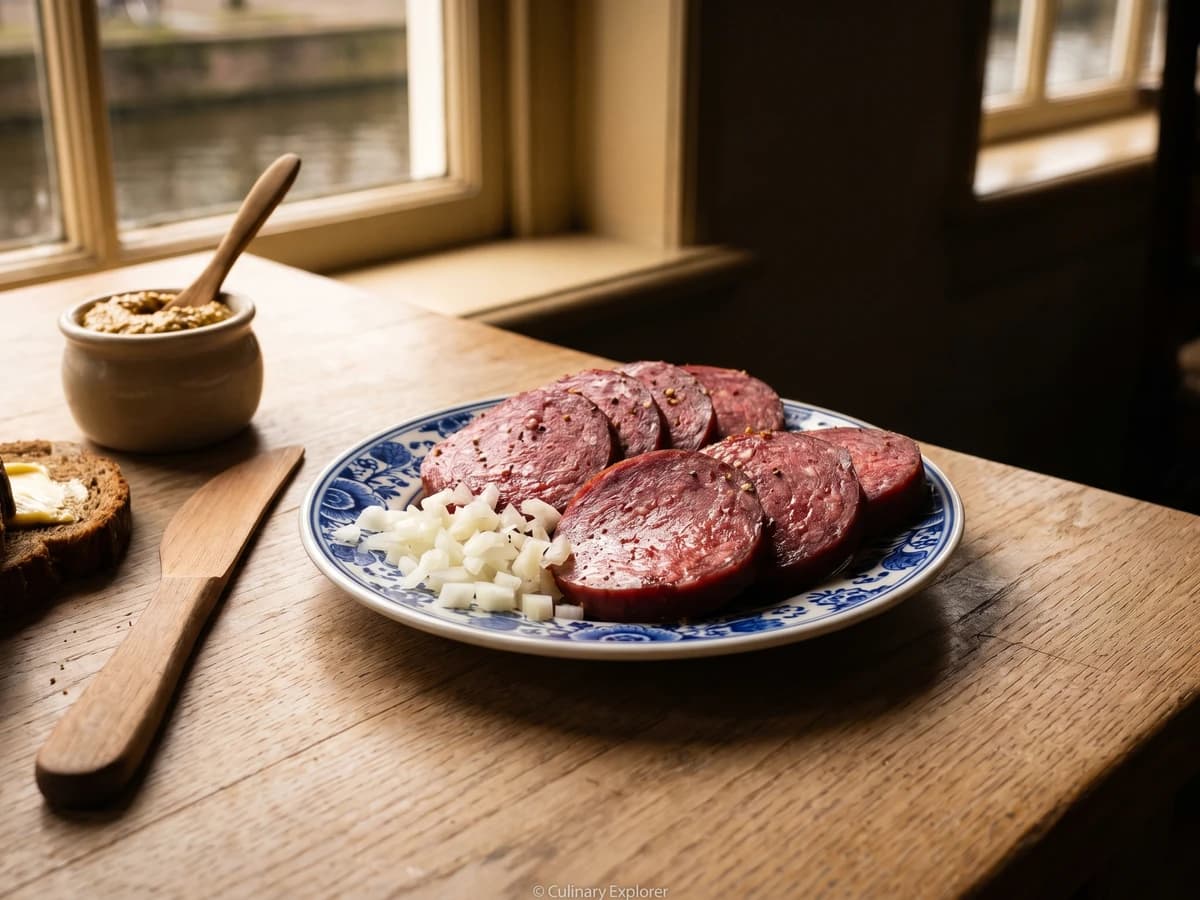
Amsterdamse Ossenworst
The name means ox sausage, but the real story is Amsterdam itself: cattle trade, Jewish butchers, VOC spices, and raw beef sliced thin with onion.
A cooking platform built around craft, culture, and the stories behind what we eat.

Created by
The little ham roll of the Dutch birthday table: cream cheese, augurk, and a prikker, a cocktail stick, proving modern recipes can become family memory before anyone writes them down.
Every Dutch birthday table has a moment when scholarship must lower its voice and make room for the tray with prikkertjes. In my grandmother's second notebook, the older recipes stand in careful script: beans for winter, mussels by the tide, pancakes from leaner years. Then, on a later page, in a different pen, the modern party architecture appears: ham, MonChou, augurk. No sailcloth. No guild seal. Just the small cold roll that disappears before the coffee is finished.
But let me tell you a secret: not every tradition is old, and that doesn't make it thin. Ham-MonChou rolletjes are the food of the verjaardag, the Dutch birthday, where chairs form a polite circle, the coffee arrives first, and the borrelhapjes, drink-table bites, come out when the room has softened. The name already tells you, and for once we should simply believe it: ham, MonChou fresh cream cheese, rolletjes, little rolls. A prikker, a cocktail stick, makes them official. This is philology with a toothpick in it.
Your work here is proportion, not performance. The augurk, the gherkin, cuts the cream. The chives wake it. The ham brings the salt, so don't bully the filling with more. Dry the pickles, soften the cheese, spread thinly, roll firmly, and chill before cutting. Hou het altijd simpel, always keep it simple. A dish without its story is half a meal, but a party snack that needs a lecture has already missed the tray.
Ham-MonChou rolletjes belong to the late twentieth-century Dutch borrel table, especially the verjaardag, birthday, where cold snacks could be made ahead and passed around a room of chairs. MonChou, a fresh cream cheese brand sold widely in Dutch supermarkets and strongly associated with party food by the 1970s, gave home cooks a mild, spreadable filling that made the older ham-and-pickle combination softer and neater. The dish is modern rather than provincial, but it teaches a very Dutch lesson: convivial food often survives because it is cheap, tidy, and ready before the guests ring the bell.
Quantity
10 large slices
patted dry
Quantity
200g
softened
Quantity
3 small
finely chopped
Quantity
1 tablespoon
Quantity
2 tablespoons
finely chopped
Quantity
1 tablespoon
finely chopped
Quantity
1 teaspoon
Quantity
to taste
Quantity
20
| Ingredient | Quantity |
|---|---|
| thin cooked ham (achterham)patted dry | 10 large slices |
| MonChou fresh cream cheesesoftened | 200g |
| gherkin (augurk)finely chopped | 3 small |
| gherkin brine | 1 tablespoon |
| chivesfinely chopped | 2 tablespoons |
| flat-leaf parsleyfinely chopped | 1 tablespoon |
| mild Dutch mustard or Dijon mustard | 1 teaspoon |
| freshly ground white pepper | to taste |
| wooden cocktail sticks (prikkertjes) | 20 |
Finely chop the augurken, then press them in a small sieve or between kitchen paper until they no longer drip. This seems fussy until you skip it once. Wet pickle loosens the cheese, and then the tidy little roll becomes a pink landslide.
Beat the softened MonChou with the gherkin brine, chives, parsley, mustard, and a little white pepper until smooth. Fold in the chopped augurk. Taste before adding anything salty; the ham is waiting to do that work.
Lay the ham slices flat on a board and pat them dry with kitchen paper. If the slices are very large, trim them into neat rectangles. Keep the offcuts for a sandwich or an omelette, because thrift is not decoration in a Dutch kitchen.
Spread a thin layer of filling over each ham slice, leaving a narrow bare edge at the far side. Roll from the filled edge toward the bare edge, firm but not tight, and place each roll seam-side down. A heavy hand squeezes the filling out; a loose hand gives you a roll that opens on the plate. The middle road is Dutch for a reason.
Cover the rolls and chill for at least 30 minutes. This short rest firms the cheese and lets the herbs settle into it, so the knife cuts cleanly instead of dragging cream across the ham.
Cut each roll in half with a sharp knife, wiping the blade between cuts if needed. Push a prikker through each piece and set them on a plate, cut side showing if you like the green flecks of herb and augurk to announce themselves. Serve cold, but not refrigerator-hard; ten minutes on the table is enough.
1 serving (about 26g)
Culinary guides, cultural storytelling, and the editorial depth that makes cooking meaningful.
Discover Culinary ExplorerChef Joost
The name means ox sausage, but the real story is Amsterdam itself: cattle trade, Jewish butchers, VOC spices, and raw beef sliced thin with onion.

Chef Joost
The little yellow onion on the Amsterdam borrel board looks modest, until vinegar, turmeric, and patience turn it into the sharp bite that wakes cheese, herring, and sausage.

Chef Joost
The bear's claw of the northern snackbar: a seasoned gehaktbal, Dutch meatball, cut into thick discs, skewered with onion, fried until the edges catch, then dragged through peanut sauce.

Chef Joost
The name points to the drink, not the mood: bitterballen are crisp little balls of beef ragout made for the borrel table, mustard beside them, fingers slightly burned by impatience.