Culinary Explorer

A cooking platform built around craft, culture, and the stories behind what we eat.
Discover Culinary Explorer
Haepari-naengchae (Jellyfish Salad)

Haepari-naengchae (Jellyfish Salad)

Created by

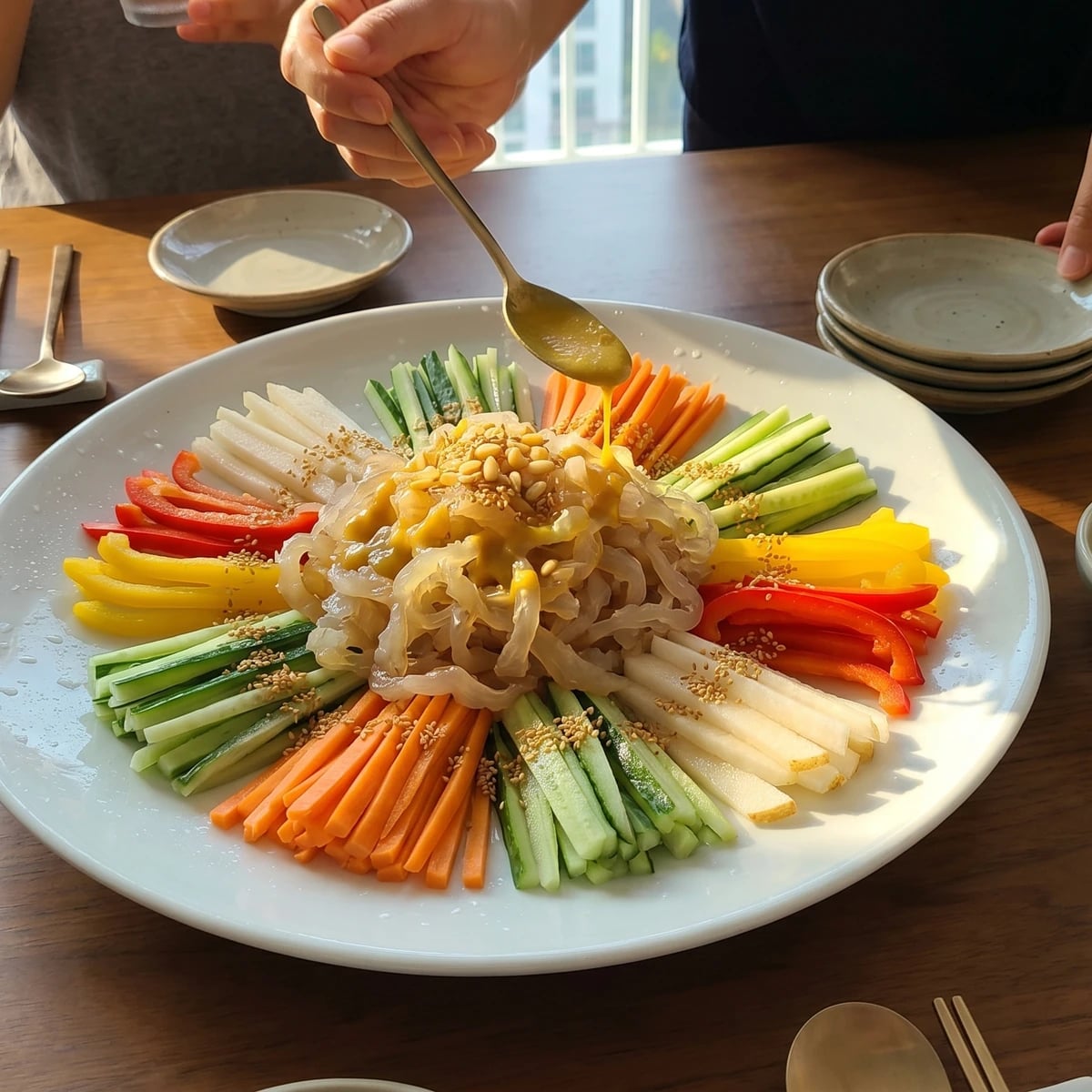
A cold celebration salad of crisp jellyfish, pear, cucumber, and bright vegetables, fanned on a chilled platter and dressed at the table with garlic-sharp Korean mustard sauce.

Salads
Korean
Dinner Party
Celebration
45 min
Active Time
1 min cook1 hr 20 min total
Yield4 to 6 servings

The whole dish can be ruined in fifteen seconds. Haepari (jellyfish) is not boiled. It is woken in water just warm enough to tighten its crunch, then shocked cold before it curls into rubber. Notebook 41 says 52 degrees Celsius for 15 seconds, and I wrote it twice because people think a celebration dish must forgive them. This one does not.

At a party table, haepari-naengchae is the cold bright plate that arrives before the heavy things: galbi-jjim, jeon, stews, the dishes that ask for rice. It gives the mouth a clean slap from gyeoja (Korean mustard), vinegar, garlic, and crisp vegetables cut to the same length as the jellyfish. That knife work matters. If the cucumber is thick and the pear is thin, one bites first and the other disappears.

My teacher made us fan every color separately and sauce only at the end. She was not being decorative, though she enjoyed pretending decoration was a moral failing. The sauce pulls water from the vegetables, so dress early and the platter goes slack. Chill the plate, cut clean matchsticks, blanch gently, and serve it when people are already sitting down. 손맛 is real; I measure it anyway, so this bright little party plate can travel from one kitchen to the next.

Naengchae means a chilled dressed dish, and haepari-naengchae belongs to Korea's modern banquet and home-party table more than to the old daily rice table. Its closest relative is the Chinese cold jellyfish appetizer made from salted prepared jellyfish, but Korean cooks settled it into a mustard-vinegar salad with cucumber, pear, and julienned vegetables; by the late twentieth century it was common at wedding halls, hotel buffets, and housewarming meals. The dish records a practical Korean habit: take a market ingredient, cut everything to one measured bite, and use a sharp sauce to open the meal before richer celebration dishes arrive.

The technique, the tradition, and the story behind every dish.

Discover Culinary Explorer

Ingredients

salted prepared jellyfish strips (haepari)

Quantity

300g

cold water

Quantity

8 cups

for soaking

water

Quantity

4 cups

heated to 50 to 55 degrees Celsius, for blanching

ice water

Quantity

4 cups

rice vinegar

Quantity

1 tablespoon

for seasoning the jellyfish

sugar

Quantity

1 teaspoon

for seasoning the jellyfish

fine sea salt

Quantity

1/8 teaspoon

for seasoning the jellyfish

English or Korean cucumber

Quantity

1 medium (about 180g)

seeded and julienned

fine sea salt

Quantity

1/4 teaspoon

for salting the cucumber

carrot

Quantity

1 medium (about 80g)

julienned

red bell pepper

Quantity

1/2

julienned

yellow bell pepper

Quantity

1/2

julienned

Korean or Asian pear

Quantity

1/2 (about 160g)

peeled and julienned

Korean mustard powder (gyeoja-garu)

Quantity

1 tablespoon

warm water

Quantity

1 tablespoon

for blooming the mustard

rice vinegar

Quantity

3 tablespoons

sugar

Quantity

1 1/2 tablespoons

soy sauce

Quantity

1 tablespoon

garlic

Quantity

2 teaspoons

minced

toasted sesame oil

Quantity

1 teaspoon

fine sea salt

Quantity

1/4 teaspoon

cold water

Quantity

1 tablespoon

to loosen the sauce

toasted sesame seeds

Quantity

1 teaspoon

pine nuts (optional)

Quantity

1 tablespoon

lightly crushed

Equipment Needed

  • Digital thermometer
  • Large bowls for soaking and chilling
  • Sharp chef's knife or mandoline with cut-resistant glove
  • Wide chilled serving platter

Instructions

  1. 1

    Soak the jellyfish

    Rinse the salted jellyfish under cold running water for 1 minute, squeezing lightly with your fingers to loosen the salt. Put it in a bowl with 8 cups cold water and soak 30 minutes, changing the water at 10 minutes and 20 minutes. Bite one strand. It should taste faintly seasoned, not sharply salty. If it still bites with salt, soak 10 minutes more and drain well.

    Buy food-grade salted prepared jellyfish from a Korean or Chinese market, already cleaned and sliced. This recipe is not for fresh jellyfish from the sea.
  2. 2

    Blanch barely warm

    Heat 4 cups water to 50 to 55 degrees Celsius, 122 to 131 degrees Fahrenheit, then turn off the heat. Add the drained jellyfish, stir for 15 seconds, and lift it straight into the ice water. Do not boil it. Boiling water makes jellyfish shrink, curl, and toughen, and no mustard sauce can repair that mistake.

    Use a thermometer here. If the water has gone above 60 degrees Celsius, cool it with a splash of cold water before the jellyfish goes in.
  3. 3

    Season and chill

    Drain the jellyfish from the ice water and squeeze gently, not hard enough to crush the strips. Cut any long pieces into 6cm lengths. Toss with 1 tablespoon rice vinegar, 1 teaspoon sugar, and 1/8 teaspoon salt, then chill 20 minutes. This light seasoning reaches the jellyfish before the final sauce, so the center does not taste washed out.

  4. 4

    Cut the vegetables

    Halve the cucumber lengthwise, scrape out the watery seeds, and cut it into 6cm matchsticks. Toss the cucumber with 1/4 teaspoon salt for 10 minutes, then pat it dry. Cut the carrot, red bell pepper, yellow bell pepper, and pear into the same length and close to the same width. The matched cut is not for prettiness alone; it makes the jellyfish and vegetables bite together.

    Cut the pear last, or hold the cut pear in cold water with 1 teaspoon rice vinegar for 2 minutes, then drain. Pear browns quickly once it meets the air.
  5. 5

    Make mustard sauce

    Stir the Korean mustard powder with 1 tablespoon warm water to make a paste. Cover and let it stand 10 minutes, because mustard needs time to bloom before it becomes sharp. Stir in 3 tablespoons rice vinegar, 1 1/2 tablespoons sugar, 1 tablespoon soy sauce, 2 teaspoons minced garlic, 1 teaspoon sesame oil, 1/4 teaspoon salt, and 1 tablespoon cold water. Taste a drop with a strand of jellyfish, not from the spoon alone. It should hit the nose first, then land sour, sweet, and garlicky.

    If you use prepared Korean mustard paste instead of powder, use 2 tablespoons paste, skip the blooming water, and start with only 1 tablespoon sugar. Prepared paste is usually milder and saltier.
  6. 6

    Fan the platter

    Chill a wide platter for 10 minutes. Drain the seasoned jellyfish again, but do not rinse it. Arrange the cucumber, carrot, peppers, and pear in separate fans around the platter, then pile the jellyfish in the center or lay it in a pale arc across the vegetables. Spoon half the mustard sauce in thin lines over the jellyfish and keep the rest in a small bowl for the table.

  7. 7

    Toss and serve

    Scatter the sesame seeds and pine nuts, if using, just before serving. At the table, spoon on more sauce and toss from the bottom with chopsticks so the jellyfish does not stay hidden under the vegetables. Serve immediately. After 30 minutes, the sauce starts pulling water from the vegetables, and the clean crunch you worked for begins to leave.

Chef Tips

  • The blanch is the dish's narrow gate. Keep the water at 50 to 55 degrees Celsius and count the seconds. Hotter water makes the jellyfish tough, while cold water leaves it flat and too salty in the bite.
  • Cut everything 6cm long and close to matchstick width. A composed salad eats properly only when every strip travels together on the chopsticks.
  • Korean pear is best in autumn and winter. In summer, when the pear is tired and expensive, use a crisp sweet apple or add more cucumber. Cook the month you're standing in.
  • Dress late. You can fan the platter ahead, but the mustard sauce should meet the vegetables only when the table is ready.
  • Leftovers keep poorly once dressed. Refrigerate them and eat within a day, knowing the vegetables will soften and the sauce will become stronger.

Advance Preparation

  • The mustard sauce can be made up to 2 days ahead and refrigerated. Stir it well before serving, because the mustard settles and the garlic grows stronger as it sits.
  • The jellyfish can be rinsed, warm-blanched, lightly seasoned, and refrigerated up to 1 day ahead. Keep it covered and cold.
  • The carrot and peppers can be julienned up to 4 hours ahead. Salt and dry the cucumber up to 2 hours ahead. Cut the pear close to serving, or hold it briefly in the vinegar water described in the instructions.
  • Assemble the platter no more than 15 minutes before serving, and sauce it at the table.

Frequently Asked Questions

Nutrition Information

1 serving (about 190g)

Calories
105 calories
Total Fat
4 g
Saturated Fat
1 g
Trans Fat
0 g
Unsaturated Fat
3 g
Cholesterol
5 mg
Sodium
1050 mg
Total Carbohydrates
14 g
Dietary Fiber
2 g
Sugars
9 g
Protein
5 g

Note: Chef personas and recipes are created with AI assistance. Cook with care: follow safe food-handling practices, check doneness with a thermometer when needed, and adapt for allergies and your kitchen.

Where cooking meets culture.

Culinary guides, cultural storytelling, and the editorial depth that makes cooking meaningful.

Discover Culinary Explorer

More from Saengchae, Geotjeori & Fresh Muchim

Browse the full collection