
Chef Jeong-sun
Aehobak-guk (애호박국, Korean Zucchini Soup)
A clean summer soup of Korean zucchini and salted shrimp, built on quick anchovy-kelp broth and finished before the half-moons lose their shape on a weeknight table.
A cooking platform built around craft, culture, and the stories behind what we eat.
Created by
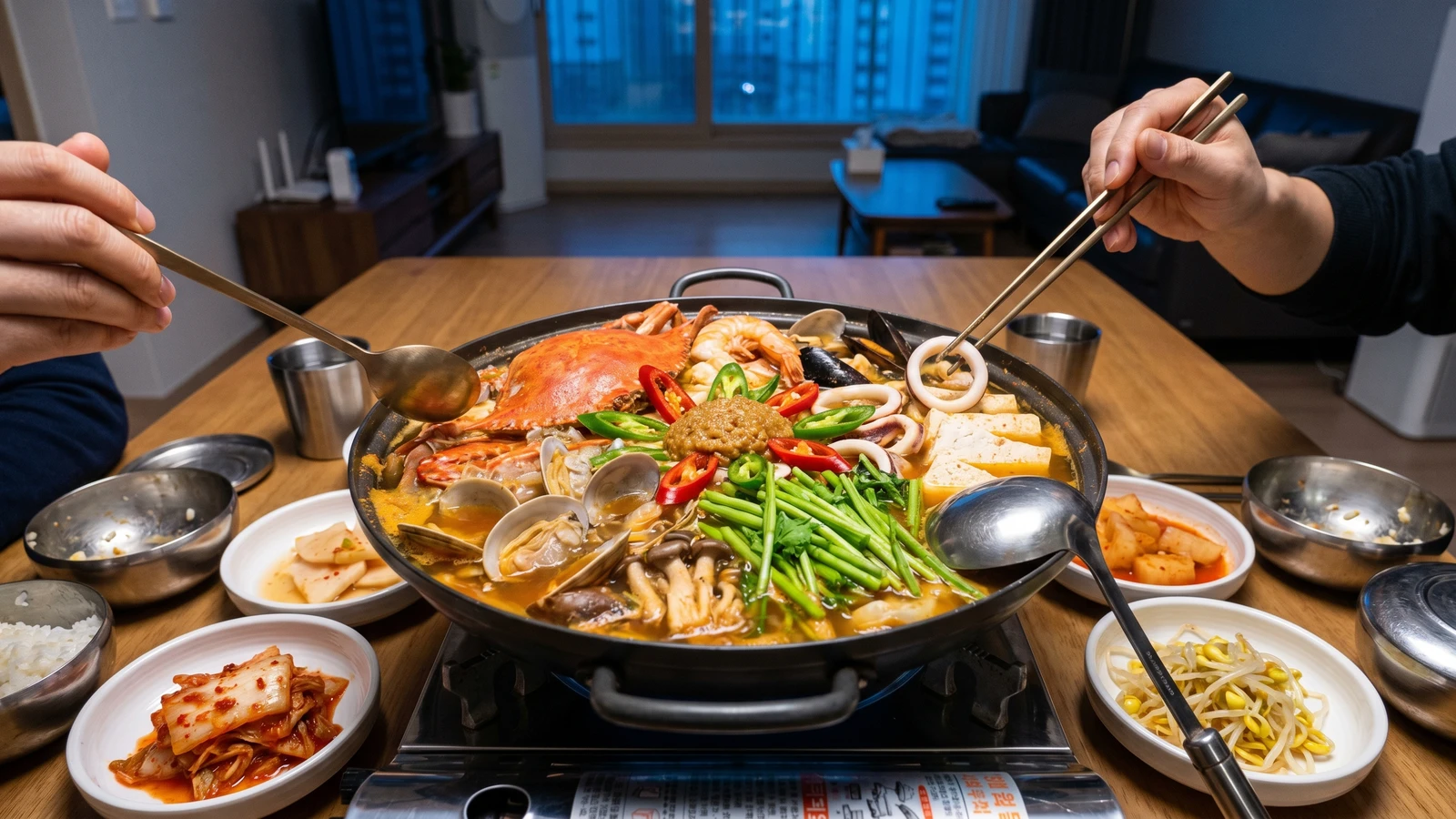
A briny Korean seafood hot pot arranged by color, broth poured over at the table, and simmered just long enough for crab, clams, shrimp, and squid to turn sweet.
Haemul-jeongol begins at the fish market, not at the stove. Buy what still smells clean and cold: crab heavy for its size, clams shut tight, shrimp with firm shells, squid with clear skin. If the market gives you poor seafood, don't force this dish. Cook something else. A jeongol has nowhere to hide a bad ingredient.
This is not jjigae. Jjigae often names one main ingredient and comes to the table already cooked; jeongol carries several ingredients arranged together and finishes in front of the people eating. That arrangement is not decoration. Napa cabbage and radish go underneath to sweeten the broth, seafood sits where everyone can reach it, mushrooms and minari give color and scent, and the broth rises through everything instead of beating it down.
My teacher made us place the raw pot twice before she let us light the burner. White squid, red crab, grey clam, brown mushroom, green minari. 눈동냥, 귀동냥, borrowing with the eyes and ears. You look first, then you cook. Pour in less broth than you think, because the seafood will give its own liquid, and season with restraint so each thing still tastes like itself.
Tonight this dish asks for attention, not difficulty. Pull the kelp before it turns bitter. Add seafood in the right order. Lift the octopus the moment it curls. 손맛 is real; I measure it anyway, so the next table can eat the same good pot.
Jeongol is a Korean category of shared hot pot, arranged raw or partly cooked in a shallow pan and simmered at the table, with roots in late Joseon banquet and tavern cooking rather than one single household dish. Seafood versions grew naturally in coastal regions and port markets, where mixed catches of crab, shellfish, squid, and small fish could be cooked together quickly for a group. Modern homes often use a portable gas burner or electric shabu pot in place of older charcoal vessels, but the principle remains the same: arranged ingredients, clean broth, and communal cooking at the table.
Quantity
7 cups
Quantity
1 piece, about 4 inches square
Quantity
14
heads and guts removed
Quantity
150g
sliced 1/4 inch thick
Quantity
1/2 small
peeled
Quantity
2
Quantity
2 tablespoons
Quantity
2 tablespoons
Quantity
1 tablespoon
Quantity
1 tablespoon
Quantity
1 tablespoon
minced
Quantity
1 teaspoon
grated
Quantity
1/2 teaspoon, plus more as needed
Quantity
1/4 teaspoon
Quantity
1 small, about 450g
cleaned and cut into 4 pieces
Quantity
8
shells on, deveined if possible
Quantity
250g
scrubbed and purged
Quantity
200g
scrubbed and debearded
Quantity
1 medium, about 250g
cleaned and cut into rings, tentacles separated
Quantity
1, about 250g
cleaned
Quantity
200g
cut into 2-inch pieces
Quantity
200g
cut into thin half-moons
Quantity
1/2 medium
sliced
Quantity
150g
cut into thick rectangles
Quantity
100g
rinsed
Quantity
100g
trimmed
Quantity
60g
cut into 3-inch lengths
Quantity
2
cut into 2-inch lengths
Quantity
1
sliced on the diagonal
Quantity
1
sliced on the diagonal
Quantity
1 handful, about 25g
Quantity
to serve
Quantity
to finish
| Ingredient | Quantity |
|---|---|
| water | 7 cups |
| dried kelp (dasima) | 1 piece, about 4 inches square |
| large dried anchovies (myeolchi)heads and guts removed | 14 |
| Korean radish for brothsliced 1/4 inch thick | 150g |
| onion for brothpeeled | 1/2 small |
| dried shiitake mushrooms (optional) | 2 |
| gochugaru (Korean chili flakes) | 2 tablespoons |
| soup soy sauce (guk-ganjang) | 2 tablespoons |
| fish sauce or Korean tuna sauce | 1 tablespoon |
| mirim or rice wine | 1 tablespoon |
| garlicminced | 1 tablespoon |
| gingergrated | 1 teaspoon |
| fine sea salt | 1/2 teaspoon, plus more as needed |
| black pepper | 1/4 teaspoon |
| blue crab or Korean flower crabcleaned and cut into 4 pieces | 1 small, about 450g |
| large shrimpshells on, deveined if possible | 8 |
| littleneck clamsscrubbed and purged | 250g |
| musselsscrubbed and debearded | 200g |
| squidcleaned and cut into rings, tentacles separated | 1 medium, about 250g |
| small octopus (nakji) (optional)cleaned | 1, about 250g |
| napa cabbagecut into 2-inch pieces | 200g |
| Korean radish for the potcut into thin half-moons | 200g |
| onionsliced | 1/2 medium |
| medium-firm tofucut into thick rectangles | 150g |
| soybean sproutsrinsed | 100g |
| mixed mushroomstrimmed | 100g |
| minari (Korean water parsley)cut into 3-inch lengths | 60g |
| scallionscut into 2-inch lengths | 2 |
| red chilisliced on the diagonal | 1 |
| green chilisliced on the diagonal | 1 |
| crown daisy (ssukgat) (optional) | 1 handful, about 25g |
| cooked rice (optional) | to serve |
| cooked kalguksu noodles or udon noodles (optional) | to finish |
Put the clams in 4 cups cold water mixed with 1 tablespoon salt for 30 minutes, then scrub them well. Scrub the mussels and pull away the beards. Discard any shellfish that stay open after a firm tap. This is not fussiness; one bad clam can spoil the whole pot.
Put the water, kelp, anchovies, 150g radish, 1/2 small onion, and dried shiitake mushrooms in a pot. Bring it slowly to a bare simmer over medium heat. Pull the kelp out as soon as the water trembles, about 8 to 10 minutes, because kelp left too long gives bitterness and a slick texture. Simmer the rest 15 minutes more, then strain. You should have about 5 1/2 cups broth.
Stir together the gochugaru, soup soy sauce, fish sauce, mirim, garlic, ginger, salt, black pepper, and 3 tablespoons of the warm broth to make a loose paste. Do not add gochujang here. This pot needs clarity, not sweetness and thickness. Taste the paste; it should be salty and clean, with chili warmth but no heaviness.
Clean the crab and cut it into 4 pieces, keeping the shells because they sweeten the broth. Leave shrimp shells on for flavor, but devein them if you can. Cut the squid body into 1/2-inch rings and leave the tentacles in small clusters. If using octopus, rub it with 1 tablespoon coarse salt for 1 minute, rinse very well, and cut it into 2-inch pieces. The octopus goes in late, or it tightens like a rubber band.
In a wide shallow jeongol pan, lay napa cabbage, the 200g sliced radish, onion, soybean sprouts, and tofu across the bottom. Set crab, clams, mussels, shrimp, squid, and mushrooms in separate sections over the vegetables, then spoon the seasoning paste in the center. Arrange by color before the broth goes in: white squid, red crab and chili, green minari, brown mushrooms, pale tofu. This lets the table see what it is eating, and it also cooks evenly because each ingredient has its place.
Set the pot on a portable burner at the table. Pour in 4 cups of broth around the side, not directly over the seasoning paste, so the arrangement stays clear at first. Bring it to a lively simmer, then loosen the paste into the broth with a spoon. Keep the remaining broth warm nearby. Use less liquid than feels generous, because the seafood will release its own briny juices.
Simmer 6 to 8 minutes, nudging the crab and shellfish down into the broth. When the clams and mussels open, move them to the side of the pot so they do not toughen. Add the squid and octopus only for the last 2 to 3 minutes. Lift the octopus the moment it curls and turns opaque; that is the tender point. Shrimp are done when they turn pink and firm. Discard any shellfish that do not open.
Lay the minari, scallions, sliced chilies, and crown daisy over the top for the final minute. They should bend and brighten, not collapse. Taste the broth now, after the seafood has spoken. Add salt 1/4 teaspoon at a time only if it tastes flat. Add warm broth if it grows too strong.
Serve directly from the shared pot with rice and small side dishes. When most of the seafood is gone, add cooked kalguksu noodles or udon to the remaining broth and simmer 2 to 3 minutes. That last bowl is why the first seasoning must be restrained; the broth concentrates as the table eats.
1 serving (about 850g)
Culinary guides, cultural storytelling, and the editorial depth that makes cooking meaningful.
Discover Culinary ExplorerChef Jeong-sun
A clean summer soup of Korean zucchini and salted shrimp, built on quick anchovy-kelp broth and finished before the half-moons lose their shape on a weeknight table.
Chef Jeong-sun
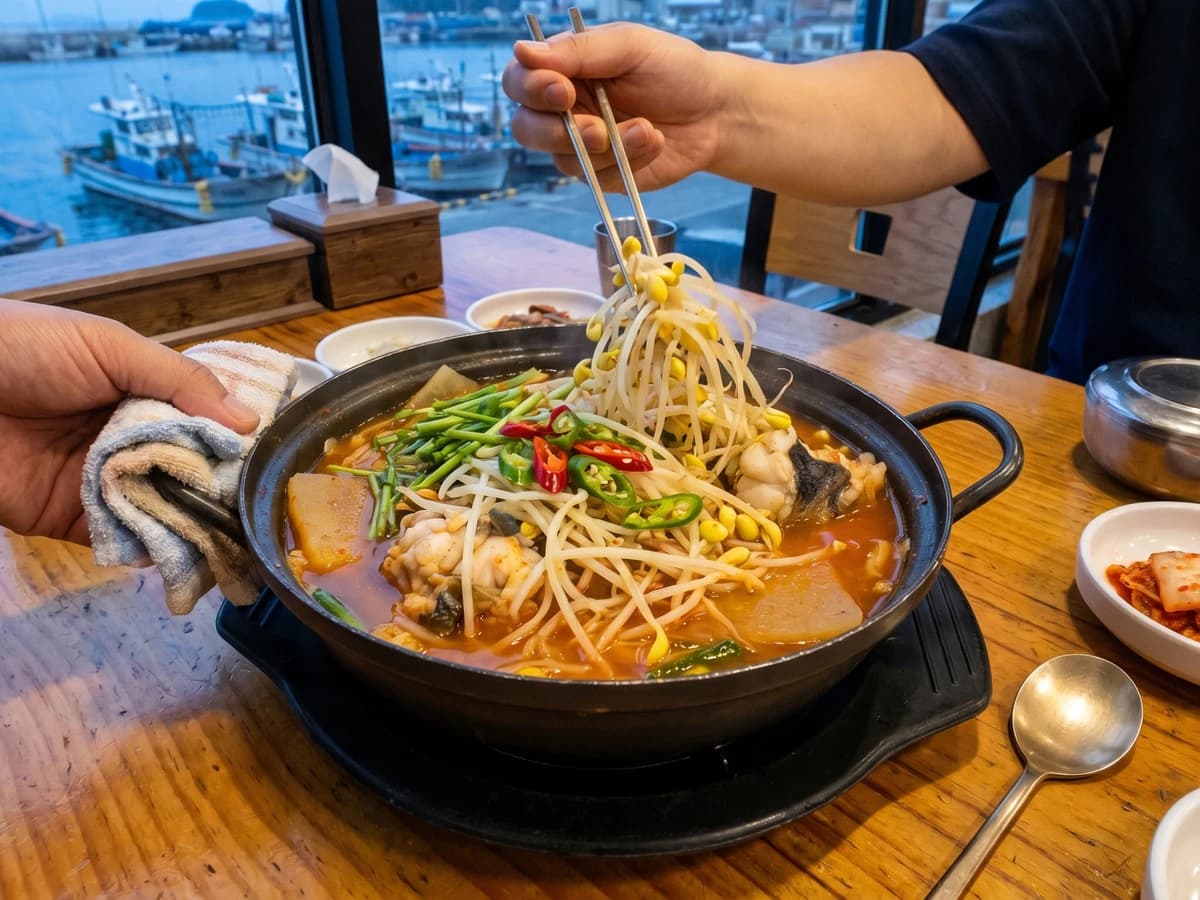
A Masan coast monkfish stew with firm white meat, gelatin at the bones, soybean sprouts for crunch, and a red broth seasoned to carry the fish, not bury it.

Chef Jeong-sun
A weeknight fish roe stew with radish and crown daisy in a clean spicy broth, where the whole success depends on adding the roe late enough that it sets tender, not chalky.

Chef Jeong-sun
Late-summer mallow leaves rubbed with salt until the bitter green water runs off, then simmered in a clean doenjang broth with dried shrimp, the quiet soup a Korean weeknight deserves.