
Chef Joost
Amsterdamse Ossenworst
The name means ox sausage, but the real story is Amsterdam itself: cattle trade, Jewish butchers, VOC spices, and raw beef sliced thin with onion.
A cooking platform built around craft, culture, and the stories behind what we eat.
Created by
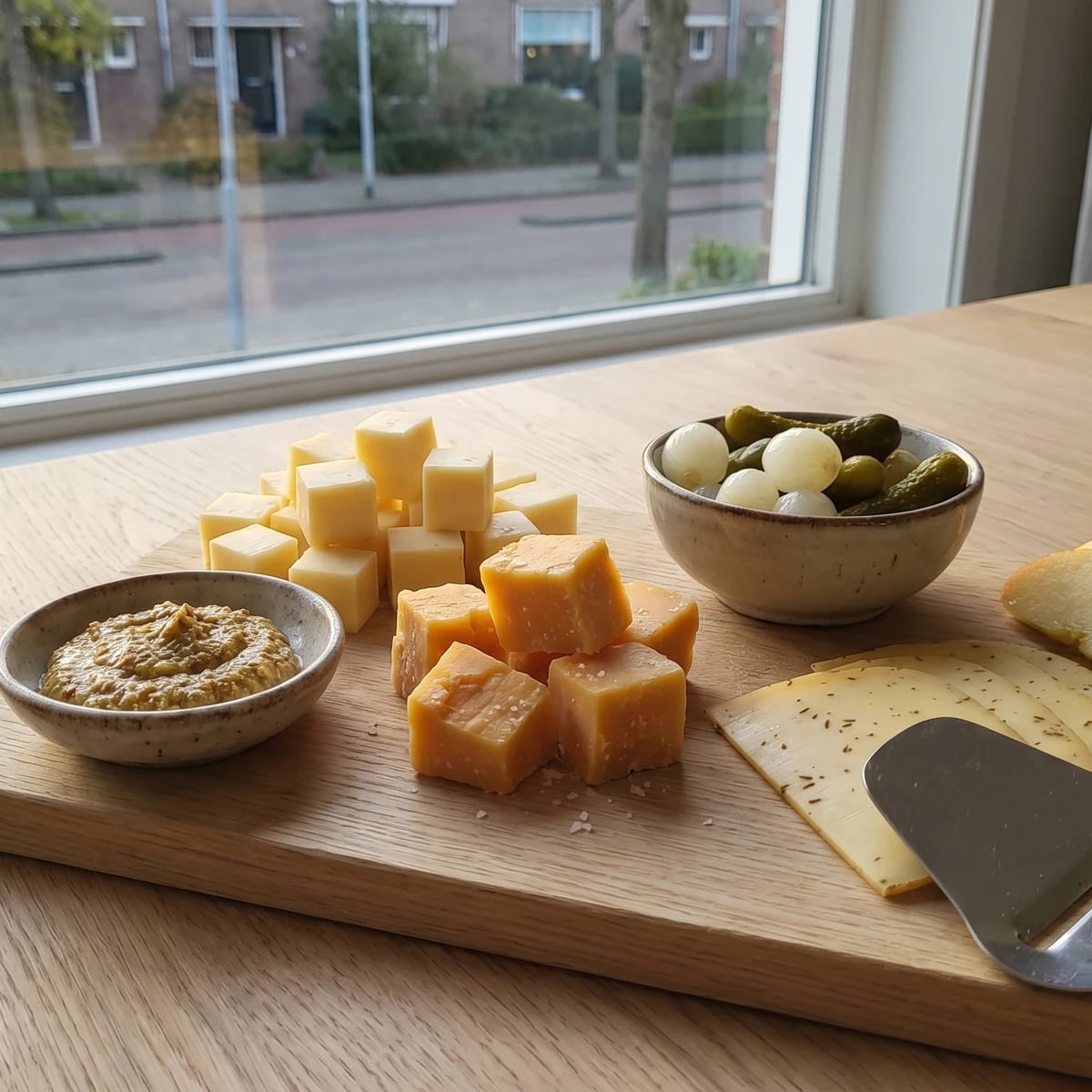
The heart of the Dutch borrelplank: sweet young Gouda, deep aged Gouda, and cumin-studded Leidse, cut with the kaasschaaf and served without ceremony.
ADutch cheese board is not a board trying to impress you. It is a table deciding to stay open a little longer. In my grandmother's second notebook there was no recipe for kaasplank, cheese board, because who writes down how to cut cheese? She did write down who liked jonge kaas, young Gouda, who wanted the brokkelkaas that crumbles under the knife, and which uncle would steal every zilveruitje, little pickled onion, before the coffee arrived. This too is cookery. The family table keeps records in appetite.
But let me tell you a secret: Gouda is not really a cheese from Gouda in the narrow way people imagine. It is a market name, a trading name, the name of the town where the wheels were weighed, bargained over, and sent onward. Leidse kaas, Leiden cheese, tells a different story. It is leaner, drier, flecked with cumin, born from farms where the cream had already gone to butter and the remaining milk still had to earn its place at supper. Exuberant cookery in a frugal country, yes, even in a cube of cheese on a cocktail stick.
So the work here is restraint. Cut the young Gouda into clean cubes because it is soft and friendly. Break the aged Gouda into rough pieces because its crystals deserve edges, not obedience. Shave the Leidse thin with a kaasschaaf, cheese slicer, so the cumin opens on the tongue instead of arriving as a hard little sermon. Add mustard, rye bread, pickled onions, and a glass already poured. Hou het altijd simpel: the board is finished when people begin reaching across it.
Goudse kaas takes its name from the city of Gouda, whose cheese market is documented from the late Middle Ages and became a trading centre for wheels made across the surrounding polders rather than only inside the town itself. Leidse kaas developed around Leiden and Rijnland as a farm cheese made from partly skimmed milk after butter-making, with cumin added for fragrance and keeping character; the protected Boeren-Leidse met sleutels still carries the crossed keys of Leiden. Together they show two Dutch dairy economies at the table: Gouda as market power, Leiden as frugal farm ingenuity.
Quantity
250g
cut into 2cm cubes
Quantity
250g
broken or cut into rough bite-size pieces
Quantity
200g
thinly shaved or cut into small wedges
Quantity
150g
drained
Quantity
100g
Quantity
1 small loaf
sliced
Quantity
2
cored and sliced
Quantity
100g
drained
Quantity
as needed
softened
Quantity
to taste
| Ingredient | Quantity |
|---|---|
| young Goudacut into 2cm cubes | 250g |
| aged Goudabroken or cut into rough bite-size pieces | 250g |
| Leidse kaas with cuminthinly shaved or cut into small wedges | 200g |
| pickled pearl onions (zilveruitjes)drained | 150g |
| Dutch mustard | 100g |
| dark rye bread or roggebroodsliced | 1 small loaf |
| crisp applescored and sliced | 2 |
| cornichons or Dutch pickles (augurken)drained | 100g |
| unsalted buttersoftened | as needed |
| freshly ground black pepper (optional) | to taste |
Take the cheeses from the refrigerator 30 to 45 minutes before serving. Cold cheese is mute cheese; the fat needs time to soften so the young Gouda tastes milky, the aged Gouda tastes nutty, and the cumin in the Leidse wakes properly.
Cut the young Gouda into tidy cubes, break or cut the aged Gouda into rough bite-size pieces, and shave the Leidse kaas thinly with a kaasschaaf, cheese slicer. The shapes matter because the cheeses behave differently: young Gouda wants a clean cube, aged Gouda wants fractured edges, and Leidse wants thinness so the cumin doesn't bully the milk.
Arrange the three cheeses in separate groups on a wooden board or broad plate, leaving space between them so people can taste them in their own order. Tuck the pickled onions and augurken into small bowls, spoon the mustard into another, and set the rye bread and butter at the edge. A kaasplank should invite hands, not require choreography.
Add the sliced apple at the last moment so it stays crisp, give the aged Gouda a little black pepper if you like, and serve at room temperature. Don't crowd the board. Refill it as people eat; abundance looks better when it arrives in waves than when every corner is buried at the start.
1 serving (about 270g)
Culinary guides, cultural storytelling, and the editorial depth that makes cooking meaningful.
Discover Culinary Explorer
Chef Joost
The name means ox sausage, but the real story is Amsterdam itself: cattle trade, Jewish butchers, VOC spices, and raw beef sliced thin with onion.

Chef Joost
The little yellow onion on the Amsterdam borrel board looks modest, until vinegar, turmeric, and patience turn it into the sharp bite that wakes cheese, herring, and sausage.

Chef Joost
The bear's claw of the northern snackbar: a seasoned gehaktbal, Dutch meatball, cut into thick discs, skewered with onion, fried until the edges catch, then dragged through peanut sauce.

Chef Joost
The name points to the drink, not the mood: bitterballen are crisp little balls of beef ragout made for the borrel table, mustard beside them, fingers slightly burned by impatience.