Culinary Explorer

A cooking platform built around craft, culture, and the stories behind what we eat.
Discover Culinary Explorer
Gestoofde Witlof

Gestoofde Witlof

Created by

Witlof means white leaf, and the name is plain because the trick is not: a bitter winter vegetable grown in darkness, softened with butter, patience, and restraint.

Side Dishes
Dutch
Weeknight
Dinner Party
Comfort Food
10 min
Active Time
25 min cook35 min total
Yield4 servings

Witlof is the vegetable that learned to live without daylight. In Dutch the name is almost too honest: wit, white, and lof, leafage. White leaf. But let me tell you a secret: plain names often hide the strangest stories. This one begins not in a sunlit field but in the dark, where chicory roots are forced to send up tight pale heads, bitter enough to keep their dignity, tender enough to sit beside almost anything.

In my grandmother's second notebook, witlof appears in the winter pages, never with ceremony. Butter. A little sugar. A covered pan. That was all. She understood what many modern cooks forget, that bitterness is not a flaw to erase but a voice to lower. The sugar doesn't turn witlof sweet; it persuades it. The butter gives gloss, the lid traps the vegetable's own moisture, and the slow heat turns the cut sides faintly gold.

History and cookery, they cannot be separated, but the pan work is wonderfully simple. Hou het altijd simpel, always keep it simple. Trim the endive, brown it lightly, then let it stew until a knife slips through the core without argument. Serve it glossy from the pan, with the juices spooned over. A dish without its story is half a meal, and this one tastes of winter, thrift, and the cleverness of growing something pale and fresh when the garden has gone to sleep.

Modern witlof, called witloof in Flanders and chicon in French-speaking Belgium, developed around Brussels in the nineteenth century from chicory roots forced in darkness, with gardener Franciscus Bresiers of the Brussels botanical garden often credited with refining the method in the 1850s. Dutch growers adopted the crop in the late nineteenth and early twentieth centuries, and it became a winter staple because it could be produced when field vegetables were scarce. The literal Dutch name, witlof, means white leaf, a practical description of a vegetable whose colour depends on being grown away from light.

The technique, the tradition, and the story behind every dish.

Discover Culinary Explorer

Ingredients

Belgian endive (witlof)

Quantity

6 heads, about 750g

trimmed and halved lengthwise

unsalted butter

Quantity

40g

sugar

Quantity

1 teaspoon

fine salt

Quantity

1/2 teaspoon

white pepper

Quantity

to taste

freshly ground

water or dry white wine

Quantity

2 tablespoons

lemon juice (optional)

Quantity

1 teaspoon

Equipment Needed

  • Wide heavy-bottomed frying pan or braising pan with lid
  • Sharp paring knife
  • Serving spoon

Instructions

  1. 1

    Trim the witlof

    Pull away any tired outer leaves, trim only a thin slice from the root end, and halve each head lengthwise. Keep enough core intact to hold the leaves together. If the core is very large and woody, shave out a small wedge, but don't hollow it out like surgery; the core is bitter, yes, but it is also the backbone of the vegetable.

  2. 2

    Brown the cut sides

    Melt the butter in a wide heavy pan over medium heat. Lay the witlof cut side down and cook for 4 to 5 minutes, until the cut faces take on a pale gold edge and the butter smells nutty. This little browning matters. It gives the final dish its faint caramel note instead of leaving you with boiled bitterness.

  3. 3

    Season and stew

    Sprinkle over the sugar, salt, and white pepper, then add the water or white wine. Turn the witlof once, lower the heat, cover the pan, and let it stew gently for 15 to 18 minutes. The heads should relax but not collapse, and a knife should slide through the core without resistance.

    Use the smallest amount of liquid you can trust. Witlof carries water in its leaves, and too much added liquid turns braising into boiling, which is how good vegetables lose their nerve.
  4. 4

    Gloss the pan juices

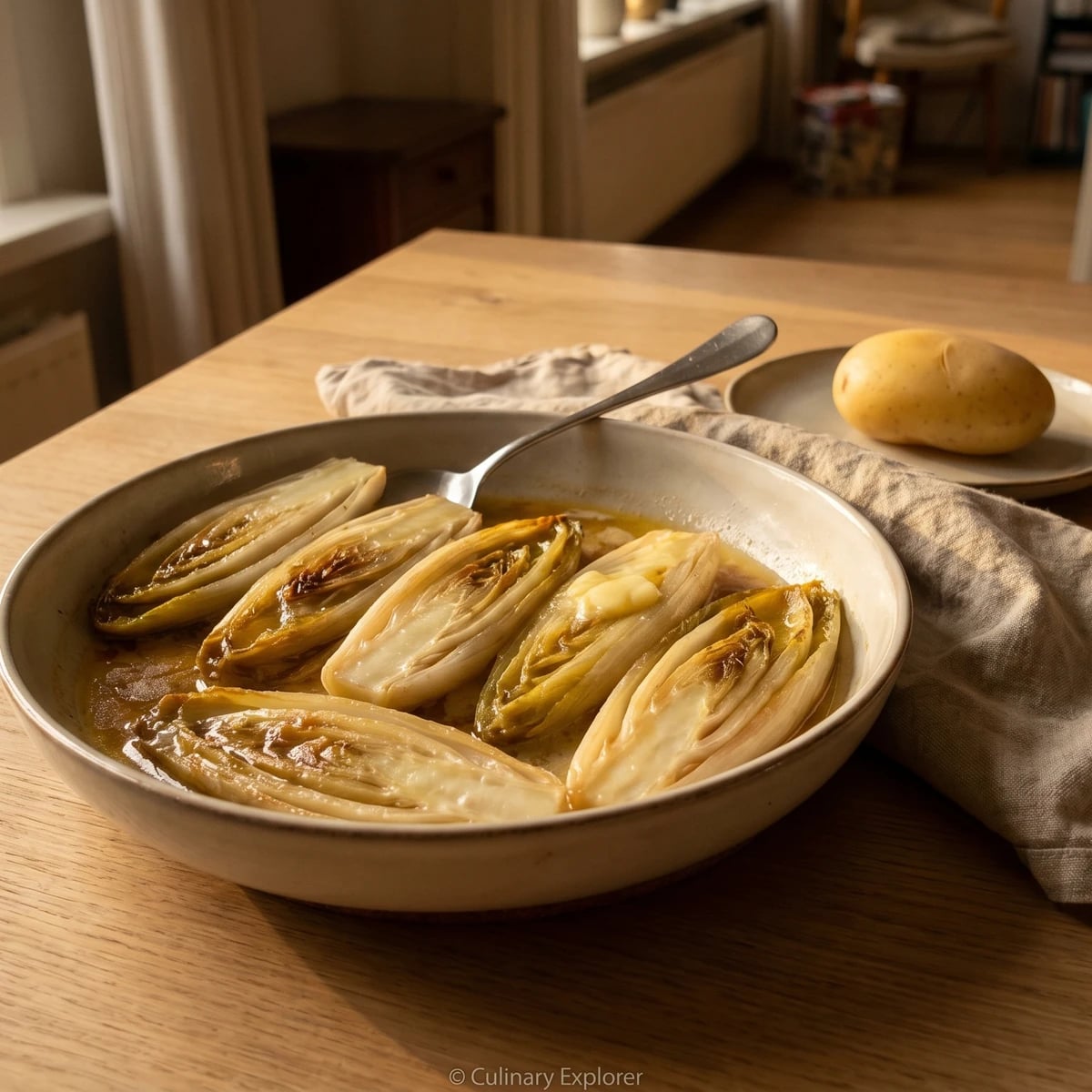
    Remove the lid and raise the heat for 2 to 3 minutes, spooning the buttery juices over the witlof as they reduce. Add the lemon juice only if the dish tastes too heavy. You're looking for glossy leaves, a little golden butter clinging to them, and bitterness softened rather than buried.

  5. 5

    Serve at once

    Transfer the witlof to a warm serving dish and spoon every drop of the pan juices over the top. Serve beside roast chicken, pork, potatoes, or a simple fish supper. I prefer to keep it a bit more relaxed, in the Dutch way: pan on the table, spoon in the juices, and nobody pretending a winter vegetable needs decoration.

Chef Tips

  • Choose tight, heavy heads with pale leaves and no green tips. Green means light has reached them, and light makes witlof harsher.
  • This is a winter vegetable by temperament. The tide sets the menu, and so does the calendar; witlof in deep winter tastes cleaner and more purposeful than tired heads kept too long under supermarket lights.
  • A pinch of sugar is enough. If you make the dish sweet, you've misunderstood the vegetable; bitterness is part of the conversation.
  • For a dinner party, braise the witlof just until tender, then rewarm gently with the pan juices. It forgives this better than most green vegetables because it was never trying to be crisp.

Advance Preparation

  • Trim and halve the witlof up to 4 hours ahead; keep it covered in the refrigerator so the cut sides do not dry out.
  • The finished dish can be made up to 1 day ahead and reheated gently in a covered pan with a spoonful of water, though it is glossiest straight from the stove.

Frequently Asked Questions

Nutrition Information

1 serving (about 165g)

Calories
115 calories
Total Fat
9 g
Saturated Fat
5 g
Trans Fat
0 g
Unsaturated Fat
3 g
Cholesterol
20 mg
Sodium
330 mg
Total Carbohydrates
8 g
Dietary Fiber
6 g
Sugars
2 g
Protein
2 g

Note: Chef personas and recipes are created with AI assistance. Cook with care: follow safe food-handling practices, check doneness with a thermometer when needed, and adapt for allergies and your kitchen.

Where cooking meets culture.

Culinary guides, cultural storytelling, and the editorial depth that makes cooking meaningful.

Discover Culinary Explorer

More from Dutch Vegetable & Potato Sides

Browse the full collection