Chef Joost
Amsterdamse Ossenworst
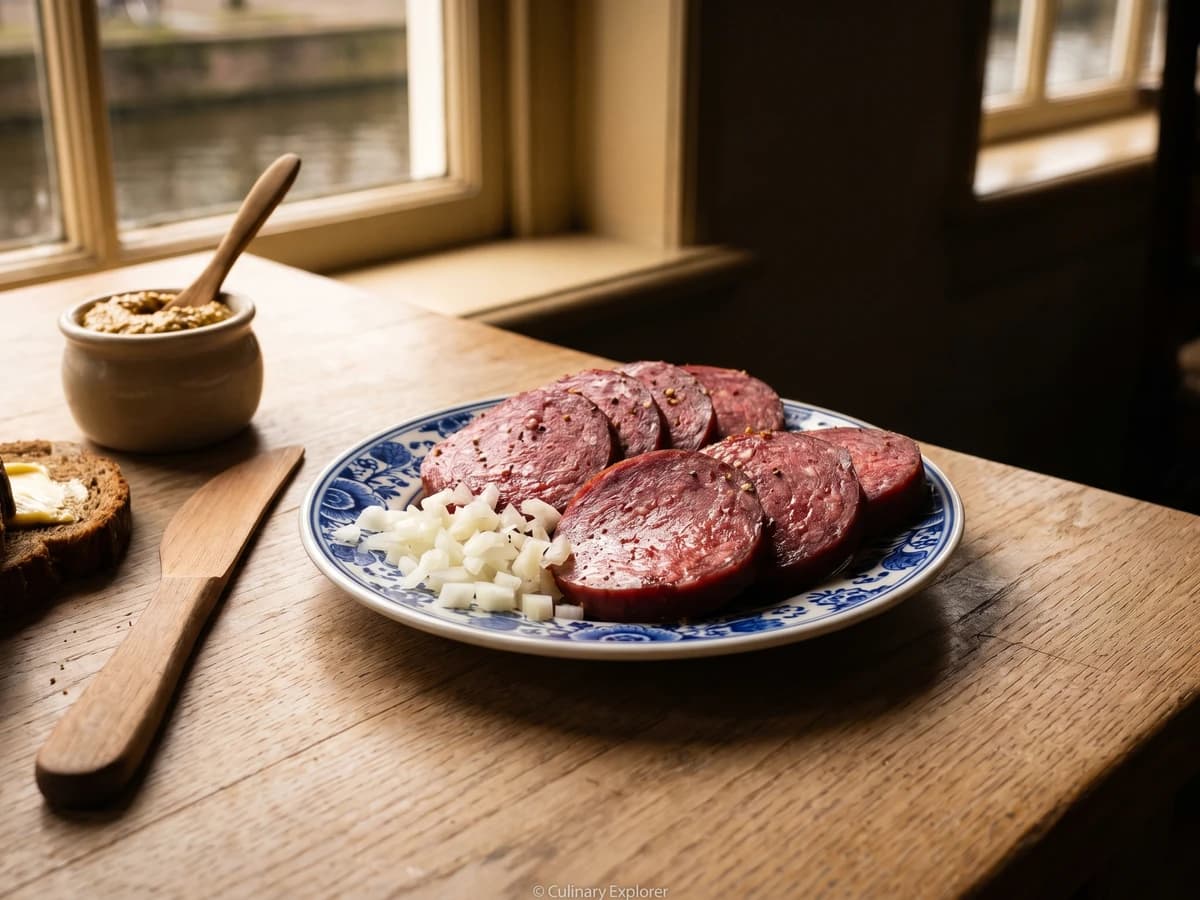
The name means ox sausage, but the real story is Amsterdam itself: cattle trade, Jewish butchers, VOC spices, and raw beef sliced thin with onion.
A cooking platform built around craft, culture, and the stories behind what we eat.

Created by
A North Sea croquette for the good borrel, where tiny grey shrimp vanish into a pale ragout, return in every bite, and prove that Dutch frying can be delicate.
At the quay, the smallest catches taught the largest lessons. Hollandse garnalen, the tiny grey-brown shrimp of the North Sea, do not arrive with the theatre of turbot or the authority of cod. They come in little heaps, already cooked on the boat, smelling of salt, iodine, and the cold mudflats where the tide has been doing its slow work.
But let me tell you a secret. The garnalenkroket is called the luxe kroket because the luxury is hidden in labor, not decoration. A kilo of unpeeled shrimp becomes only a modest bowl of meat after patient hands have done their work. The name already tells you its little journey: garnalen are shrimp, and kroket is the Dutch spelling of French croquette, from croquer, to crunch. The Dutch took that French idea, filled it with ragout, and turned it into borrel food, the shared drinks-hour snacks that keep conversation moving before dinner.
Your enemy here is not difficulty but impatience. These shrimp are already cooked, so fold them into the ragout after the heat is off; boil them and they'll turn woolly, a terrible fate for such expensive little creatures. The ragout must be thick, chilled, and breaded without cracks, so the oil can crisp the shell before the filling softens. Hou het altijd simpel, always keep it simple: lemon, sharp mustard, a glass already poured, and a plate passed around the table.
The French croquette, named from croquer, to crunch, was absorbed into Dutch cookery by the nineteenth century, when cookbooks and hotel kitchens treated ragout bound in a breaded crust as respectable party food. Garnalenkroketten belong especially to the North Sea coast shared by Zeeland, South Holland, and Flanders, where Crangon crangon, the brown or grey shrimp sold in the Netherlands as Hollandse garnaal, was traditionally boiled aboard fishing vessels and peeled by hand in coastal households. Their celebration status rests on plain arithmetic: a kilo of unpeeled shrimp yields only a small bowl of sweet meat, so the croquette preserves costly labor inside a frugal shell.
Quantity
300g
patted dry
Quantity
60g
Quantity
1 small
very finely minced
Quantity
75g
Quantity
300ml
warm
Quantity
75ml
warm
Quantity
2 sheets, about 4g total, or 4g powdered
Quantity
1
Quantity
1 tablespoon
Quantity
1 teaspoon
Quantity
1 small pinch
Quantity
2 tablespoons
finely chopped
Quantity
to taste
Quantity
100g
Quantity
2
beaten
Quantity
150g
Quantity
1.5 liters
for frying
Quantity
to serve
Quantity
to serve
| Ingredient | Quantity |
|---|---|
| peeled Hollandse garnalen (North Sea brown or grey shrimp)patted dry | 300g |
| unsalted butter | 60g |
| shallotvery finely minced | 1 small |
| all-purpose flour | 75g |
| shrimp or fish stockwarm | 300ml |
| whole milk or light creamwarm | 75ml |
| leaf gelatin or powdered gelatin | 2 sheets, about 4g total, or 4g powdered |
| egg yolk | 1 |
| lemon juice | 1 tablespoon |
| sharp Dutch mustard or Dijon mustard | 1 teaspoon |
| ground mace or nutmeg | 1 small pinch |
| flat-leaf parsleyfinely chopped | 2 tablespoons |
| fine sea salt and white pepper | to taste |
| all-purpose flour, for breading | 100g |
| eggs, for breadingbeaten | 2 |
| fine dry breadcrumbs (paneermeel) | 150g |
| neutral oil, such as sunflower or peanut oilfor frying | 1.5 liters |
| lemon wedges (optional) | to serve |
| sharp Dutch mustard (optional) | to serve |
If using leaf gelatin, soak it in cold water for 10 minutes; if using powdered gelatin, stir it with 2 tablespoons cold water and let it swell. Pat the shrimp dry on kitchen paper and pick through them for any bits of shell. Warm the stock and milk together in a small pan; warm liquid joins a roux politely, cold liquid makes lumps and bad moods.
Melt the butter in a heavy saucepan over medium heat and soften the shallot for 2 minutes without letting it brown. Stir in the 75g flour and cook for 3 minutes, until the paste looks sandy and smells faintly nutty. Whisk in the warm stock a little at a time, then the milk, and keep stirring for 4 to 5 minutes until the ragout falls from the spoon in heavy folds. It should look almost too stiff. That is correct.
Take the pan off the heat. Squeeze the leaf gelatin dry and stir it into the hot ragout, or add the bloomed powdered gelatin. Loosen the egg yolk with a spoonful of the hot ragout, then stir it back into the pan. Add the lemon juice, mustard, mace, white pepper, and a cautious pinch of salt. Taste before salting much; the shrimp and stock already know the sea. Let the ragout cool for 10 minutes, then fold in the shrimp and parsley gently.
Spread the ragout in a shallow dish, about 2cm deep, and press baking parchment or plastic wrap directly onto the surface. Refrigerate for at least 4 hours, preferably overnight, until firm enough to cut. Cold gives it manners; warm ragout will pretend to shape, then split in the oil.
Divide the chilled ragout into 12 equal pieces. With lightly floured hands, roll each piece into a short log, about 8cm long and 3cm wide. If the ragout softens, return it to the refrigerator for 15 minutes. Smooth any cracks with a fingertip dipped in water, because every crack is a little escape route waiting for hot oil.
Put the breading flour, beaten eggs, and breadcrumbs into three separate shallow dishes. Roll each croquette in flour, then egg, then breadcrumbs; return it to the egg and breadcrumbs for a second coat. This double coat is not fuss, it is insurance. Set the breaded croquettes on a tray and chill for 30 minutes while the oil heats.
Heat the oil to 175C in a deep fryer or heavy pan. Fry 3 or 4 croquettes at a time for 3 to 4 minutes, turning once if needed, until evenly deep golden. Keep the oil between 170C and 180C; low oil invites leaking, high oil darkens the crust before the center softens. Drain on a rack or paper, rest for 2 minutes, and serve with lemon wedges and sharp mustard.
1 serving (about 90g)
Culinary guides, cultural storytelling, and the editorial depth that makes cooking meaningful.
Discover Culinary ExplorerChef Joost
The name means ox sausage, but the real story is Amsterdam itself: cattle trade, Jewish butchers, VOC spices, and raw beef sliced thin with onion.

Chef Joost
The little yellow onion on the Amsterdam borrel board looks modest, until vinegar, turmeric, and patience turn it into the sharp bite that wakes cheese, herring, and sausage.

Chef Joost
The bear's claw of the northern snackbar: a seasoned gehaktbal, Dutch meatball, cut into thick discs, skewered with onion, fried until the edges catch, then dragged through peanut sauce.

Chef Joost
The name points to the drink, not the mood: bitterballen are crisp little balls of beef ragout made for the borrel table, mustard beside them, fingers slightly burned by impatience.