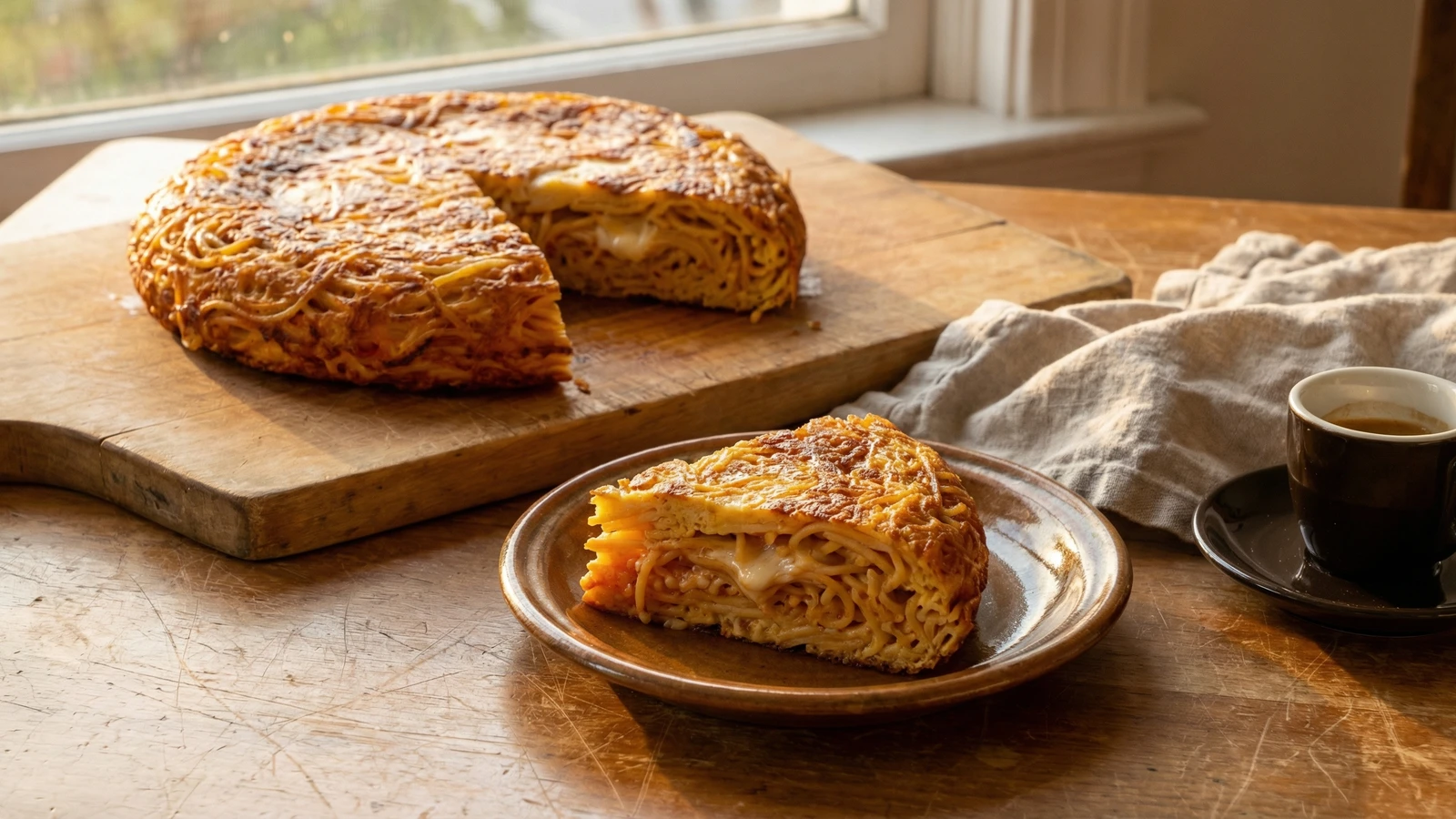
The Neapolitan genius for wasting nothing. Yesterday's pasta becomes this morning's golden treasure, bound with eggs and crisped until it holds its shape like a promise.
Breakfast & Brunch
Italian, Neapolitan
Weeknight
Budget Friendly
10 min
Active Time
20 min cook•30 min total
Yield4 servings
In Naples, there is no such thing as leftover pasta. There is only the promise of tomorrow's frittata.
This is cucina povera at its most practical and delicious. The working-class cooks of Naples understood that pasta dressed with sauce, left to cool overnight, becomes something new when mixed with eggs and pan-fried until golden. What was dinner becomes breakfast. What might have been discarded becomes the centerpiece of the table.
The rules are simple because the dish is simple. Cold pasta absorbs egg better than warm. The pan must be hot enough to set the bottom quickly, then the heat must drop so the inside cooks without burning the crust. The flip requires confidence, not skill. You do it once, quickly, and you do not apologize if it breaks apart. Press it back together. It still tastes the same.
I have eaten frittata di pasta in Naples at seven in the morning from a woman selling wedges wrapped in paper from a cart. I have eaten it at midnight, cold from a friend's refrigerator. It is never wrong. This is what Italian home cooking actually looks like: practical, unfussy, and born from the refusal to waste good food.
Frittata di pasta, also called frittata di maccheroni, has fed Neapolitan workers and schoolchildren for centuries. It emerged from the necessity of the city's crowded quarters, where women stretched resources by transforming yesterday's pasta into a portable meal. By the late 1800s, vendors sold wedges from street carts, and it became the traditional Easter Monday picnic food when families traveled outside the city walls.
The technique, the tradition, and the story behind every dish.
•10-inch nonstick or well-seasoned cast iron skillet
•Large flat plate wider than the skillet
•Flexible spatula
Instructions
1
Prepare the egg mixture
In a large bowl, beat the eggs with the Parmigiano-Reggiano and generous grindings of black pepper. The leftover pasta already contains salt from its original preparation. Taste before adding more. Add the cubed mozzarella or provola to the egg mixture and stir to combine.
2
Combine with pasta
Add the cold leftover pasta to the egg mixture. Use your hands or two forks to separate any clumps and distribute the egg evenly through the strands. Every bit of pasta should be coated. The pasta absorbs the egg better when cold, which is why you do not warm it first.
This is not a recipe for fresh pasta. It exists because of yesterday's pasta, dressed and sauced and waiting in the refrigerator. Without leftovers, there is no frittata di pasta.
3
Heat the pan
Place a 10-inch nonstick or well-seasoned cast iron skillet over medium heat. Add the olive oil and swirl to coat the bottom and sides of the pan. When the oil shimmers and flows easily, the pan is ready. The oil must be hot enough to begin setting the eggs immediately, but not so hot that they burn.
4
Cook the first side
Pour the pasta mixture into the hot pan and spread it evenly with a spatula, pressing gently to compact it into a uniform cake. Reduce the heat to medium-low. Cook undisturbed until the bottom is deeply golden and the frittata moves freely when you shake the pan, 8 to 10 minutes. Peek underneath by lifting an edge with a spatula. You want the color of a good crust.
Patience matters here. If you rush the first side, the frittata will stick and tear. Let it develop a proper crust before attempting to flip.
5
Flip with courage
Place a large flat plate over the skillet. In one decisive motion, invert the pan so the frittata lands on the plate, golden side up. Add another tablespoon of oil to the pan if it looks dry. Slide the frittata back into the skillet, uncooked side down. Do not be timid. Hesitation causes more kitchen accidents than boldness.
The plate must be wider than the skillet. Hold the plate firmly against the pan. Turn everything over in one motion. If some of the frittata breaks apart, press it back together in the pan. No one will know.
6
Cook the second side
Cook the second side over medium-low heat until golden, another 5 to 7 minutes. Press gently with the spatula to help it hold together. The frittata is done when both sides are deeply golden and the center is set but not dry.
7
Rest and serve
Slide the frittata onto a cutting board and let it rest for at least 10 minutes. Neapolitans eat this at room temperature, often hours after cooking. The flavors settle. The texture becomes more cohesive. Cut into wedges and serve. This is breakfast, lunch, or a midnight snack. It travels well. It waits patiently.
Chef Tips
•The original sauce on your pasta becomes part of the frittata's flavor. Tomato-sauced pasta is traditional, but any dressed pasta works. Even pasta with butter and cheese makes a fine frittata.
•Do not attempt this with freshly made pasta. The dish exists because of leftovers. The cold pasta has firmed, the sauce has been absorbed, and the starches have set. This is the proper starting point.
•Some Neapolitan cooks add cubed salami or cooked sausage. Others keep it pure. Both traditions are valid. What matters is that you use what you have.
•A nonstick pan makes the flip forgiving. Cast iron works if well-seasoned. Avoid stainless steel unless you enjoy frustration.
Advance Preparation
•The leftover pasta must be cold. Make it a day ahead or use whatever sauced pasta remains from last night's dinner.
•The finished frittata keeps at room temperature for several hours and refrigerates well for two days. Serve it cold or at room temperature. Reheating is unnecessary.
Frequently Asked Questions
Nutrition Information
1 serving (about 175g)
Calories
360 calories
Total Fat
23 g
Saturated Fat
7 g
Trans Fat
0 g
Unsaturated Fat
14 g
Cholesterol
210 mg
Sodium
350 mg
Total Carbohydrates
21 g
Dietary Fiber
2 g
Sugars
2 g
Protein
18 g
Where cooking meets culture.
Culinary guides, cultural storytelling, and the editorial depth that makes cooking meaningful.