Culinary Explorer

A cooking platform built around craft, culture, and the stories behind what we eat.
Discover Culinary Explorer
Crespelle ai Funghi Trifolati

Crespelle ai Funghi Trifolati

Created by

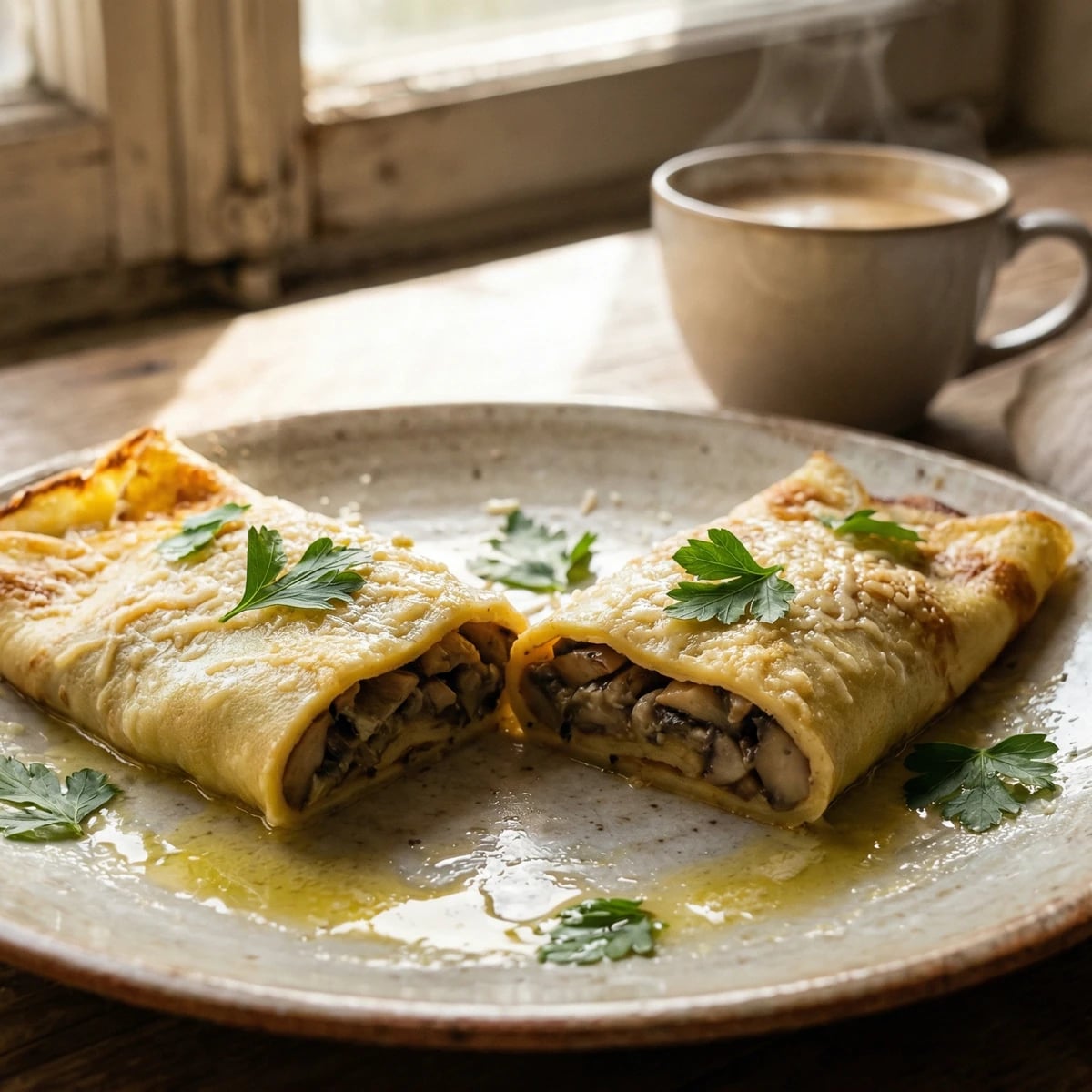
Delicate Italian crepes wrapped around mushrooms sautéed in the trifolati manner, where olive oil, a breath of garlic, and fresh parsley create something far greater than the sum of their parts.

Breakfast & Brunch
Italian
Dinner Party
Make Ahead
45 min
Active Time
35 min cook1 hr 20 min total
Yield6 servings (12 crespelle)

Crespelle are not French crêpes, though they share ancestors. They are thinner, more delicate, and in the hands of a Northern Italian cook, they become vessels for fillings that require restraint rather than abundance. The mushrooms here are prepared alla trifolati, an ancient technique whose name derives from the truffle: you slice the funghi as thin as you would that precious tuber, then cook them quickly in olive oil with garlic and parsley until they surrender their moisture and concentrate their flavor.

The garlic here is a whisper, not a shout. You crush the cloves, let them perfume the oil, then remove them before they can overwhelm. This is the difference between Italian cooking and what Americans imagine Italian cooking to be. The parsley must be flat-leaf, chopped at the last moment so it releases its fragrance onto the warm mushrooms rather than into the cooking oil.

I learned to make crespelle watching farm wives in Emilia-Romagna who moved the pan with the confidence of women who had made thousands before me. The batter rests because gluten needs time to relax. The pan must be hot but not smoking. You pour, you swirl, you wait for the edges to curl, you flip with your fingers if you are brave or a spatula if you are sensible. There is no mystery here, only practice.

Crespelle appear in Italian cookery manuscripts from the Renaissance, though the technique of wrapping thin batter pancakes around savory fillings predates written records. The trifolati method of cooking mushrooms emerged in Piedmont and Lombardy, where wild porcini grew in abundance and cooks learned that thin slicing and quick cooking preserved their woodsy essence better than any elaborate preparation.

The technique, the tradition, and the story behind every dish.

Discover Culinary Explorer

Ingredients

all-purpose flour

Quantity

1 cup

large eggs

Quantity

3

whole milk

Quantity

1 1/4 cups

unsalted butter

Quantity

3 tablespoons

melted and cooled, plus more for the pan

fine sea salt

Quantity

1/2 teaspoon

mixed fresh mushrooms

Quantity

1 1/2 pounds

cremini, shiitake, oyster

extra virgin olive oil

Quantity

1/4 cup

garlic cloves

Quantity

3

lightly crushed

fresh flat-leaf parsley

Quantity

3 tablespoons

chopped fine

kosher salt

Quantity

to taste

black pepper

Quantity

to taste

freshly ground

Parmigiano-Reggiano

Quantity

1/2 cup

freshly grated

unsalted butter

Quantity

2 tablespoons

cold, cut into small pieces

Equipment Needed

  • 8-inch nonstick or seasoned crepe pan
  • Fine-mesh strainer
  • Large skillet for mushrooms
  • 9x13-inch baking dish

Instructions

  1. 1

    Make the batter

    Place the flour in a mixing bowl and make a well in the center. Crack the eggs into the well and add the salt. Begin whisking from the center, gradually drawing flour from the edges. Add the milk in a slow stream, whisking constantly to prevent lumps. Whisk in the melted butter. The batter should be thin, like heavy cream. If lumps remain, pass it through a fine-mesh strainer. Cover and let rest at room temperature for 30 minutes.

    Resting the batter is not optional. The flour needs time to absorb the liquid fully, and the gluten needs to relax. Skipping this step produces tough crespelle with ragged edges.
  2. 2

    Prepare the mushrooms

    Clean the mushrooms with a damp cloth or soft brush. Never submerge them in water; they absorb it like sponges. Trim the stems and slice thin, about one-eighth inch. All the slices should be uniform so they cook evenly. If using shiitakes, discard the woody stems entirely.

  3. 3

    Cook the trifolati

    Heat the olive oil in a large skillet over medium-high heat. Add the crushed garlic cloves and let them sizzle until fragrant and barely golden, about one minute. Remove and discard them. They have done their work. Add the mushrooms in a single layer, working in batches if necessary. Do not crowd the pan or they will steam rather than sauté. Let them sit undisturbed for two minutes to develop color, then stir. Cook until golden and the moisture has evaporated, 8 to 10 minutes total. Season with salt and pepper. Remove from heat and stir in the parsley.

    The unbalanced use of garlic is the single greatest cause of failure in would-be Italian cooking. Here it perfumes the oil and departs. That is all it needs to do.
  4. 4

    Cook the crespelle

    Heat an 8-inch nonstick or well-seasoned crepe pan over medium heat. Add a small piece of butter and swirl to coat. Ladle about 3 tablespoons of batter into the pan, immediately tilting and rotating to spread it into a thin, even circle. Cook until the edges turn golden and begin to curl from the pan, about one minute. Flip with a thin spatula or your fingers and cook 30 seconds more. The second side will be spotted, not uniformly golden. This is correct. Stack the finished crespelle on a plate, separating them with parchment if you are cautious. You should have 12 crespelle.

  5. 5

    Fill and assemble

    Heat the oven to 375 degrees Fahrenheit. Butter a baking dish large enough to hold the rolled crespelle in a single layer. Place about 2 tablespoons of the mushroom filling in the center of each crespella. Fold the bottom edge over the filling, fold in the sides, and roll into a neat cylinder. Place seam-side down in the prepared dish. Repeat with the remaining crespelle.

  6. 6

    Finish in the oven

    Scatter the grated Parmigiano-Reggiano over the crespelle. Dot with the cold butter pieces. Bake until the cheese is melted and the edges turn golden, 12 to 15 minutes. The butter and cheese will form a light gratin without the heaviness of a sauce. Serve immediately, two per person, while the edges still have warmth.

Chef Tips

  • Wild porcini, if you can find them fresh, transform this dish into something transcendent. Dried porcini, soaked and chopped, may be added to cultivated mushrooms for depth. Strain the soaking liquid through cheesecloth and use it to deglaze the pan.
  • The crespelle can be made the day before and refrigerated, stacked between parchment. Bring to room temperature before filling or they will crack.
  • Some Northern Italian cooks add a thin layer of besciamella to their crespelle. I find this unnecessary when the mushrooms are properly cooked. The cheese and butter provide richness enough. What you keep out is as significant as what you put in.

Advance Preparation

  • The crespelle can be made one day ahead, stacked with parchment, wrapped tightly, and refrigerated.
  • The mushroom filling can be prepared several hours ahead and held at room temperature. Do not refrigerate or the texture suffers.
  • The assembled dish can wait, covered, at room temperature for up to one hour before baking. Do not refrigerate once assembled.

Frequently Asked Questions

Nutrition Information

1 serving (about 210g)

Calories
395 calories
Total Fat
29 g
Saturated Fat
13 g
Trans Fat
0 g
Unsaturated Fat
16 g
Cholesterol
140 mg
Sodium
660 mg
Total Carbohydrates
23 g
Dietary Fiber
2 g
Sugars
3 g
Protein
14 g

Note: Chef personas and recipes are created with AI assistance. Cook with care: follow safe food-handling practices, check doneness with a thermometer when needed, and adapt for allergies and your kitchen.

Where cooking meets culture.

Culinary guides, cultural storytelling, and the editorial depth that makes cooking meaningful.

Discover Culinary Explorer

More from Chef Graziella's Breakfast and Brunch

Browse the full collection