
Chef Joost
Beschuit met Muisjes
The airy Dutch rusk sold in rolls of thirteen, twice baked until crisp, then buttered and crowned with sugared aniseed for the birth of a child.
A cooking platform built around craft, culture, and the stories behind what we eat.
Created by
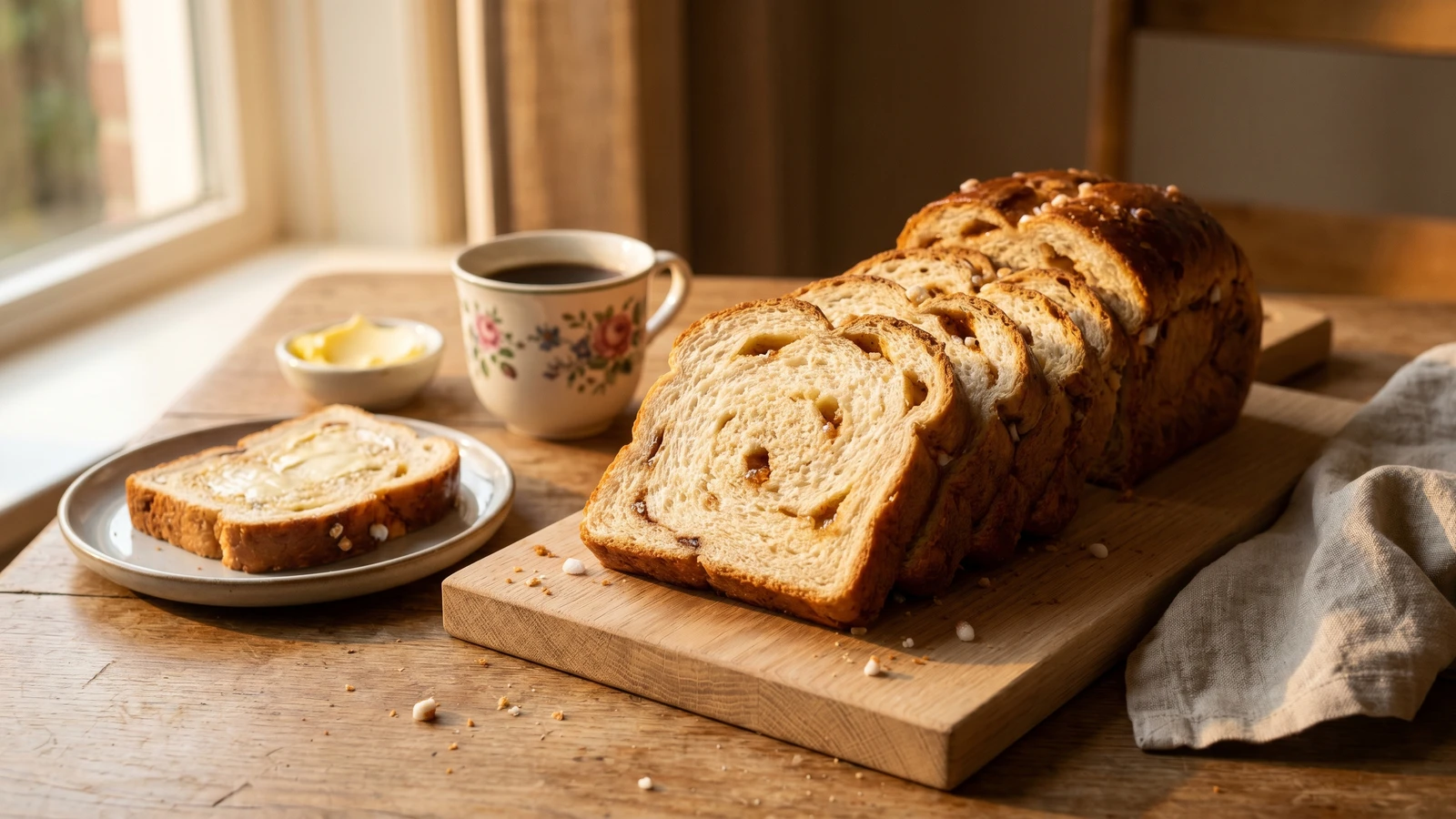
Friesland's sugar bread looks modest until the knife finds molten pockets of pearl sugar, cinnamon, and old coffee-table ceremony, the loaf a province still slices thick for celebration.
Friesland knows how to hide extravagance in a plain slice of bread. This loaf has no tide table and no harvest week; its season is visite, the Dutch household visit, when coffee appears and nobody admits they were waiting for cake. In my grandmother's second notebook, between the Zeeland things that smell of salt and the careful household sums of a woman who had seen water take a kitchen, there is a clipped recipe for Fries suikerbrood, marked voor visite, for visitors. Not everyday bread, then. Bread that expected a knock at the door.
The name already tells you the joke and the seriousness. In Frisian it is Fryske sûkerbôle, sûker for sugar, bôle for loaf: sugar bread. Nothing hidden, and yet the method hides everything. Stir fine sugar into the dough and the story disappears into sweetness. Keep the sugar in lumps, pearl sugar if you can find it or broken sugar cubes if you must, and the knife opens amber pockets that tug at the crumb.
But let me tell you a secret: this is not a national sweet bread wearing Frisian clothes. It belongs to Friesland's coffee table and to celebration, especially the old kraamvisite, the visit after childbirth, when rich bread did the talking before the family did. Cinnamon gives the dough its low warmth, the old Asian spice route made domestic; the sugar remembers Atlantic colonial ledgers and later beet fields. History and cookery, they cannot be separated.
What I want from you is not fancy work. Hou het altijd simpel, always keep it simple: make a soft enriched dough, let it rise, fold the cold sugar in late, and line the tin because melted sugar is a splendid glue and a poor houseguest. Turn the loaf out before the caramel hardens, then wait long enough not to burn yourself. A dish without its story is half a meal; this one gives you the story in every sticky slice.
Fries suikerbrood, in Frisian Fryske sûkerbôle, is a regional Frisian enriched yeast loaf served in thick buttered slices at coffee visits and family celebrations. Regional accounts from the nineteenth and early twentieth centuries tie it to kraamvisite, the visit after childbirth, and in parts of Friesland the sweet loaf marked the birth of a girl while currant bread served other occasions. Cinnamon reached Dutch cupboards through Asian spice commerce, while sugar ran through Atlantic colonial trade and later beet fields; in this loaf those once-costly goods became homely abundance.
Quantity
500g
plus a little for shaping
Quantity
7g
Quantity
240ml
lukewarm
Quantity
1
room temperature
Quantity
45g
Quantity
75g
softened, plus more for the tin
Quantity
8g
Quantity
2 tablespoons
Quantity
2 teaspoons
Quantity
200g
broken into chickpea-size pieces
Quantity
2 tablespoons
for the tin
Quantity
1 tablespoon
for brushing
| Ingredient | Quantity |
|---|---|
| bread flourplus a little for shaping | 500g |
| instant yeast | 7g |
| whole milklukewarm | 240ml |
| large eggroom temperature | 1 |
| light brown sugar | 45g |
| unsalted buttersoftened, plus more for the tin | 75g |
| fine sea salt | 8g |
| ginger syrup (gembersiroop) | 2 tablespoons |
| ground cinnamon | 2 teaspoons |
| large pearl sugar (parelsuiker) or sugar cubesbroken into chickpea-size pieces | 200g |
| granulated sugarfor the tin | 2 tablespoons |
| melted butter (optional)for brushing | 1 tablespoon |
Butter a 23 x 13 cm loaf tin and line it with a parchment sling, then scatter the granulated sugar over the buttered sides and base. If you are using sugar cubes, break them into rough chickpea-size pieces, not dust. Put the pearl sugar or broken cubes in the freezer while the dough rises; cold sugar is slower to melt, and that buys you the pockets this bread is known for.
In a large bowl, mix the flour and yeast. Add the lukewarm milk, egg, brown sugar, ginger syrup, softened butter, and salt, then knead by hand for 12 minutes or in a stand mixer for 8 minutes, until the dough is smooth, elastic, and still a little tacky. If it feels dry, add a teaspoon of milk; enriched dough should be soft enough to sigh under your palm, not stiff like a doorstop.
Cover the bowl and let the dough rise in a warm place until doubled, usually 60 to 90 minutes. It is ready when a floured fingertip leaves a slow dent. If it springs back at once, give it time; sugar bread is an occasion, not a tram schedule.
Toss the chilled pearl sugar with the cinnamon. Turn the dough onto a lightly floured worktop and pat it into a rectangle. Scatter the cinnamon sugar over it, fold the dough in thirds, then press and fold a few times until the sugar is mostly enclosed. Stop once it is distributed; too much kneading now tears the dough and drags sugar to the surface where it can burn.
Pat the dough into a rectangle as wide as the tin, roll it up firmly, and pinch the seam closed. Set it seam-side down in the prepared tin. Cover and prove until the dough rises just above the rim, about 45 to 60 minutes. It will not balloon like a plain white loaf; the sugar is heavy, and the crumb should stay tender.
During the last 20 minutes of proving, heat the oven to 180C, or 160C fan. Bake for 35 to 40 minutes, tenting loosely with foil after 25 minutes if the top darkens quickly. The loaf is done when the crust is deep golden, caramel shines at the edges, and the bread sounds hollow when tapped, or reads 92C in the centre. If sugar leaks, that is not failure; that is why the tin was lined.
Let the loaf stand in the tin for 5 minutes, brush with melted butter if using, then lift it out while the caramel is still pliable. Cool for at least 30 minutes before slicing. Hot sugar clings and burns; patience is not ceremony here, it is self-preservation. Serve thick slices with butter, coffee, or tea.
1 slice (about 90g)
Culinary guides, cultural storytelling, and the editorial depth that makes cooking meaningful.
Discover Culinary ExplorerChef Joost
The airy Dutch rusk sold in rolls of thirteen, twice baked until crisp, then buttered and crowned with sugared aniseed for the birth of a child.

Chef Joost
The Dutch square loaf baked under a lid, with a quiet crumb, a disciplined crust, and exactly the right shape for the tosti pan.

Chef Joost
Before bread came from a packet of yeast, it came from yesterday: flour, water, salt, and a living desem starter carrying one loaf into the next.

Chef Joost
A round raisin bread for Driekoningen, Three Kings' Day, with a hidden bean, a star in the crust, and one ordinary eater crowned king for a day.