
Chef Joost
Beschuit met Muisjes
The airy Dutch rusk sold in rolls of thirteen, twice baked until crisp, then buttered and crowned with sugared aniseed for the birth of a child.
A cooking platform built around craft, culture, and the stories behind what we eat.
Created by
A Zaanstreek feast bread with the devil hiding in its name, lemon in its crumb, and a shape old bakers knew before holiday tables learned to behave.
Some breads arrive under the protection of saints. Duivekater comes to the Christmas breakfast with the devil tucked into its name. The name already tells you there is an older story here, though it tells it in a half-whisper: duive is commonly heard as duivel, devil, while the rest has kept scholars and folklorists busy enough to justify a second slice. I won't pretend more certainty than the word allows. A forced etymology is worse than an unbuttered heel of bread.
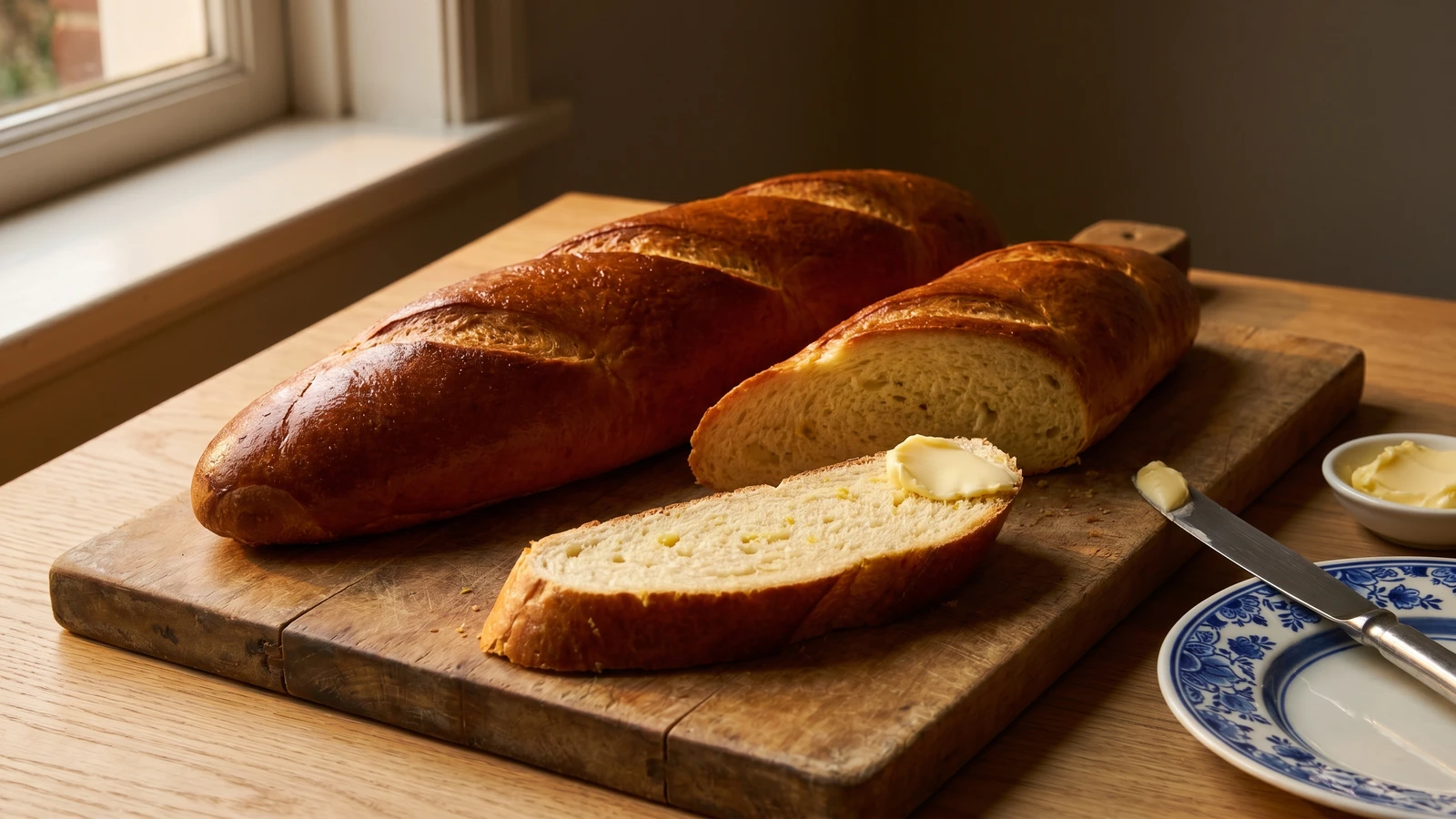
In the Zaanstreek, Waterland, and old Amsterdam, this was feestbrood, festival bread, not daily bread. Milk, butter, sugar, egg, and lemon turned plain white dough into something pale and generous, shaped into a long lozenge with cut ends, the kind of loaf a baker could hold up in a doorway and sell before the church bells had finished arguing with the weather. But let me tell you a secret: Duivekater is not loud holiday baking. It doesn't have the spice cargo of speculaas or the sticky drama of a bolus. Its pleasure is quieter: a soft yellow crumb, the clean lift of lemon, a glossy crust, and butter sinking into a thick slice.
Your work is simple, which means it asks for attention. Enriched dough rises more slowly because butter and sugar make yeast walk, not run. Give it time. Shape it firmly, cut the old marks before the final prove, and bake it until the loaf is deep gold and light in the hand. Hou het altijd simpel, always keep it simple. Put it on the table at Christmas or Easter with coffee, good butter, and the small satisfaction that even the devil, in North Holland, learned to behave like breakfast.
Duivekater is a North Holland feast bread especially tied to the Zaanstreek, Waterland, and Amsterdam, where bakers sold it for Christmas, Easter, and sometimes Pentecost. Jan Steen's 1658 baker portrait of Arent Oostwaard shows a long pale loaf recognized as duivekater, placing the bread clearly in the seventeenth-century Dutch bakery. The first part of the name is generally connected with duivel, devil, while the full origin remains disputed; older folklore links the shaped loaf to pre-Christian animal offerings later absorbed into the church calendar.
Quantity
500g
Quantity
7g
Quantity
250ml
lukewarm
Quantity
80g
Quantity
75g
softened
Quantity
1 large
Quantity
from 1 lemon
finely grated
Quantity
8g
Quantity
1
Quantity
1 tablespoon
Quantity
as needed
| Ingredient | Quantity |
|---|---|
| strong white bread flour or Dutch patentbloem | 500g |
| instant yeast | 7g |
| whole milklukewarm | 250ml |
| fine sugar or witte basterdsuiker | 80g |
| unsalted buttersoftened | 75g |
| egg | 1 large |
| unwaxed lemon zestfinely grated | from 1 lemon |
| fine sea salt | 8g |
| egg yolk | 1 |
| milk for glazing | 1 tablespoon |
| butter for serving (optional) | as needed |
Stir the yeast into the lukewarm milk with a spoonful of the sugar and leave it for five to ten minutes, until the surface looks creamy. The milk should feel warm to the touch, not hot; yeast is a living thing, and boiling it is a very efficient way to make festive bread into a paperweight.
Put the flour, remaining sugar, lemon zest, and salt in a large bowl. Add the yeasted milk and the egg, then mix until a rough dough forms. Knead for five minutes, then work in the softened butter in small pieces and knead for another eight to ten minutes, until the dough is smooth, elastic, and only lightly tacky. Don't bury it in extra flour; a soft dough gives the tender crumb Duivekater is meant to have.
Shape the dough into a ball, set it in a lightly buttered bowl, cover it, and leave it somewhere warm until doubled, about one to one and a half hours. Enriched dough is slower than plain bread dough. This is not failure; this is butter asking for patience.
Turn the dough onto a lightly floured surface and press out the large bubbles with your fingertips. Shape it into a long lozenge, about 32 centimetres long and 12 centimetres wide, tapering both ends to soft points. Place it on a parchment-lined baking tray. With a sharp knife or scissors, make a lengthwise slit near each tapered end and two or three shallow diagonal cuts along the sides. These marks are not decoration alone; they guide the loaf as it expands, so it opens where you ask instead of tearing where it pleases.
Cover the shaped loaf loosely and let it prove for 35 to 45 minutes, until puffy and light. Press it gently with a fingertip. If the mark springs back at once, it needs more time. If it fills back slowly, the oven may be called in as witness.
Heat the oven to 190C. Beat the egg yolk with the tablespoon of milk and brush the loaf gently, taking care not to flood the cuts. Bake for 25 to 30 minutes, until the crust is glossy deep gold, the sides feel set, and the underside sounds hollow when tapped. If the top colours too quickly, lay a loose sheet of foil over it for the last ten minutes.
Move the loaf to a rack and let it cool for at least 40 minutes before slicing. Hot enriched bread tears into damp crumbs under the knife, and we have waited through history for this loaf, so we can wait through cooling. Serve in thick slices with butter, at breakfast or the holiday koffietafel, the coffee table spread.
1 serving (about 95g)
Culinary guides, cultural storytelling, and the editorial depth that makes cooking meaningful.
Discover Culinary ExplorerChef Joost
The airy Dutch rusk sold in rolls of thirteen, twice baked until crisp, then buttered and crowned with sugared aniseed for the birth of a child.

Chef Joost
The Dutch square loaf baked under a lid, with a quiet crumb, a disciplined crust, and exactly the right shape for the tosti pan.

Chef Joost
Before bread came from a packet of yeast, it came from yesterday: flour, water, salt, and a living desem starter carrying one loaf into the next.

Chef Joost
A round raisin bread for Driekoningen, Three Kings' Day, with a hidden bean, a star in the crust, and one ordinary eater crowned king for a day.