
Chef Joost
Casinobrood (Dutch Square Tin Loaf)
The Dutch square loaf baked under a lid, with a quiet crumb, a disciplined crust, and exactly the right shape for the tosti pan.
A cooking platform built around craft, culture, and the stories behind what we eat.
Created by
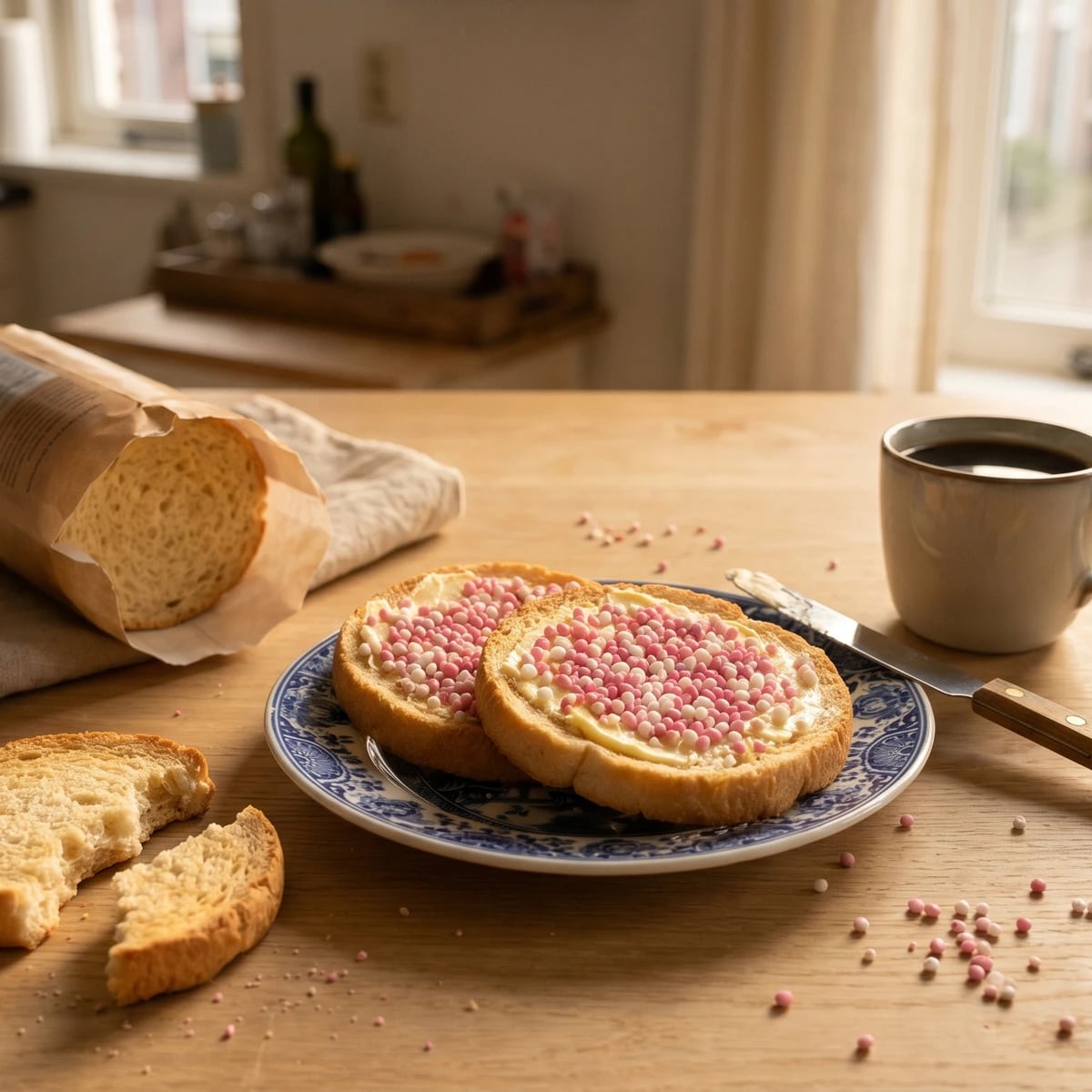
The airy Dutch rusk sold in rolls of thirteen, twice baked until crisp, then buttered and crowned with sugared aniseed for the birth of a child.
The name already tells you the method. Beschuit comes by way of the old European family of biscuit, from bis coctus, twice cooked, and that is exactly what it asks of you: bake a small bread once to give it life, then bake it again to make it keep. History and cookery, they cannot be separated. Sometimes the dictionary is also the recipe.
But let me tell you a secret. The most ceremonial Dutch food is not grand at all. It is a pale round rusk from a paper roll, spread with butter and scattered with muisjes, sugared aniseeds whose name means little mice, for obvious reasons once you look at their tiny tails. Pink and white, blue and white, or plain white for older customs: this is what arrives when a baby arrives. Not champagne first. Beschuit.
In my grandmother's second notebook, the birth visit had its own economy. Coffee ready, butter softened, tin opened only when the guests sat down, because beschuit forgives many things but not damp air. The rusk should crack cleanly under the knife and then soften slightly under the butter, enough to hold the muisjes in place without turning meek. Hou het altijd simpel, always keep it simple. Bake, dry, butter, scatter. A whole household changes, and the food remains blessedly practical.
Beschuit belongs to the same twice-baked bread family as biscuit and ships' bread, valued in the Low Countries because a dry rusk kept well in damp northern weather and at sea. The custom of serving beschuit met muisjes at a birth is documented in the Netherlands from at least the seventeenth century, when aniseed was associated with digestion and milk supply after childbirth. The modern colour code became fixed in the twentieth century, with orange muisjes famously produced for royal births and blue-and-white becoming standard after the birth of Princess Beatrix in 1938.
Quantity
300g
Quantity
7g
Quantity
25g
Quantity
5g
Quantity
175ml
Quantity
1
Quantity
35g
softened
Quantity
as needed
for serving
Quantity
as needed
pink, blue, or white, for serving
| Ingredient | Quantity |
|---|---|
| strong white bread flour | 300g |
| instant yeast | 7g |
| fine sugar | 25g |
| fine sea salt | 5g |
| lukewarm milk | 175ml |
| large egg | 1 |
| unsalted buttersoftened | 35g |
| butterfor serving | as needed |
| muisjes (sugared aniseeds)pink, blue, or white, for serving | as needed |
Stir the flour, yeast, sugar, and salt together in a large bowl. Add the lukewarm milk and egg, then mix to a soft dough. Knead for 8 to 10 minutes, adding the softened butter in pieces during the last few minutes, until the dough is smooth, elastic, and just a little tacky.
Cover the bowl and let the dough rise until doubled, about 1 hour. This first rise gives the beschuit its lightness; rush it and you make a dry little brick with a respectable name.
Butter 8 cups of a muffin tin or 8 small round baking rings. Divide the dough into 8 equal pieces, shape each into a tight ball, and set one in each cup. Cover and let rise again for 35 to 45 minutes, until puffed and rounded above the rim.
Bake at 200C for 15 to 18 minutes, until the tops are pale gold and the rolls sound light when tapped. Turn them out and let them cool completely on a rack. Completely means completely; a warm crumb will tear instead of split.
Use a serrated knife to split each roll horizontally into two neat rounds. Place them cut side up on a baking tray and bake at 120C for 45 to 55 minutes, turning once, until dry, crisp, and lightly golden at the edges. Let them cool in the oven with the door ajar so the last moisture leaves quietly.
Spread each cooled beschuit with a thin, even layer of butter, right to the edge, then spoon over the muisjes so they cling. Serve at once. The butter is the glue, the anise is the announcement, and the rusk is the small crisp stage beneath them both.
1 serving (about 40g)
Culinary guides, cultural storytelling, and the editorial depth that makes cooking meaningful.
Discover Culinary Explorer
Chef Joost
The Dutch square loaf baked under a lid, with a quiet crumb, a disciplined crust, and exactly the right shape for the tosti pan.

Chef Joost
Before bread came from a packet of yeast, it came from yesterday: flour, water, salt, and a living desem starter carrying one loaf into the next.

Chef Joost
A Zaanstreek feast bread with the devil hiding in its name, lemon in its crumb, and a shape old bakers knew before holiday tables learned to behave.

Chef Joost
Friesland's dark rye bread is not baked so much as persuaded: coarse grain, sourdough, salt, and time, ending in thin slices beside cheese, butter, or a bowl of snert.