Culinary Explorer

A cooking platform built around craft, culture, and the stories behind what we eat.
Discover Culinary Explorer
Focaccia di Recco col Formaggio

Focaccia di Recco col Formaggio

Created by

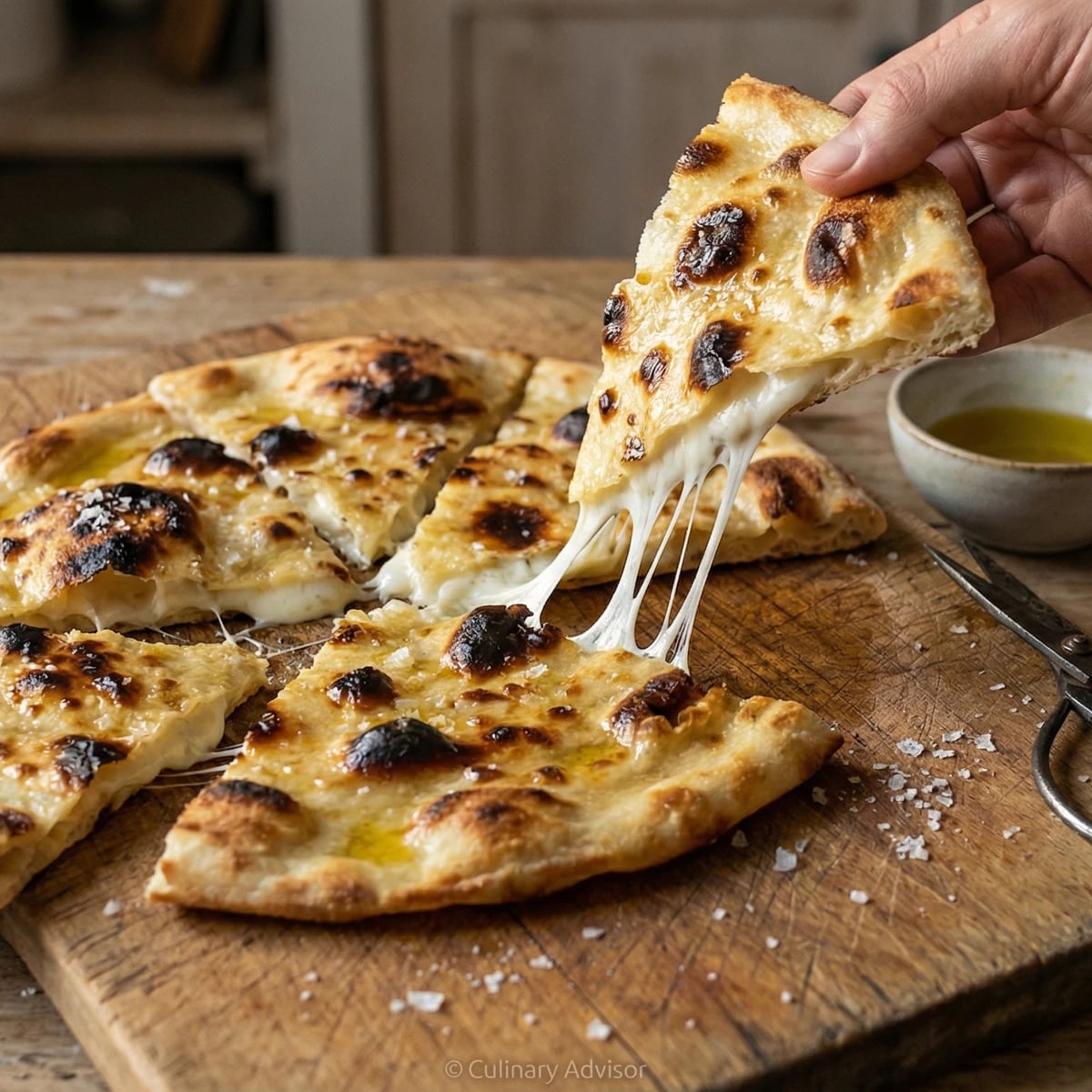
The legendary cheese-filled flatbread of Recco, where dough stretched thin as silk encloses soft stracchino cheese and emerges from a blazing oven blistered, bubbling, and demanding to be eaten within minutes.

Sandwiches & Wraps
Italian, Ligurian
Special Occasion
Dinner Party
45 min
Active Time
8 min cook1 hr 30 min total
Yield1 large focaccia, serving 6 to 8

This is not focaccia as you know it. The soft, dimpled, olive oil-soaked bread of Genoa shares nothing with this except geography. Focaccia di Recco is two sheets of unleavened dough stretched so thin you can read a newspaper through them, filled with stracchino cheese, and baked in a roaring oven until the surface blisters and chars in spots while the cheese becomes a molten river inside.

The dough contains no yeast. It requires no rising time. What it demands instead is the patience to stretch it properly and the courage to pull it thin enough that you believe it will tear. It will not tear, if your technique is correct. The gluten, developed through kneading and resting, will stretch like silk.

I have watched tourists in Recco order this and then wait to finish their wine before eating. This is a tragedy. The focaccia must be eaten within five minutes of leaving the oven, cut into irregular pieces with scissors, passed hand to hand while still too hot to hold comfortably. The cheese will be flowing, the dough will shatter, and you will understand why this small town guards its recipe with the ferocity of a Ligurian grandmother protecting her pesto.

Legend traces focaccia di Recco to the Saracen invasions of the 8th century, when villagers fled to the hills above the Ligurian coast and improvised flatbreads from flour and water over open fires. The cheese came later, when the town grew prosperous enough to fill its bread. In 2015, the European Union granted Focaccia di Recco col Formaggio PGI status, protecting both its name and its method from imitation.

The technique, the tradition, and the story behind every dish.

Discover Culinary Explorer

Ingredients

all-purpose flour

Quantity

300g (2 1/3 cups)

plus more for stretching

water

Quantity

150ml (2/3 cup)

at room temperature

extra virgin olive oil

Quantity

2 tablespoons

plus more for the pan and drizzling

fine sea salt

Quantity

1 teaspoon

stracchino cheese

Quantity

400g (14 ounces)

at room temperature

flaky sea salt

Quantity

for finishing

Equipment Needed

  • 35cm (14-inch) round pizza pan or large rimmed baking sheet
  • Rolling pin
  • Kitchen scissors for cutting

Instructions

  1. 1

    Make the dough

    Mound the flour on your work surface and make a well in the center. Add the water, olive oil, and salt to the well. Using a fork, gradually draw flour from the walls into the liquid, mixing until a shaggy dough forms. Knead vigorously for 10 minutes until the dough is smooth, elastic, and no longer sticky. It should feel supple, like your earlobe when pressed.

    The dough must be kneaded thoroughly. Underdeveloped gluten will tear when stretched. You cannot rush this step.
  2. 2

    Rest the dough

    Divide the dough into two equal pieces. Shape each into a smooth ball, coat lightly with olive oil, and cover with plastic wrap or an overturned bowl. Let rest at room temperature for at least 30 minutes. The dough must relax completely before stretching. One hour is better.

  3. 3

    Prepare your workspace

    Position a rack in the upper third of the oven and preheat to 260°C (500°F), or as hot as your oven will go. Generously oil a 35cm (14-inch) round pizza pan or a large rimmed baking sheet. Clear a large work surface and dust it lightly with flour.

  4. 4

    Stretch the first sheet

    Place one ball of dough on the floured surface. Using a rolling pin, roll it into a rough circle about 20cm across. Now use your hands. Place the dough over your fists, knuckles facing up, and stretch gently, rotating and pulling, letting gravity help. The dough should become nearly translucent. You should be able to see the shadow of your hands through it. Lay this sheet in the prepared pan, letting the edges drape over the sides.

    Work quickly and confidently. Hesitation leads to uneven thickness. If a small hole forms, pinch it closed and continue. A large tear means starting over.
  5. 5

    Add the cheese

    Distribute the stracchino in small dollops across the dough, leaving a 2cm border at the edges. The cheese should be at room temperature and very soft, almost spreadable. Space the dollops evenly; they will spread and merge as the focaccia bakes.

  6. 6

    Stretch and seal the top

    Stretch the second ball of dough exactly as you did the first. Lay it over the cheese, stretching it gently to cover. Press the edges together to seal, then tear or trim away the excess dough hanging over the pan. Pinch the edges to create a secure border. Using your fingertips, poke several holes through the top layer to allow steam to escape.

  7. 7

    Finish and bake

    Drizzle the surface with olive oil. Bake in the upper third of the oven until the top is blistered and charred in spots, the edges are golden and crisp, and the cheese is bubbling visibly through the vent holes. This takes 6 to 8 minutes in a properly hot oven. Watch it constantly. The difference between perfect and burned is measured in seconds.

  8. 8

    Serve immediately

    Remove from the oven and scatter flaky salt across the surface. Using kitchen scissors, cut the focaccia into irregular pieces. Do not let it sit. Do not wait for your guests to arrange themselves. Call them to the kitchen. Hand them the pieces directly. This must be eaten within five minutes. After that, you have only a memory of what it was.

    The cheese will be searingly hot. Warn your guests, but do not let this stop them from eating immediately. A burned tongue is the price of perfection.

Chef Tips

  • Stracchino is essential. Some American stores label it as crescenza, which is acceptable. Do not substitute cream cheese, ricotta, or mozzarella. The texture and flavor will be wrong, and you will have made something else entirely.
  • Your oven must be as hot as possible. Home ovens rarely reach the temperatures of professional pizza ovens, but preheat yours for at least 30 minutes at its maximum setting. A pizza stone, if you have one, will help.
  • The dough should be stretched so thin that you fear it will tear. This fear is correct; keep stretching. When you can see through it, you are almost thin enough. When you can read through it, you are there.
  • Leftovers do not exist. Plan for your guests to eat it all immediately. Reheated focaccia di Recco is a disappointment I will not discuss further.

Advance Preparation

  • The dough can be made up to 24 hours ahead, wrapped tightly in plastic, and refrigerated. Bring it to room temperature for at least one hour before stretching.
  • Everything else must be done at the moment of baking. This is not a dish for advance preparation. It exists only in the present tense.

Frequently Asked Questions

Nutrition Information

1 serving (about 115g)

Calories
380 calories
Total Fat
20 g
Saturated Fat
10 g
Trans Fat
0 g
Unsaturated Fat
9 g
Cholesterol
35 mg
Sodium
560 mg
Total Carbohydrates
33 g
Dietary Fiber
1 g
Sugars
0 g
Protein
15 g

Note: Chef personas and recipes are created with AI assistance. Cook with care: follow safe food-handling practices, check doneness with a thermometer when needed, and adapt for allergies and your kitchen.

Where cooking meets culture.

Culinary guides, cultural storytelling, and the editorial depth that makes cooking meaningful.

Discover Culinary Explorer

More from Chef Graziella's Sandwiches and Wraps

Browse the full collection