Culinary Explorer

A cooking platform built around craft, culture, and the stories behind what we eat.
Discover Culinary Explorer
Fideuà de Gandía

Fideuà de Gandía

Created by

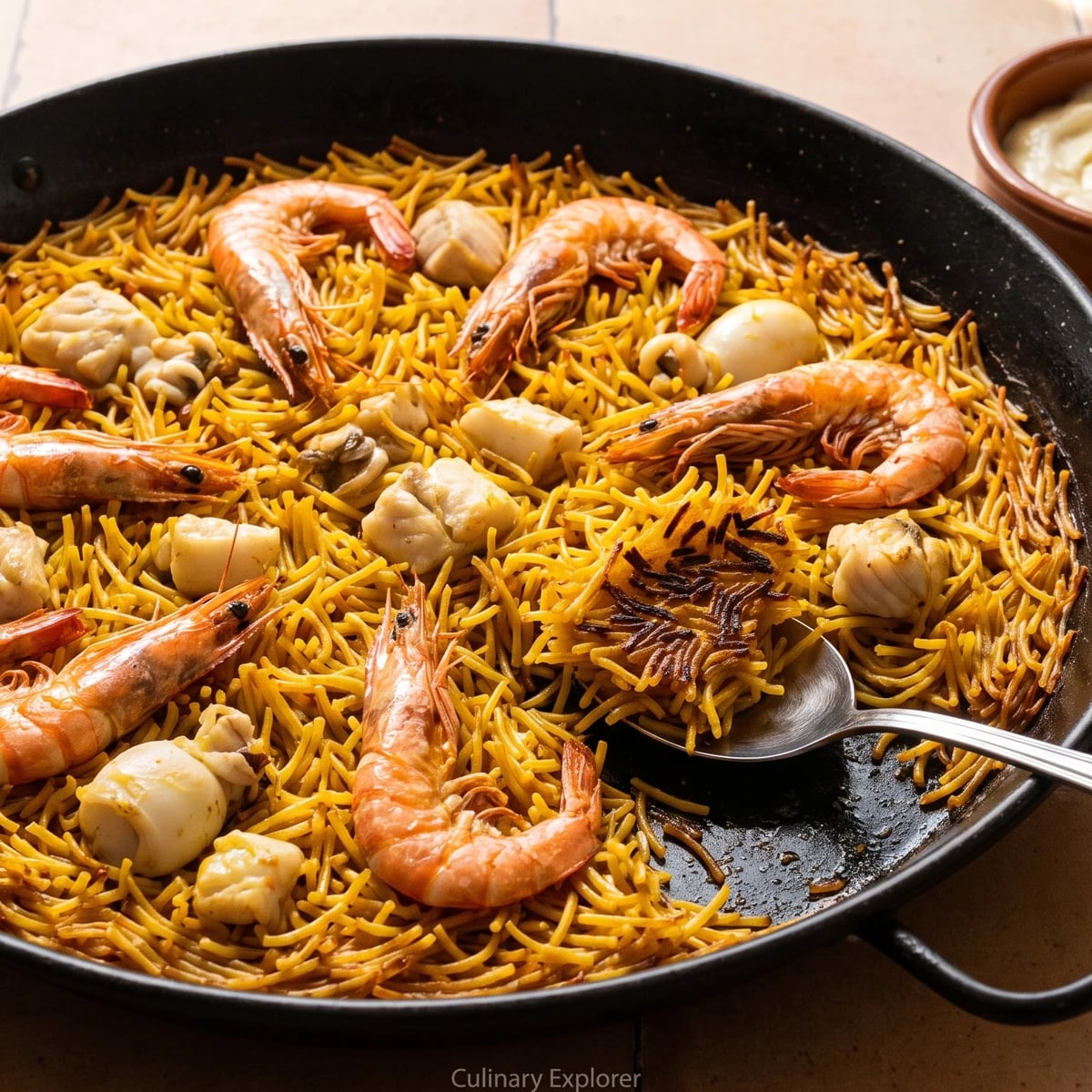
Fideuà de Gandía is Valencia's seafood noodle pan: short hollow fideos toasted in olive oil, cooked in strong fish broth, and left alone until the tips stand and catch.

Main Dishes
Spanish
Dinner Party
Celebration
Outdoor Dining
30 min
Active Time
55 min cook1 hr 25 min total
Yield4 servings

Fideuà de Gandía is Valencian, from the fishing port of Gandía in La Safor, and it takes the dry-pan method of the Valencian coast and gives it to short hollow fideos, not rice. That is what makes it itself: noodles toasted first, seafood kept clean, and fish broth measured so the pan finishes dry, glossy, and a little crisp at the tips. This is not seafood pasta in sauce. It is a pan dish from the coast, tal como se hace allí.

The method that decides it is this: toast the fideos, build a dark tomato-and-garlic sofrito, then add hot fumet and stop touching it. Stir after the broth goes in and the noodles go soft and crowded instead of separate. Leave the pan alone, rotate it if your burner is uneven, and the tips stand up at the end. That little toasted edge is the prize.

If you're far from Valencia, spend your effort on the broth before you spend it on pretty shellfish. Morralla, the little rockfish used for fumet, is hard to find away from the coast; white fish bones, shrimp heads, or a clean fish stock get you there. No fideuà noodles? Use short hollow macaroni broken small, and know it will need a little more broth and will stand less neatly. No hace falta haber pisado España.

In my Margin beside this one I wrote only this: caldo flojo, fideuà triste, weak broth, sad fideuà. Pésalo, no lo adivines. Siempre sale, si lo sigues.

Fideuà belongs to Gandía, the Valencian port in La Safor, where fishermen adapted the dry-pan method of arroz a banda to short noodles. The local account names Gabriel Rodríguez Pastor, a cook on a Gandía fishing boat, as the hand that first made the swap when the galley wanted the flavour of fish broth without another rice pan. Gandía still treats the dish as its own, cooked in a paella pan, finished dry, and served with allioli; not every pan from Valencia is a paella.

The technique, the tradition, and the story behind every dish.

Discover Culinary Explorer

Ingredients

morralla (small rockfish) or white fish bones and heads

Quantity

700g

rinsed

cold water

Quantity

1.5 litres

small onion

Quantity

1

halved

bay leaf

Quantity

1

parsley stems

Quantity

2

extra virgin olive oil

Quantity

80ml

fideo grueso no. 4 or short hollow fideuà noodles

Quantity

350g

large shell-on prawns or langostinos

Quantity

8 (about 320g)

cleaned cuttlefish or squid

Quantity

300g

cut into 2cm pieces

monkfish tail or firm hake

Quantity

350g

cut into 3cm pieces

garlic cloves

Quantity

3

finely chopped

ripe tomato

Quantity

200g

grated, skin discarded

ñora paste or flesh from soaked dried ñoras

Quantity

1 tablespoon

sweet pimentón

Quantity

1 teaspoon

saffron threads

Quantity

0.2g

lightly crushed

fine sea salt

Quantity

8g, plus more to taste

allioli

Quantity

120g

to serve

Equipment Needed

  • 38-40cm paella pan or wide shallow pan
  • Medium pot for fumet
  • Fine sieve
  • Box grater
  • Wooden spoon

Instructions

  1. 1

    Make the fumet

    Put the morralla or fish bones in a pot with the water, onion, bay leaf, parsley stems, and 4g of the salt. Bring it just to a simmer, skim the grey foam, and cook gently for 25 minutes. Strain without pressing hard on the bones, then measure 1.2 litres of broth; if you have less, add water, and if you have more, boil it down a little. Keep it hot. Weak broth gives weak fideuà, and no amount of pretty prawns fixes that.

    Avoid oily fish like salmon, mackerel, or sardines for the broth. They make the fumet heavy and strong in the wrong direction.
  2. 2

    Toast the fideos

    Set a 38-40cm paella pan or wide shallow pan over medium heat and add 30ml of the olive oil. Add the fideos and stir them for 3 to 5 minutes, until they are patchy gold and smell nutty. Do not take them dark all over; they still have cooking to do. Lift them out to a bowl and keep them ready.

    If you are using short hollow macaroni because fideuà noodles are impossible to find, toast it the same way. It will need a little more broth and a minute or two longer in the pan.
  3. 3

    Sear the seafood

    Add another 30ml of oil to the pan. Salt the monkfish lightly. Sear the prawns for about 45 seconds per side, just until the shells colour, then lift them out. Sear the monkfish for 1 minute per side and lift it out too. Add the cuttlefish or squid and cook for 5 to 6 minutes, until its liquid cooks off and the oil shines clear again.

  4. 4

    Cook the sofrito

    Lower the heat and add the remaining oil if the pan looks dry. Stir in the garlic for 30 seconds, then add the grated tomato, ñora paste, and a pinch of salt. Cook slowly for 8 to 10 minutes, scraping the pan, until the tomato darkens, thickens, and the oil separates at the edges. Pull the pan briefly off the heat, stir in the pimentón and saffron, then return it to the heat. The tomato must lose its water, or the whole pan tastes thin.

  5. 5

    Add hot broth

    Return the toasted fideos to the pan and stir them through the sofrito and cuttlefish until every noodle is stained. Spread them flat. Pour in 1.1 litres of the hot fumet, keeping 100ml back in case the pan needs it. Taste the liquid: it should be seasoned like a good soup. Tuck the monkfish pieces into the noodles and boil lively for 4 minutes, then lower to a steady bubble for 5 minutes. From the moment the broth goes in, do not stir.

    If your hob heats unevenly, rotate the pan by the handles. Move the pan, not the noodles.
  6. 6

    Rest and serve

    Lay the prawns on top and cook 3 to 5 minutes more, until the broth is absorbed and the fideo tips stand upright. If the noodles are still firm and the pan is dry, spoon the reserved hot broth around the edge, not over the top. Raise the heat for the final 30 to 45 seconds to catch the underside, stopping before it smells bitter. Rest the pan off the heat for 5 minutes. Serve straight from the pan with allioli at the side, not stirred through.

Chef Tips

  • The broth is where you spend your care. Morralla is right if you can get it; away from Valencia, use white fish bones, fish heads, and shrimp shells from a fishmonger with good turnover. Boxed fish stock is only worth using if it tastes clean and strong after you simmer it with shells for a few minutes.
  • Use fideo grueso no. 4, the short hollow noodle made for fideuà. Thin vermicelli belongs to other noodle pans and cooks differently. Short hollow macaroni broken into small pieces is the honest substitute, but the tips will not stand as neatly.
  • The pan must be wide. A deep pot gives you boiled noodles, not fideuà. The liquid should sit shallow enough to reduce quickly while the noodles drink it.
  • Buy seafood by smell and firmness, not by price. Fresh squid and a good broth beat tired langostinos every time. If the market has cigalas in good shape, use a few in place of some prawns.
  • No chorizo, no peas for colour, and no cream. Those things make another pan, not Fideuà de Gandía. Keep the flavour to fish broth, tomato, ñora, saffron, and the seafood.
  • Serve a dry white from Valencia, something bright and not sweet. Or put cold beer on the table and save the argument for the onion in tortilla.

Advance Preparation

  • Make the fumet up to 2 days ahead and keep it covered in the refrigerator, or freeze it for up to 2 months. Bring it back to a full simmer before it goes into the pan.
  • Clean and cut the cuttlefish or squid and monkfish up to 12 hours ahead. Keep them covered and very cold, then pat dry before cooking.
  • Grate the tomato and prepare the ñora paste a few hours ahead. Do not toast the noodles or start the pan until you are ready to eat.
  • Do not make the whole fideuà ahead. It is best after its 5 minute rest, while the noodles are still separate at the top and tender underneath.

Frequently Asked Questions

Nutrition Information

1 serving (about 520g)

Calories
900 calories
Total Fat
44 g
Saturated Fat
6 g
Trans Fat
0 g
Unsaturated Fat
37 g
Cholesterol
245 mg
Sodium
1400 mg
Total Carbohydrates
72 g
Dietary Fiber
4 g
Sugars
5 g
Protein
52 g

Note: Chef personas and recipes are created with AI assistance. Cook with care: follow safe food-handling practices, check doneness with a thermometer when needed, and adapt for allergies and your kitchen.

Where cooking meets culture.

Culinary guides, cultural storytelling, and the editorial depth that makes cooking meaningful.

Discover Culinary Explorer

More from Fideuà & Fideos

Browse the full collection