Chef Lupita
Acúmara Tatemada al Comal
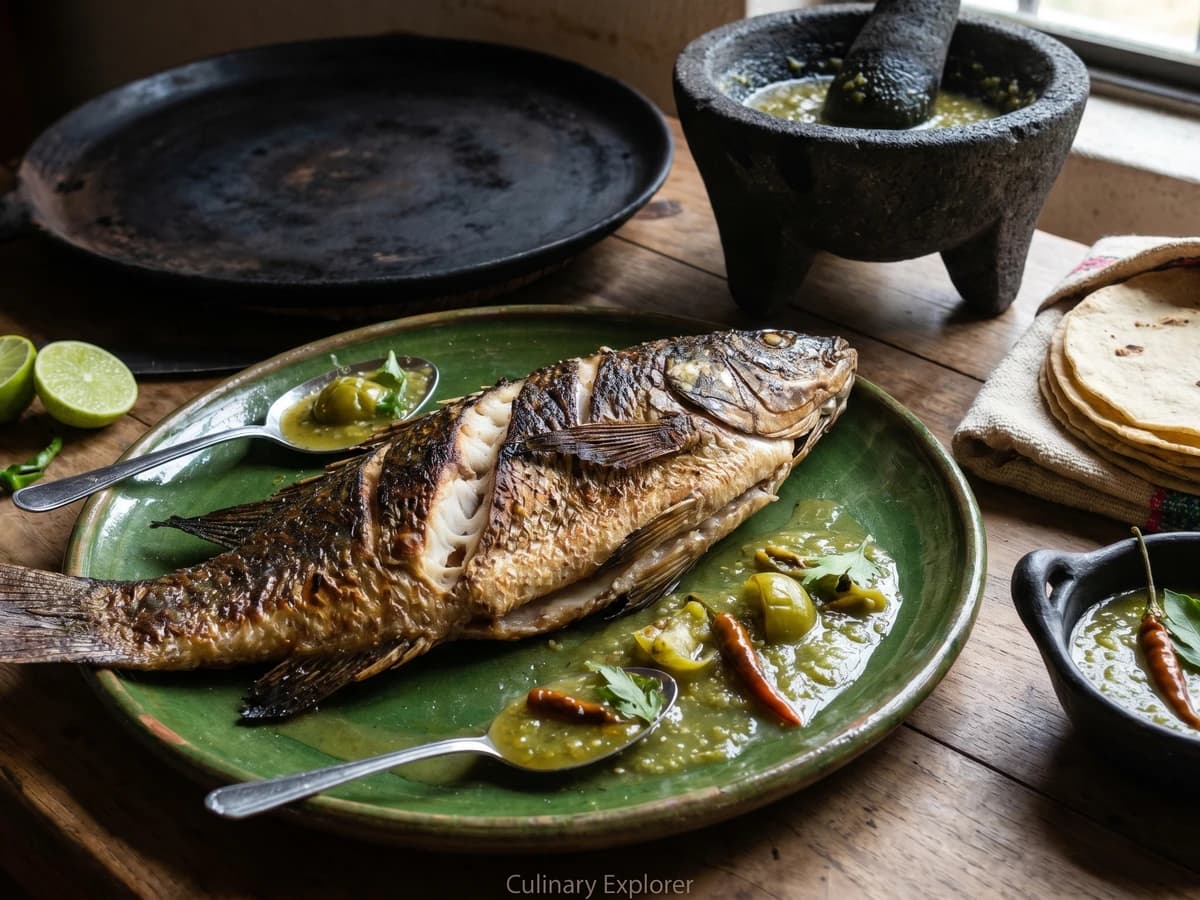
Michoacán's Lake Pátzcuaro acúmara, a whole kurucha from the lago tatemada on a comal de leña and served with chile perón atápakua, corn tortillas, and P'urhépecha discipline.
A cooking platform built around craft, culture, and the stories behind what we eat.

Created by
Ciudad de Mexico's green spaghetti, built on charred poblano, crema, and cheese, the pasta plate every capitalino remembers from childhood birthday parties and Sunday lunches at the abuela's table.
Espagueti verde is from Ciudad de Mexico. Not from Italy, not from Puebla, from the kitchens of the capital, where Italian pasta arrived in the late 19th century and was promptly absorbed into the Mexican household. The capitalino home cook took the spaghetti, looked at what was in the cazuela, and said: this needs poblano.
The sauce is the dish. Charred chile poblano, crema, evaporated milk, queso crema, cilantro, parsley, onion, garlic. Nothing else. The poblano has to be roasted black on a flame, not steamed, not boiled. The char is what gives the sauce its smoke. The crema and the queso crema give it the silk. The evaporated milk is the secret nobody from Mexico City will tell you about, it is what makes the sauce coat the pasta the way it does in childhood memory.
This is birthday-party food. School-lunch food. The plate the abuela makes when the grandchildren come over and there is no time for mole. Every cumpleanos infantil in Colonia Roma, Coyoacan, or Iztapalapa has had a tray of espagueti verde next to the tinga de pollo and the gelatina. My mother made it on Sundays when we needed something fast and green and filling, and she always finished it with crumbled queso fresco at the table. Cada estado, su propia cocina, and this one belongs to the capital. Asi se hace y punto.
Pasta arrived in Mexico in significant volume during the late 19th-century Porfiriato, when Italian immigrants and French culinary influence reshaped middle-class urban dining in Ciudad de Mexico. The dish known as espagueti verde emerged in the early 20th century as part of the broader 'comida casera capitalina' tradition, alongside espagueti rojo (with a tomato and chile guajillo base) and espagueti blanco (with crema and queso). Its rise as a fixture of children's birthday parties coincided with the post-revolutionary expansion of the Mexican middle class in the 1940s and 1950s, when industrial dried pasta, canned evaporated milk from companies like Carnation and Nestle, and bottled crema became affordable household staples, embedding the dish into a generational memory shared by virtually every chilango born after 1950.
Quantity
4 large
Quantity
1 pound
Quantity
2 tablespoons
Quantity
1 cup
Quantity
1 cup
Quantity
4 ounces
at room temperature
Quantity
1/2 cup, packed
Quantity
1/2 cup, packed
Quantity
1/2 medium
roughly chopped
Quantity
2
Quantity
1 1/2 teaspoons, plus more to taste
Quantity
3 tablespoons
Quantity
1 tablespoon
Quantity
1 cup
crumbled, for serving
Quantity
1/2 cup
finely grated, for serving
Quantity
for serving
Quantity
for serving
| Ingredient | Quantity |
|---|---|
| fresh chile poblano | 4 large |
| dried spaghetti | 1 pound |
| kosher salt (for the pasta water) | 2 tablespoons |
| Mexican crema | 1 cup |
| whole milk evaporada (evaporated milk) | 1 cup |
| queso crema (Mexican-style cream cheese)at room temperature | 4 ounces |
| fresh cilantro leaves and tender stems | 1/2 cup, packed |
| flat-leaf parsley leaves | 1/2 cup, packed |
| white onionroughly chopped | 1/2 medium |
| garlic cloves | 2 |
| kosher salt | 1 1/2 teaspoons, plus more to taste |
| unsalted butter | 3 tablespoons |
| manteca de cerdo (pork lard) | 1 tablespoon |
| queso frescocrumbled, for serving | 1 cup |
| queso Cotijafinely grated, for serving | 1/2 cup |
| sliced avocado (optional) | for serving |
| fresh cilantro leaves (optional) | for serving |
Set the poblanos directly over an open gas flame on medium-high. Turn them with tongs every minute or so. The skins should blacken and blister across every surface, not just brown. This takes about eight minutes per chile. If you have an electric stove, do them on a comal over high heat or under the broiler. The char is not optional. The smoke that goes into the flesh is half the flavor of this dish.
Drop the blackened chiles into a plastic bag or a covered bowl. Let them sit for ten minutes. The trapped heat loosens the skin from the flesh. Pull off the charred skin with your fingers, do not rinse them under water. Water washes away the smoke you worked for. Tear each chile open, pull out the stem, the seeds, and the white veins. Some cooks leave a few seeds in for heat. That is your decision.
Place the peeled poblanos in the blender with the crema, evaporated milk, queso crema, cilantro, parsley, onion, garlic, and 1 1/2 teaspoons salt. Blend on high for a full minute, until the sauce is completely smooth and a deep, even green. No flecks. No chunks. The color should be the green of a freshly painted Coyoacan wall. Taste for salt. The sauce needs to be assertive because the pasta will mute it.
Bring a large pot of water to a hard boil. Add 2 tablespoons of salt. The water should taste like the Gulf of Mexico. Add the spaghetti and cook until just shy of al dente, two minutes less than the package time. The pasta finishes cooking in the sauce. Reserve one cup of the pasta water before draining. Do not rinse the pasta. The starch on the surface is what helps the sauce cling.
In a wide, heavy skillet or a clay cazuela, melt the butter with the lard over medium heat. La manteca da el sabor de fondo, the butter da la cremosidad. When the foam settles, pour in the green sauce. It will sputter. Cook it for five to seven minutes, stirring constantly with a wooden spoon, until the sauce darkens slightly, the raw onion smell is gone, and a thin film of butter rises to the edges. This step is the difference between a sauce that tastes like a smoothie and a sauce that tastes cooked. No me vengas con atajos.
Drop the drained spaghetti into the sauce. Use tongs to lift and turn the strands until every one is coated in green. If the sauce feels tight, add a splash of the reserved pasta water, a few tablespoons at a time, until it loosens to a silky, clinging consistency. The pasta should be glossy, not soupy. Cook one more minute on low heat so the spaghetti finishes its cooking inside the sauce and pulls in the flavor.
Pull the pan off the heat. Pile the spaghetti into a warm serving platter or straight from the cazuela onto plates. Scatter the crumbled queso fresco generously across the top, then a finer dusting of grated Cotija. Add a few cilantro leaves and a fan of avocado on the side if it is in season. Serve at the table, family-style. Every capitalino over thirty has eaten this from a paper plate at a birthday party. Serve it the same way. Saber cocinar es saber vivir.
1 serving (about 290g)
Culinary guides, cultural storytelling, and the editorial depth that makes cooking meaningful.
Discover Culinary ExplorerChef Lupita
Michoacán's Lake Pátzcuaro acúmara, a whole kurucha from the lago tatemada on a comal de leña and served with chile perón atápakua, corn tortillas, and P'urhépecha discipline.

Chef Lupita
Puebla's weekday adobo of pork shoulder braised in a thick guajillo and ancho sauce sharpened with vinegar, cumin, and clove. The deep red of a market spice stall, the dish a poblana cooks without thinking.

Chef Lupita
Loreto's pit-roasted clams, planted hinge-up in beach sand and tatemadas under a fast fire of dried romerillo brush, the resinous Baja desert shrub that gives this dish its smoke.

Chef Lupita
Oaxaca's eighth mole, the silky, almond-and-cinnamon almendrado, served over poached chicken. Mild, sweet, restrained, and a quiet rebuttal to anyone who thinks Mexican food has to be hot to be Mexican.