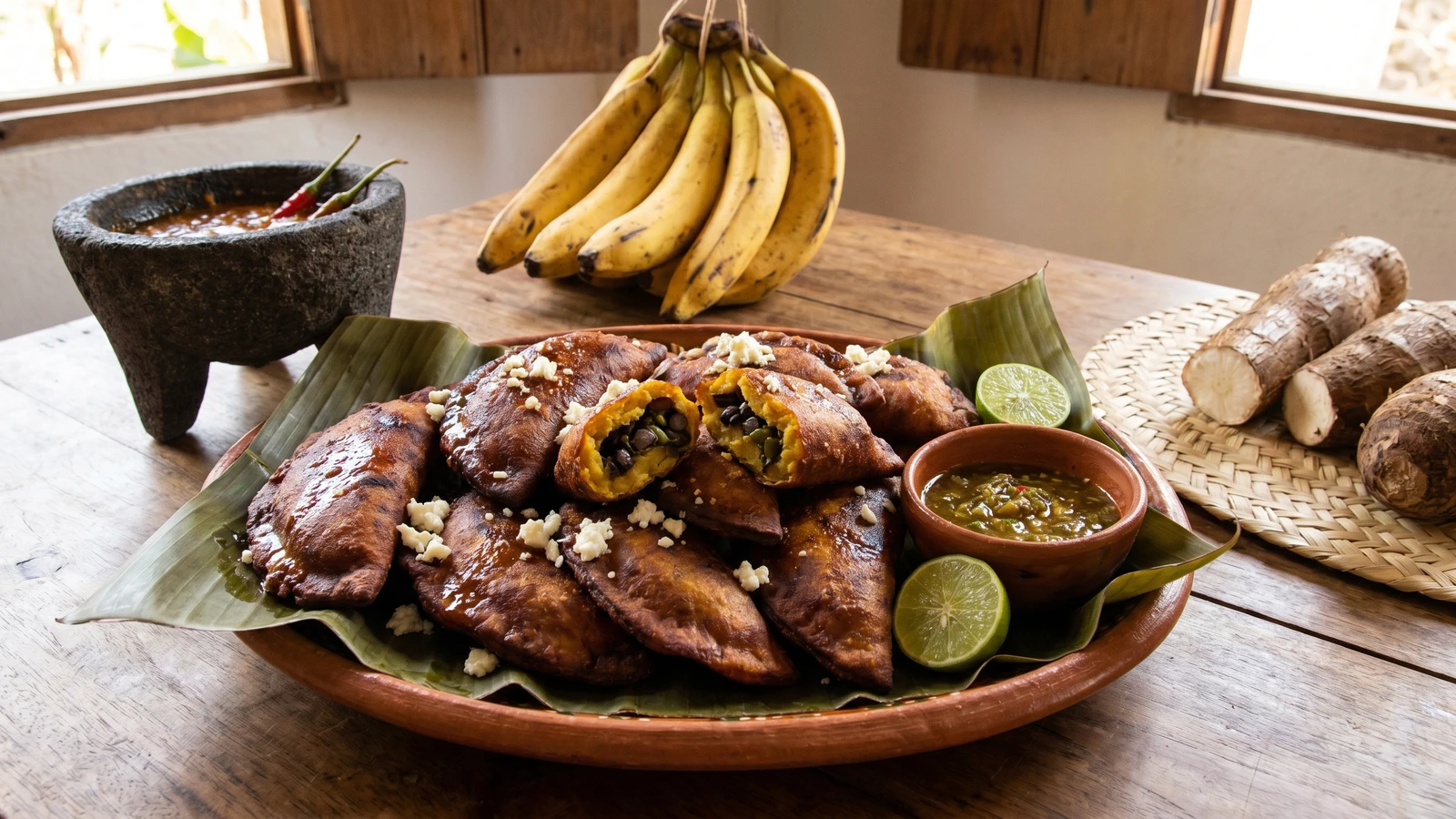
Central-coast Veracruz empanadas built from ripe plátano macho, folded around epazote black beans or jarochos picadillo, then fried until the edges turn dark and sweet.
Appetizers & Snacks
Mexican
Comfort Food
Make Ahead
Budget Friendly
40 min
Active Time
45 min cook•1 hr 25 min total
Yield12 empanadas
Veracruz, the Sotavento coast and the Afro-Mexican kitchens of Coyolillo in Actopan, is where these empanadas belong. The port brought plantain, sugar, livestock, and hard history. The women made food from it. That is how cuisine survives: in hands, not in speeches.
The dough is not masa. It is ripe plátano macho, cooked until soft, peeled while hot, and pounded until it behaves like dough. In Coyolillo and in port cantinas near Veracruz, you see the same intelligence: sweet plantain wrapped around something salty, frijoles negros refritos with epazote or a small picadillo sharpened with chile jalapeño, tomato, olive, and capers. Not every Mexican empanada uses corn. Cada estado, su propia cocina.
I learned this version from a señora outside Actopan who pressed the plantain with a wooden pestle and told me not to add flour unless the fruit betrayed me. She was right. The plantain should be mature, black-spotted, and heavy in the hand. If it is green, make tostones and stop pretending. If it is ripe, it gives you a dough that fries dark at the edges and stays tender inside.
La manteca es el sabor. You can fry in oil if you must, but the old Veracruz kitchen knows what pork fat does to plantain. It browns it properly. It gives the edge that savory finish against the sweetness. Recetas probadas y garantizadas, but only if you start with the right fruit.
Plantains reached Veracruz through Atlantic trade routes tied to Spanish colonial ports and the forced movement of African peoples beginning in the 16th century. Afro-Mexican communities such as Coyolillo in Actopan and the Sotavento port neighborhoods helped make plantain, yuca, malanga, coconut, and frying techniques part of Veracruz's coastal cooking vocabulary over more than 400 years. Mexico's 2020 constitutional recognition of Afro-Mexican peoples was overdue; the cuisine had already been documenting their presence at the table for centuries.
The technique, the tradition, and the story behind every dish.
salsa de chile costeño or salsa de jalapeño asado (optional)
Quantity
for serving
lime halves (optional)
Quantity
for serving
Ingredient
Quantity
very ripe plátano machoblack-spotted and heavy
4
kosher saltdivided
1 teaspoon
masa harina (optional)only if the plantain dough is too wet
2 tablespoons
frijoles negros refritos with epazotecooled
1 1/2 cups
manteca de cerdo for bean filling (optional)
1 tablespoon
white onionfinely chopped
1/2 small
chile jalapeñofinely chopped
1
Roma tomatofinely chopped
1 ripe
cilantrochopped
1 tablespoon
fresh epazotefinely chopped
1 teaspoon
ground beef or pork (optional)for picadillo filling
1/2 pound
raisins (optional)chopped
1 tablespoon
green olives (optional)chopped
1 tablespoon
capers (optional)rinsed and chopped
1 teaspoon
manteca de cerdo for frying
2 cups
queso fresco (optional)crumbled
for serving
salsa de chile costeño or salsa de jalapeño asado (optional)
for serving
lime halves (optional)
for serving
Equipment Needed
•Heavy skillet or shallow cazuela for frying
•Tortilla press or two squares of clean plastic
•Molcajete, potato masher, or wooden pestle
•Wire rack or brown paper for draining
Instructions
1
Cook the plantains
Cut the ends from the plátanos machos and score each peel lengthwise. Place them in a pot, cover with water, add 1/2 teaspoon salt, and simmer for 18 to 22 minutes, until a knife slips through the flesh with no resistance. The peel will darken and split. That is correct. You need the fruit soft enough to pound while it is still hot.
2
Pound the dough
Drain the plantains and peel them while hot, using a towel to protect your hands. Mash in a wide bowl or molcajete with the remaining 1/2 teaspoon salt until smooth and sticky. Do not add flour at the beginning. Work the plantain first. If it is still loose after five minutes of pounding, knead in masa harina one teaspoon at a time. The dough should hold together without cracking when you press it flat.
If the plantain is not ripe, the dough will fight you. A green plantain is starch, not dough for these empanadas. Pregúntale a las señoras del mercado and buy the ugly black-spotted ones.
3
Prepare the filling
For the bean version, warm 1 tablespoon manteca de cerdo in a skillet and fry the onion until soft. Add the chile jalapeño, tomato, epazote, and frijoles negros refritos. Cook until thick enough to mound on a spoon, then stir in cilantro and let cool completely. For picadillo, brown the ground meat in the same base, then add tomato, raisins, olives, capers, and epazote. Cook until dry. A wet filling breaks the empanada. No me vengas con atajos.
4
Shape the empanadas
Cut two squares of plastic from a clean produce bag or use a tortilla press lined with plastic. Divide the plantain dough into 12 balls. Press one ball into a 4-inch circle, place 1 heaping tablespoon cooled filling in the center, and fold the plastic over to make a half-moon. Press the edge firmly to seal. If the edge cracks, pinch it with damp fingers. The plantain is tender, so work with calm hands.
5
Fry in manteca
Heat the manteca de cerdo in a heavy skillet to 350F. Fry 3 or 4 empanadas at a time, turning once, until the outside is dark golden with mahogany spots at the edges, 2 to 3 minutes per side. Do not crowd the pan. The fat temperature drops and the empanadas drink grease. La manteca es el sabor, but it must be hot enough to do its work.
6
Drain and serve
Lift the empanadas onto a rack or brown paper. Let them rest five minutes so the filling settles and the plantain firms. Serve warm with crumbled queso fresco, lime halves, and salsa de chile costeño if you are leaning toward the Afro-Pacific table, or salsa de jalapeño asado for the Veracruz kitchen. Saber cocinar es saber vivir.
Chef Tips
•The plantain must be ripe enough that the peel is mostly black. Yellow plantain with a few spots will taste flat and crack when you fold it. This dish starts at the market, not the stove.
•Frijoles negros with epazote are the most Veracruz filling here. Picadillo is also recognized in port kitchens, especially with olives and capers. Choose one filling and make it dry. Wet filling is the enemy.
•Chile jalapeño belongs to Veracruz. Chile costeño belongs more strongly to the Costa Chica table of Guerrero and Oaxaca, especially around Cuajinicuilapa, Pinotepa Nacional, and Chacahua. Use it here only if you want the Afro-Mexican collection to speak across the coast, and know what you are doing.
•Do not serve these with sour cream, cheddar, or lettuce. That is not this kitchen. A little queso fresco, lime, and a proper salsa are enough.
Advance Preparation
•The bean or picadillo filling can be made two days ahead and refrigerated. It must be cold before shaping, or it will soften the plantain dough.
•The plantain dough is best shaped the same day it is cooked. You can form the empanadas up to four hours ahead and refrigerate them in a single layer, covered.
•Fried empanadas reheat well on a comal or in a 375F oven for 8 to 10 minutes. Do not microwave them unless you want soft edges.
Frequently Asked Questions
Nutrition Information
1 serving (about 150g)
Calories
260 calories
Total Fat
14 g
Saturated Fat
6 g
Trans Fat
0 g
Unsaturated Fat
8 g
Cholesterol
30 mg
Sodium
480 mg
Total Carbohydrates
28 g
Dietary Fiber
3 g
Sugars
11 g
Protein
8 g
Where cooking meets culture.
Culinary guides, cultural storytelling, and the editorial depth that makes cooking meaningful.